Only Atma Can Experience Atma
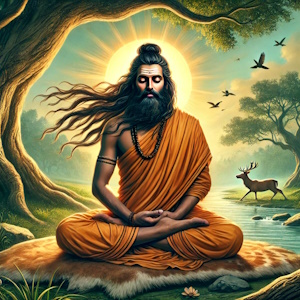
We have various states of awareness.
When we are awake—listening, seeing, smelling.
When we are dreaming—a lot of things happen, they self-generate, you can feel, you can sense, you fear, you enjoy. All happen inside without any connection with the external world.
When we are in deep sleep—without the dreams. Total blankness. This is another state which most of us experience every day.
Then there is a fourth state called Tureeyavastha, which we will not get into now, but understand that it is even beyond or different from the blankness of deep sleep.
So, initially, when you quieten your mind through meditation, what we achieve is the equivalent of the state of deep sleep. This is where the spiritual journey starts.
To start the spiritual journey, you have to first be cut off from the stimuli or various signals coming from the external world. But still, there will be self-generated sounds and images within the mind, which are like the dream state. Then, when you silence even them, you go to the third state—it doesn’t mean that you will start sleeping. You can fall into sleep, but that you should not.
There will be awareness. You will be seeing your mind as calm and tranquil. The difference between this and sushupti is that, in sushupti or deep sleep, there is no awareness.
In the calm state of meditation, time exists. You can observe your mind for a certain period of time.
'My mind remained calm for 1 minute, five minutes, after that, thoughts started again.'
You may not be counting time, but you know that it is only for a certain period. You can feel time.
Even in the dream state, time does not exist. Within the events that are running in your mind, the dreams, there may be time. Like, you will see yourself sitting in a car—starting, going, reaching.
But outside of it, you are not keeping track of how long this entire episode is occupying your mind.
Say a biopic movie—it shows the life of a person lasting, let’s say, 80 years. But the eighty years are shown to us in a period of 2 hours.
In the same way, the dream may have a time scale running within it on its own, but we don’t know in what duration we are experiencing the dream.
We can wake up and say, 'I saw this dream in which I was going through a river in a boat, and suddenly, flowers started showering upon me.'
There is a time in this, but we can never say, 'I saw this dream from 1:33 AM to 1:41 AM.' That is not possible.
The time felt within the dream is different from the actual time running outside. They are not connected to each other. The time inside the dream can go back to the past, go to the future even, which the actual time outside cannot do.
But understand that we have not even started the spiritual journey.
These three states are available to everyone, which everyone experiences. Whether you know meditation or do not meditate does not matter.
If you are a human being, all these three states are available to you. Almost every day, you go through these three states for some time or the other, whether you know meditation or not.
There is nothing spiritual about this. This only means you are alive.
The only minor difference is that you are aware of these when you are meditating.
So, when it is said that controlling the activities of the mind is yoga, it means you have reached the bus stand, railway station, or airport.
The real journey hasn’t started. The real journey of thousands of kilometers is yet to begin.
Of course, attaining control over the mind is important, just as reaching the bus stand, railway station, or airport is important in a journey.
But some people show this as the destination.
'You have silenced the mind' means 'You have become one with Paramatma.'
You feel great that your meditation is successful. Now you can start teaching others.
Have this clear in your mind.
What you achieve by silencing the mind is what even an infant, a rickshaw puller, or a fruit seller also experiences every day.
Even in this state of meditation, you are still in the realm of the mind only.
One part of the mind meditates, and another part of the mind observes.
You have just divided your mind into two parts.
You have just trained your mind to divide itself into two, and one part observes the other.
I am not saying that this is worthless.
This is a great achievement.
But don’t confuse this with bliss.
'You silence your mind and then experience bliss'—it is not as simple as that.
Only Atma can experience Atma.
Mind cannot experience Atma.
These can be very illusory.
It is still your mind, but you think that this is my real self or Atma.
Only Atma can experience Atma.
Beyond these three states is the fourth, the Tureeya Avastha.
They could not find the right word to describe it, like jagrat, swapna, and sushupti.
This state could not be described, so they just called it the Tureeya state, the fourth state.
Tureeya simply means 'the fourth.'
Now, we easily say Parabrahma and Paramatma.
The state of Parabrahma is beyond the Tureeya and many such states.
It doesn’t mean it is far away.
It is very much here.
Like how there is oil all over a sesame seed—it is.
It is not something that you get by going somewhere.
It is not something that you get by going outward or going inward.
This is why Vedanta says—Neti Neti.
The moment you conclude that 'This is it,' be sure that that’s not it.





English
Devi
Click on any topic to open
7
30
Astrology
Bhagavad Gita
Bhagavatam
Bharat Matha
Devi
Devi Mahatmyam
Ganapathy
Garuda Puranam
Glory of Venkatesha
Hanuman
Kathopanishad
Mahabharatam
Mantra Shastra
Mystique
Practical Wisdom
Purana Stories
Radhe Radhe
Ramayana
Rare Topics
Rigveda Explained
Rituals
Sages and Saints
Shiva
Spiritual books
Sri Suktam
Story of Sri Yantra
Temples
Vedas
Vishnu Sahasranama
Yoga Vasishta
26
17
10
0


