One Question and Many Answers
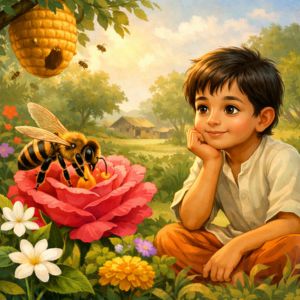
In a peaceful village, there lived a curious child named Kavi.
He was not the loudest talker.
But he noticed things.
He noticed -
How elders spoke slowly.
How teachers explained patiently.
How farmers worked silently.
How travelers told strange stories.
One afternoon, Kavi sat under a tree after school.
His head felt full.
He said to himself,
'Everyone teaches something. But everyone teaches differently.
Some people know a lot. Some know very little.
How do I decide what to take and what to leave?'
That was a real question.
Not a question from a book.
A question from life.
Just then, Kavi saw a small bee flying nearby.
The bee went to a bright red rose.
Then to a tiny white jasmine.
Then to a wild flower growing near a stone.
Kavi watched carefully.
The bee did not stay too long at any flower.
It did not think,
'This flower is small, so I will ignore it.'
It did not think,
'This flower is famous, so I will take everything.'
It took only nectar.
Then it moved on.
Kavi followed the bee with his eyes and whispered,
'Why does the bee do that?'
That night, Kavi asked the same question to different people.
He asked his teacher,
'How should I learn from what others teach me?'
The teacher said,
'Learn deeply. Read books carefully. Remember lessons clearly.'
Kavi thought,
'That sounds useful. But is that all?'
He asked his grandmother,
'What is the best way to learn from people?'
She smiled and said,
'Listen carefully. Even simple stories hide wisdom.'
Kavi nodded.
'That sounds different. But also true.'
He asked a farmer working in the field,
'How do you learn from others?'
The farmer wiped his sweat and said,
'Observe actions, not just words. Soil teaches more than speech.'
Kavi felt something click in his mind.
Then he asked his friend,
'How do you learn from people?'
The friend said,
'Just copy whoever is successful.'
Kavi felt unsure.
'Is copying really learning?' he wondered.
That night, Kavi remembered the bee.
It just took only what it really needed.
Kavi understood the answer to his own question.
There is not one single answer.
A wise learner takes
clarity from teachers,
wisdom from elders,
experience from workers,
and lessons even from mistakes.
But he does not take everything blindly.
Just like the bee takes nectar from every flower,
a wise person takes the best from every source.
Years later, when people asked Kavi,
'How did you become so wise?'
He did not mention books or marks.
He smiled and said,
'A small bee once taught me how to learn.'
- Why did Kavi feel his head was full before he observed the bee?
Kavi's head felt full because he was experiencing the burden of unorganized knowledge. He was constantly absorbing data from everyone around him—elders, teachers, farmers, and travelers—but he lacked a filter to process it. The fullness was not a lack of intelligence, but the confusion of trying to carry everything blindly without knowing what to value. - What is the deeper, hidden meaning behind the bee visiting both a famous rose and a wild flower near a stone?
The hidden meaning is that wisdom is non-discriminatory and independent of status. In human life, people often seek knowledge only from famous, successful, or credentialed sources, ignoring the ordinary. The bee shows that a profound truth can be found in a simple laborer or a quiet child just as easily as it can be found in a celebrated scholar. - Why did Kavi feel unsure about his friend's advice to copy whoever is successful?
Kavi instinctively understood that copying is mechanical mimicry, whereas true learning is an internal transformation. Copying takes the outer shell—the flower itself—rather than extracting the inner essence. If you copy blindly, you take another person's flaws, biases, and mismatched destiny along with their success. - What makes the farmer's statement that soil teaches more than speech a mysterious principle?
The mysterious principle is that nature communicates through silent laws rather than human language. Speech can distort truth through pride or persuasion, but the soil never lies. It reacts exactly to how it is treated, teaching the cosmic law of cause and effect, patience, and seasonal timing through pure action. - How does Kavi's method of gathering wisdom differ from standard academic learning?
Standard academic learning often focuses on memorization, accumulation, and retaining the entire structure of a lesson to pass a test. Kavi's method is alchemical. He discards the form, the words, and the background noise, and retains only the nectar—the active, life-changing principle that can be converted into the honey of personal wisdom. - What is the overlooked danger of not acting like the bee when listening to others?
The overlooked danger is intellectual and emotional poisoning. When we listen to people, we do not just absorb their wisdom; we also absorb their bitterness, their prejudices, their fears, and their limiting beliefs. If we do not act like the bee, we take the poison of the source along with the nectar. - The teacher, grandmother, and farmer all gave different answers. Were they contradicting each other, or is there a hidden unity in their advice?
There is a hidden unity. They represent the three pillars of a complete mind. The teacher represents the intellect and clarity, the grandmother represents the heart and timeless tradition, and the farmer represents the body and practical reality. A wise person does not choose one over the other but synthesizes all three into a balanced life. - Why did Kavi credit a tiny bee for his lifelong wisdom rather than the humans who actually spoke to him?
Humans gave Kavi the raw ingredients, but the bee gave him the formula on how to process those ingredients. Without the bee, the teacher's clarity and the farmer's experience would have just been conflicting voices in Kavi's head. The bee provided the ultimate operating system for his mind. - What does it mean for a wise learner to take lessons even from mistakes, as Kavi realized?
It means seeing every event as a laboratory. A mistake or a negative person is like a withered or bitter flower. Even though it lacks sweet nectar, it provides the vital nectar of caution. It teaches you what not to do, turning a negative experience into a positive asset for the soul. - How does the concept of turning nectar into honey apply to Kavi's final growth as a wise man?
Nectar is raw, external information scattered across the world. Honey is processed, internalized wisdom that belongs uniquely to the one who made it. Kavi became wise because he did not just store the nectar he took from the village; he digested it through reflection, mixed it with his own nature, and created a sweet, enduring philosophy that could nourish others for years to years.





Children's Section
Children's stories
Click on any topic to open
7
30
Astrology
Bhagavad Gita
Bhagavatam
Bharat Matha
Devi
Devi Mahatmyam
Ganapathy
Garuda Puranam
Glory of Venkatesha
Hanuman
Kathopanishad
Mahabharatam
Mantra Shastra
Mystique
Practical Wisdom
Purana Stories
Radhe Radhe
Ramayana
Rare Topics
Rigveda Explained
Rituals
Sages and Saints
Shiva
Spiritual books
Sri Suktam
Story of Sri Yantra
Temples
Vedas
Vishnu Sahasranama
Yoga Vasishta
26
17
10
0


