On Attainment of Sayujya Individuality Will Be Wiped Out
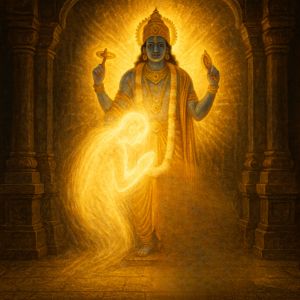
There are five kinds of moksha – salokya, sarshti, sarupya, sameepya, and sayujya.
Salokya means to live in the same world as Sri Hari.
Sarshti means to have all the aiswaryas like Sri Hari – the ashta aiswaryas. Here, aiswarya does not mean wealth. We have seen this before.
Sarupya means to resemble Sri Hari in form.
Sameepya means to be always near Sri Hari.
And finally, sayujya means to become one with Sri Hari.
Only in sayujya do you become one with Sri Hari. The kind of state that Narada has attained is sameepya, not sayujya. That is why he still takes rebirth. This state of sameepya is crores and crores of times superior compared to a mortal human being, but still one inch short of sayujya – which is becoming Sri Hari himself.
If somebody has attained sayujya, that means his individuality will be totally wiped out. He will get absorbed into Sri Hari himself. His name will be gone from the face of the earth. His memory will be gone from the face of the earth. Nobody will remember him anymore.
That means if we are still talking about a mahatma, remembering a mahatma, thinking about a mahatma, keeping photos of a mahatma, and worshiping a mahatma, he has not yet attained sayujya. He has not become one with Sri Hari. He may have gone to Vaikuntha and attained salokya.
He may have attained aiswarya as much as Sri Hari – this is quite visible. We see that there are some saints who are worshiped more than gods at times. That means they have attained sarshti.
He may have attained sarupya – the form of Sri Hari.
He may be sitting close to Sri Hari always – that means he has attained sameepya. But not sayujya yet. Like Narada. Even Narada has attained only sameepya, not sayujya.
I am saying this only to give you clarity, not in any way to play down the greatness of our saints. In fact, this whole effort is to spread the glory of our gods and our great saints and rishis. But clarity helps. Clarity helps us to know where we stand, where everyone stands, and where Sri Hari is. Clarity helps us to know what to aspire for.
Faith should be crystal clear. Faith should be firm and strong. For this, clarity is required. Not because somebody said so – you should be convinced. Otherwise, your faith will not stand the test of time.
Once again, I am saying this only because we are living in times where terms like jeevanmukta are used freely without understanding their significance. For anyone who dies, it is said Vaikuntha prapti or he has attained swarga vasa. Not so easy. These are attained only by the greatest of the greatest beings.
When we loosely use these words, they lose the importance attached to them. And when words lose their meaning, we also lose the ideas attached to them. We lose the concepts associated with them. And that will be a huge loss for humanity as a whole.
We see people trying to apply the human mind to Sri Hari’s actions. We see people trying to do psychoanalysis of Krishna, applying Freudian principles to Krishna.
This was what was there in his mind when he said this. This was what was there in his mind when he did this. This is how he strategized. It should have been like this. As simple as how you do a ball-to-ball analysis in a 20-20 cricket match – he should have played like this, played like that.
Isn’t this atrocious, preposterous, ridiculous, and ostentatious – trying to psychoanalyze Krishna, trying to apply your right and wrong upon the Almighty?
I am going to this extent because this is the times we are living in. This sells. This is the only material that appears in the public domain. This stuff is marketed, and you end up thinking that their view is correct.
No one tells you what is originally there in the scriptures. Everyone tells you his or her own convoluted viewpoint. Everyone has an agenda to promote, create a cult, monopolize followers. There is a book to sell. Make it sensational. Make it popular. Make it controversial.
Sanatana Dharma has become an easy prey to this commercial consumeristic mentality because the facts as they are are not before us. They say they are giving a new perspective into Mahabharata, into Ramayana, into Krishna, into Puranas – and giving to people to whom they are nothing but some names.
You don’t know the original, and you are being given somebody’s immature distorted perspective, and you end up thinking this is what it is. I don’t know where people get such courage from.
-
What are the main differences between salokya, sarshti, sarupya, sameepya, and sayujya?
These are five types of liberation, each offering a different relationship with the divine, ranging from living in the same realm to merging completely with the supreme. -
Why is sayujya considered the highest among all types of liberation?
Because it involves complete absorption into the divine, erasing all individuality and separate existence. -
Why would someone in sayujya not be remembered or worshipped anymore?
In this state, the person has merged into the divine essence, losing all personal identity, so there is no separate being to remember. -
Why is sameepya still considered short of the ultimate goal?
Even though it places one constantly in the presence of the divine, there is still a sense of separateness from the supreme. -
Why is clarity about spiritual stages important for faith?
It helps a seeker understand their path, avoid misconceptions, and aim for the true highest goal without settling for partial attainment. -
Why is it misleading to casually use spiritual titles like jeevanmukta or Vaikuntha prapti?
Such states are rare and extremely elevated; casual use dilutes their meaning and can misguide others. -
Why is interpreting divine actions through human logic considered flawed?
The divine operates beyond human limitations and mental frameworks, so human psychology cannot fully explain such actions. -
Why is it harmful to rely on distorted modern interpretations of scriptures?
They can replace the authentic teachings with incomplete or biased ideas, leading people away from true understanding. -
How can one protect themselves from misleading spiritual narratives?
By studying authentic scriptures, learning from genuine teachers, and verifying claims before accepting them.





English
Vishnu Sahasranama
Click on any topic to open
7
30
Astrology
Bhagavad Gita
Bhagavatam
Bharat Matha
Devi
Devi Mahatmyam
Ganapathy
Garuda Puranam
Glory of Venkatesha
Hanuman
Kathopanishad
Mahabharatam
Mantra Shastra
Mystique
Practical Wisdom
Purana Stories
Radhe Radhe
Ramayana
Rare Topics
Rigveda Explained
Rituals
Sages and Saints
Shiva
Spiritual books
Sri Suktam
Story of Sri Yantra
Temples
Vedas
Vishnu Sahasranama
Yoga Vasishta
26
17
10
0


