Observance of Dharma Means Harmonising with the Nature
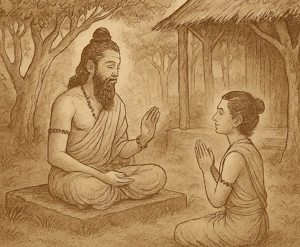
In Mahabharata Paushya Parva, we saw the stories of the three shishyas of Dhaumya — how he tested and ensured that they had become fit for knowledge, and then transferred all knowledge to them.
Among them, Veda — the shishya named Veda — was given hard task after hard task by the Guruji. When Veda came back home from the ashrama, gurukula, he got married and had shishyas of his own. But because of what he experienced in the gurukula, he was very kind and soft towards his own shishyas. Dhaumya, his own guru, was a taskmaster. But Veda was very soft and gentle towards his shishyas.
In the meantime, Janamejaya and another king by the name Paushya — they both requested Veda to be their purohit, their officiating priest. Veda agreed.
Once, Veda was about to leave for conducting some yajna for them. At that time, he called his shishya named Uttanka and told him to take care of everything at home till the time he comes back. He specifically instructed that he should not allow his absence to be felt:
'भो यत् किंचित् अस्मद्गृहे परिहीयते तदिच्छामि अहं अपरिहीयमानं भवता क्रियमाणं'
Everything should happen as normal, as usual.
When the Guru goes away, the shishya should do even his daily agnihotra on his behalf. The shishya has got the right to do this, like a son. All these things, Uttanka started doing.
In some time, the Guru Patni entered into her periods. There used to be a rule that a married woman should not allow any fertile cycle to go waste. An ovum should never be wasted. It is a gift of God, it is a gift of nature. It has come with a purpose — that it should be fertilized and grow into a child.
Procreation is a primary dharma of man. It is something that the Creator has entrusted you with. If you see the ovulation cycles among animals, they are not the same. Some animals give birth to a progeny only once in a year, some once in six months. Some give birth to multiple — like 10 or 12 in the same delivery. It all depends on what ratio Brahmaji wants of the populations of various beings.
Suppose lions give birth every month — one dozen cubs. What will happen to us with billions of hungry lions around? What will happen to us and the rest of the animals?
If weeds grow as easily as what we cultivate like rice, wheat — what will happen? Have you thought about this?
So, everything in the creation is in the right proportion. If ovulation happens in a woman once a month, then that kind of procreation is what is expected out of human beings. That is what nature wants out of human beings. Otherwise, it could have been once in a lifetime. Why not?
Dharma means to go with nature — understand the intention of nature, God, Almighty — whatever you call it. Understand that and go with it.
This is not just about procreation. If you get a fever, understand that the body is not liking something that has been done to it — maybe an infection. It is reacting to it. If you develop acidity and gas after taking a certain type of food, it means that food is not suitable for you. Don’t take it anymore.
Know your body, know the nature around you, harmonize them.
Coming back — dharma wants every fertile cycle to be fruitful. Dharma doesn’t like it if an ovum that a woman has been blessed with goes waste. Dharma, along with abortion or bhruna hatya, calls this also a papa.
Jatakarma samskara for a newborn is done so that the child is protected from such papa of the parents, which they have incurred so many times in the past. This is pure nature — what nature does and what nature wants from your body.
I am not talking family planning here — that is a national policy. Of course, we have to go with it. But I will tell you a few interesting facts.
The population density of New York City is about 10,000 people per sq. km. Population density of both Delhi and Mumbai is in the range of 30,000 people per sq. km. Population density of India as a whole is around 400 people per sq. km. Of China, it is 150 per sq. km. The population density of the whole Earth is around 110 per sq. km.
We say we have to control population or there will be a population explosion. People will starve. That is not the right logic. If you have more people, you can also produce more food. It is not that food supply is limited like how rains are limited. Food supply can improve through technology — with better-yielding crops. We have been doing that.
China came out with a one-child policy in 1979, aborted lakhs and lakhs of pregnancies — some of them even at very advanced stages. Foetuses and even newborns were dumped in garbage. Do you know what was China’s population density in 1979? 102 per sq. km — compared to the world figure of 109 even today.
I live in a city with a population density of 30,000 per sq. km.
So, if you want to implement a certain policy — for whatever reason — the size of the contraceptive market in 2025 is going to be 38,500 million US dollars, which is 2.75 lakh crores of rupees per year. You can imagine what all business interests can be involved in this.
Anyway, let governments decide and implement policies. My only point here is — when Veda says prajaana iti bhooyamsaha — multiply in abundance, when Dharma Shastra says procreation is a primary dharma, then fear of population explosion need not be a factor to be considered — at least as of now.
The Earth has about 6.38 crore sq. km of habitable land. Even taking a population density of New York — 10,000 per sq. km — it can accommodate a population of 60,380 crores. We are at about 700 crores now. We are growing at the rate of 1% per year — that is about 7 crores per year. It will take about 6,000 or 7,000 years to reach that population density. These are just rough figures.
Scientists may say it is not just the land — it is resources. Resources are always created. Did we produce as much to feed 7 billion in 1950? No.
India’s GDP in 1950 was about 2.8 lakh crores. Today, it stands at about 3.2 trillion dollars — roughly about 210 trillion rupees. Production goes up. Resources are not static.
Be clear — I am not suggesting that you produce 10, 10, 20, 20 children. Plan based on your family’s resources and, of course, the national policy.
I am only pointing out an aspect that you may not have thought about — what nature wants.
Veda’s wife — Uttanka’s Guru Patni — just finished her menses and was in her fertile period. The other ladies of the house called Uttanka and told him, 'Look, you have to make sure that the ovum is not wasted. Otherwise, the papa will go to your Guru also. Moreover, he has specifically instructed you that his absence should not be felt in any matter. So you have to impregnate her. That is your duty.'
But then dharma says — Guru Patni gamanam — having a physical relationship with the Guru Patni — is one among the five Maha Patakas.
This is the kind of situation, dilemma, that Mahabharata gives clarity on. People very casually comment, 'Krishna did not observe dharma while dealing with Karna.'
See what kind of depth Mahabharata goes to.
What did Uttanka decide?
He decided: I will not do it.
Why?
Because dharma has specifically forbidden it. It is an akarya — something that should not be done.
Guruji said, 'You have to do all that I do, my absence should not be felt.' But he never specifically instructed that I should do even if it is an akarya.
Had he been here, he would have impregnated the Guru Patni — for him, it is a duty. For me as a shishya, it is akarya — forbidden act. Guruji has not specifically instructed that even if it is an akarya, I should do it.
In the absence of such instruction, the akarya remains an akarya, and I should not do it.
'न ह्यहं उपाध्यायेन संदिष्टः अकार्यमपि त्वया कार्यमिति'
See the clarity Mahabharata gives. It is not just a set of rules that you have to follow. It makes your brain sharp.
When Veda came back, Uttanka told him whatever happened. He became happy. He told Uttanka, 'You have learned everything. You are free to go home now. I am blessing you that all your desires will be fulfilled.'
See the kind of learning that they got in the Gurukula system. This was their power.
This has another connection with what we learned from the stories of the shishyas of Dhaumya. We learned that you should never question the wisdom of the Guru — just obey instructions.
But that doesn’t mean that you can misinterpret. If Veda had specifically instructed that even if something is forbidden, in my absence you have to do that also — then yes. But he didn’t say that.
The shishya should not exceed the instruction of the Guru. That is not required. Blind obedience does not mean exceeding the instruction.





English
Mahabharatam
Click on any topic to open
7
30
Astrology
Bhagavad Gita
Bhagavatam
Bharat Matha
Devi
Devi Mahatmyam
Ganapathy
Garuda Puranam
Glory of Venkatesha
Hanuman
Kathopanishad
Mahabharatam
Mantra Shastra
Mystique
Practical Wisdom
Purana Stories
Radhe Radhe
Ramayana
Rare Topics
Rigveda Explained
Rituals
Sages and Saints
Shiva
Spiritual books
Sri Suktam
Story of Sri Yantra
Temples
Vedas
Vishnu Sahasranama
Yoga Vasishta
26
17
10
0


