No Conflict, Only Completion: Veda Meets Vedanta
Anirudh: Guruji, something has been troubling me. I hear many people say that the Upanishads oppose the rituals of the Vedas. That Vedanta dismisses Karma Kaanda. Is this true? Do the Vedas and Vedanta really contradict each other?
Guruji: (smiling gently) Ah, the old illusion of contradiction — born not from truth, but from partial understanding. No, my dear Anirudh, there is no conflict. What you are perceiving is a misunderstanding rooted in impatience and haste.
Anirudh: But then why does the Gita say things like ‘Traygunya vishaya vedah…’ — that the Vedas deal with the three gunas, and that one must transcend them?
Guruji: Good that you noticed. Krishna indeed says that. But whom is He addressing? Arjuna — a warrior in the thick of battle, already ripe with detachment, ready to hear the deeper truths. The Gita’s message isn’t a rejection of karma, but its transcendence. You don’t abandon the boat before crossing the river.
Anirudh: So you're saying karma prepares us for Vedanta?
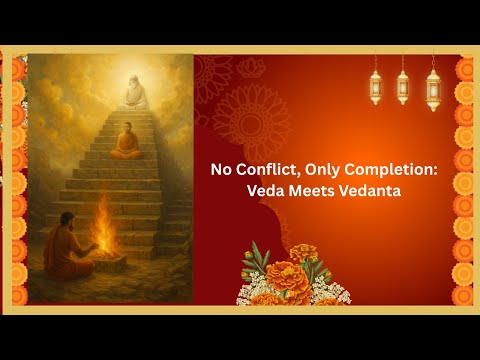
Guruji: Precisely. Think of it like a staircase. Karma is the first step. It purifies the mind, disciplines the senses, and reduces ego. Upasana, or devotion and inner contemplation, is the middle landing. Then comes Vedanta — the highest flight, where the Self is realised. But can one leap to the top without climbing the first steps?
Anirudh: That makes sense. But many modern seekers say, ‘Why perform yajnas? Why chant mantras or study the Brahmanas? Let me jump to the Upanishads — that’s where the truth is!’
Guruji: That is like someone learning poetry without knowing the alphabet. The Vedas were never meant to be read selectively. The Upanishads themselves are the concluding parts of the Veda — not replacements. The karma portions are there because they address the level at which we begin our journey: as embodied beings in a tangible world.
Anirudh: But Guruji, what about jnanis — realised beings who no longer perform rituals? Doesn’t that prove karma is unnecessary?
Guruji: Jnanis have crossed the river. They no longer need the boat — but they don’t curse it either. A true jnani respects karma because it helped him reach the shore. Even his silence, his very presence, becomes a yajna. He uplifts the world not through rituals, but through his being.
Anirudh: And what about those who see rituals as mere mechanical acts — without feeling or devotion?
Guruji: That is a real problem. The Taittiriya Kaathaka Prashna says — one who lights the yajna fire but doesn't feel the presence of the divine is like someone who cooks rice without water. The fire is there, but the rice remains raw. Rituals without surrender and bhava are like flowers without fragrance.
Anirudh: So, are rituals meant only for householders, not sanyasis or renunciates?
Guruji: Each person walks according to their stage. For grihasthas (householders), karma is both duty and means to purify. For vanaprasthas and sannyasis, karma gives way to contemplation. The Veda provides paths for all. But skipping stages out of arrogance or laziness is what the Gita criticises.
Anirudh: I see now. Even Krishna wasn’t condemning karma — He was condemning stagnation in karma.
Guruji: Well said! He criticised those who perform karmas only for worldly results — for Swarga or pleasure. That’s like planting a tree and plucking the leaves, ignoring the fruit. But He never dismissed yajna itself. In fact, He says yajna sustains the cosmic order — yajnaad bhavati parjanyah!
Anirudh: Then what about people who perform karma their whole life, but never reach jnana?
Guruji: If karma is done with attachment and desire, it binds. If done with surrender and no expectation — it becomes a ladder. When the mind becomes calm, the ego melts, and jnana arises naturally. The Upanishads blossom from such soil.
Anirudh: Guruji, this is giving me so much clarity. But I’ve heard even devatas dislike jnanis. Is that true?
Guruji: That comes from the Brihadaranyaka. The devatas prefer those who feed them through yajnas. A jnani, having realised the Self, no longer seeks favours — so he stops offerings. The devatas feel neglected. But that’s a symbolic way of saying: the jnani has outgrown even the need for divine reward.
Anirudh: So what should a sincere seeker like me do now?
Guruji: Start with where you are. Perform karma sincerely — but let each action be an offering to the Lord. Read the Upanishads — but with reverence, not pride. Know that karma is not the enemy of Vedanta — it is its womb. And when jnana dawns, karma will fall away by itself, like the husk from ripened grain.
Anirudh: Guruji, this changes everything. I used to look down on ritual. Now I see — karma is sacred. It is the path. It is my preparation.
Guruji: Walk it with love, my child. Let karma purify you. Let jnana awaken you. And when both dissolve, you will know — there was never a conflict. Only stages on a single, luminous path.





English
Vedas
Click on any topic to open
7
30
Astrology
Bhagavad Gita
Bhagavatam
Bharat Matha
Devi
Devi Mahatmyam
Ganapathy
Garuda Puranam
Glory of Venkatesha
Hanuman
Kathopanishad
Mahabharatam
Mantra Shastra
Mystique
Practical Wisdom
Purana Stories
Radhe Radhe
Ramayana
Rare Topics
Rigveda Explained
Rituals
Sages and Saints
Shiva
Spiritual books
Sri Suktam
Story of Sri Yantra
Temples
Vedas
Vishnu Sahasranama
Yoga Vasishta
26
17
10
0


