Nakula to Yudhishthira: Rule First, Renounce Later
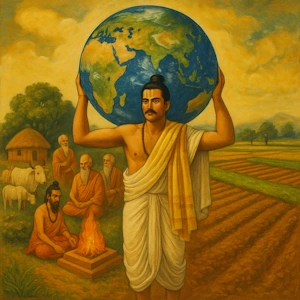
After the Kurukshetra war, Yudhishthira stood broken—haunted by the bloodshed, crushed by the cost of victory. He no longer desired the throne or the burdens of kingship. Instead, he longed to renounce it all and retreat into the forest. Seeing this, his brothers rose one by one to awaken him. In this chapter, Nakula speaks—not just as a brother, but as a voice of dharma—reminding Yudhishthira that true renunciation lies in righteous action, not escape.
Hearing Arjuna's words, Nakula stood up next.
His gaze turned to Yudhishthira — the one who bore all dharmas like a sacred fire holds flame.
Calm, respectful, yet resolved — for when silence risks dharma, speech becomes sacred.
Nakula, wise and composed, echoed Arjuna’s intent.
With a broad chest, mighty arms, and a copper-toned face,
he was measured in words, but firm in conviction.
Today, he rose as a warrior of thought.
Nakula said,
“O King, even the devas rise through yajna—
their flames leap from the visakhayupa, the sacrificial post.
They depend on karma; they are not above action but sustained by it.”
Even the pitrs, who breathe life into generations,
follow karmic law.
Look deeper—there is no realm where action does not reign.
Those who dismiss the Vedas are not wise—they are deeply misguided.
Even Brahmanas—who pursue inner renunciation—do not abandon karma.
So how can you, a Kshatriya born to uphold dharma through action, turn away from it?
The devayana—the path to heaven—runs through karma.
Even sages say the householder’s path surpasses others
when lived with dedication.
The seers earn wealth righteously and offer it in yajnas.
They don’t hoard—they dedicate.
This is the sacrifice of the wise.
He who has mastered himself, who acts with discipline—he alone is a true tyagi.
Renunciation is not in walking away, but in living free from craving.
The sage who wanders without home, rests beneath trees, never begs, always reflects—
he renounces inwardly, not outwardly.
The true renunciate avoids anger, pride, gossip, and honors his guru.
Such a one lives in quiet greatness.
The wise say:
weigh all four ashramas, and you’ll see—grihastha dharma balances them all.
It is the pillar that holds up the rest.
Heaven itself leans toward the householder’s path,
for it upholds the world with sacred steadiness.
One who walks this path with insight is a true tyagi.
But one who abandons home without understanding
simply wanders like a fool.
Renunciation without mastery over desire
only invites bondage.
Death, the silent king, binds such a man by the neck.
He loses both life and liberation.
Action done with pride bears no fruit.
Action done in surrender bears great fruit.
This is the truth, O King.
Peace, restraint, courage, truth, purity, simplicity,
sacrifice, patience, dharma—
these are the eternal practices handed down by the sages.
In serving ancestors, gods, and guests
lies the most praised dharma.
This is how artha, kama, and dharma
bear fruit.
One who walks this householder path—rooted in sacrifice,
honored by the wise—
never falls, in this world or the next.
Prajapati created the world and said,
“Let them worship Me through yajnas.”
Sacrifice became the center of life.
Trees, herbs, animals, all exist for sacred purpose.
Even offerings in yajna came from this divine order.
And it is the householder who performs these yajnas.
Thus, Nakula declares—
grihastha dharma is the hardest, and the highest.
Those who gain wealth but do not offer it in sacrifice
carry sin—not just now, but perpetually.
Some sages perform swadhyaya yajnas, others offer knowledge.
Some offer the self in silence.
The fire may burn within.
If yajna is lost, then the elements lose meaning—
earth, fire, wind, water, and sun
cease to nourish life.
Without yajna and dharma,
even stars disappear, directions dissolve, and time falls apart.
Sound, touch, form, taste, smell—all vanish.
The world becomes unanchored.
In such darkness, no perception holds,
no logic guides, no tradition helps.
Right and wrong blur.
Nothing remains.
Without dharma, there are no gods or humans,
no varnas, no ashramas, no doers, no desires.
Even purpose collapses.
The soul, though present,
loses its hunger for union with the divine.
It drifts, drowned in confusion.
Once, only the Atman was conscious;
the mind was inert.
Then Ishwara, the conscious Lord, gave motion to all.
Even mantras gained life from His breath.
Great rishis—creators of worlds—
received this consciousness
and wove the very cosmos.
Brahma worshipped the primordial yajna.
From that came creation—
not from chaos, but divine grace.
This whole world lives
because Ishwara breathes within it.
Shambhu, through yoga, infused it with life.
Dharma, artha, kama, and moksha
are all born from Ishwara’s will.
He unfolds the game and draws it to rest.
Man is helpless, a vessel of joy and pain.
It is Ishwara who sends him to rise or fall.
None move by their own power.
Prakriti and Purusha dwell in all beings.
Their minds chase, karma binds, pleasure and pain follow.
Caste, stage, gods and demons—
all move by Ishwara’s design.
Even kings live and die by His will.
None are truly free.
Even when devas destroy,
even when yajnas bring harm—
if done through dharma,
there is no sin.
Sacred action remains pure.
Householders, rishis, devas—all perform acts that hurt.
Yet when done in dharma, they rise to liberation.
Ancient kings struck down enemies not from hate,
but to protect dharma and their people.
Their violence was service, not cruelty.
If such kings sinned,
how did they reach heaven?
Duty bore them upward, not downward.
Set your mind right, O King.
Even the gods envy the twice-born householder
who lives by yajna.
You have gathered wealth for sacrifice,
and now speak like a renunciant?
Why abandon the fire after preparing the altar?
If one has accepted householder life,
then grand yajnas like Rajasuya and Ashvamedha
are the true renunciations.
Perform these, O King, like Indra himself.
Let the Brahmanas honor your sacrifice.
But a king who neglects his duty
and lets lawless men destroy his people—
he is Kali, not a raja.
If you hoard wealth—horses, cows, lands—
and offer nothing to the worthy,
then we, your brothers,
will share in your sin.
Kings who give no shelter, no charity,
are not rulers—they are shadows.
They inherit only sorrow.
If you leave without offering yajnas,
without honoring your ancestors,
without bathing in sacred duty—
your renunciation will be hollow.
You’ll drift like a cloud torn by the wind,
belonging to neither world.
True tyaga is to renounce attachment—
not the kingdom.
Without that, even the forest cannot save you.
The householder who walks this path
never falls, says the Veda.
O Partha, why grieve over dharma?
Indra struck down the asuras and ascended.
So too did your ancestors.
Why should you hang your head?
Win the world with valor.
Rule it with justice.
Then give it away in sacrifice—
that is the king’s highest path.
Your throne is not a burden.
It is the road to heaven.
Highlights
1. Even Devas Depend on Karma
Nakula begins by saying that even the gods depend on yajnas and karmic rituals for their sustenance. The devas rise through action, not by escaping it.
2. Pitrus Follow Karma Too
The pitrs (ancestral spirits) who bless and sustain lineages also act within the bounds of karmic law. Action is universal—it binds and uplifts all.
3. Vedas Must Be Upheld
Those who dismiss Vedic action are not renunciates but fools. True Brahmanas, even while inwardly detached, never abandon their duties prescribed in the Vedas.
4. Grihastha Dharma is the Foundation
The householder’s path (grihastha ashrama) is the most difficult and the most rewarding. It upholds yajna, sustains society, and balances all other ashramas.
5. True Tyaga is Inner, Not Outer
Renunciation isn’t about leaving home. It’s about dropping ego, desire, and pride while fulfilling dharma. The real tyagi is one who acts without attachment.
6. Dharma Declines Without Kingship
If a king neglects his duty, chaos spreads. Lawless men rise, the weak suffer, and dharma collapses. Rule is not privilege—it is sacrifice.
7. No Sin in Righteous Action
Kings of old performed violent acts for the sake of justice and still attained heaven. If done for dharma, even harsh actions remain pure.
8. Escape from Duty is Not Moksha
If Yudhishthira quits now—without yajna, without honoring ancestors—he will be like a cloud torn from the sky, rootless in both worlds.
9. Rule, Then Renounce
Nakula urges Yudhishthira to first fulfill his duty—rule righteously, perform yajnas, protect his people—and then renounce, like the great kings before him.
Nakula’s voice blends reason with reverence. He does not scold—he awakens. Through vivid examples, cosmic truths, and dharmic clarity, he shows Yudhishthira that renunciation without duty is hollow. True liberation, he declares, lies not in escape, but in embracing responsibility with surrender, wisdom, and fearless adherence to dharma.
- Shanti Parva. Chapter 12
- Why does Nakula argue that even the Devas and Pitrs are bound by karma?
Nakula suggests that the universe is an interconnected web of action. If the gods themselves rise through yajna (sacrifice) and the ancestors depend on the karmic rituals of their descendants, it proves that no being, no matter how high, is exempt from the law of cause and effect. By pointing this out, he shows Yudhishthira that attempting to exist without action is not a sign of holiness, but a violation of the cosmic order. - What is the hidden danger of renouncing the throne for a forest life without inner mastery?
Nakula warns that renunciation without mastery over desire is a trap. He compares a man who abandons his duties without understanding to a fool wandering in the dark. The "hidden" danger is that the mind carries its cravings into the forest. If the king leaves his responsibilities while his heart is still troubled by attachment or guilt, he becomes like a cloud torn by the wind—belonging neither to the world of men nor the world of the liberated. - How does Nakula redefine the concept of a true Tyagi (renunciate)?
The mysterious core of his argument is that Tyaga (renunciation) is an internal state, not an external location. A true Tyagi is someone who has mastered themselves and acts with discipline and surrender, regardless of whether they sit on a throne or under a tree. He emphasizes that one who lives in a palace but is free from craving is more of a renunciate than a monk who still harbors pride or anger. - Why is the Grihastha (householder) path described as the pillar of all other ashramas?
Nakula explains that the householder path is the hardest and highest because it sustains everyone else. The student, the forest-dweller, and the wandering monk all rely on the wealth and food produced by the householder. It is the "sacred steadiness" that prevents society from collapsing into chaos. Without the householder’s yajna, the material and spiritual economy of the world would cease to function. - What is the cosmic consequence of a world without Yajna and Dharma?
In a chillingly descriptive passage, Nakula suggests that if sacrifice and duty are lost, the elements themselves lose meaning. Earth, fire, wind, and water would cease to nourish life, stars would disappear, and time would fall apart. This highlights the "hidden" principle that human righteous action actually maintains the balance of the physical universe; human morality and cosmic stability are one and the same. - If Ishwara (God) is the ultimate mover, why should Yudhishthira feel responsible for the war?
Nakula introduces a sophisticated philosophical layer: man is a vessel, and Ishwara is the conscious Lord who gives motion to all. By stating that none move by their own power and that kings live and die by divine design, Nakula is trying to alleviate Yudhishthira’s personal guilt. If the war was a divine necessity for the restoration of dharma, then Yudhishthira was merely the instrument of a higher will, not a common murderer. - How can violence be considered "pure" or "sacred" in the context of a King’s duty?
Nakula argues that when a King strikes down an enemy to protect the innocent and uphold the law, it is not cruelty but service. He references ancient kings who reached heaven despite killing in battle. The purity of the act is determined by the "intent" (dharma) rather than the "content" (violence). If the action is a sacrifice for the greater good, it leaves no karmic stain. - What does Nakula mean by saying a king who neglects duty is "Kali" personified?
This is a powerful warning. In Hindu cosmology, Kali represents the age of darkness and discord. Nakula suggests that a ruler who hoards wealth or abandons his people to lawlessness isn't just a "bad king"—he is an agent of cosmic decay. By refusing to rule, Yudhishthira would effectively be inviting the age of darkness to consume the kingdom. - Why does Nakula compare Yudhishthira to someone who prepares an altar and then abandons the fire?
This metaphor addresses the timing of Yudhishthira’s desire to quit. The war has been fought, the wealth has been gathered, and the stage is set for the great sacrifices like Rajasuya. To leave now would be a waste of all the lives lost. Nakula argues that the "true" renunciation for a King is to perform the grand yajnas and give away the fruits of victory to the worthy, rather than walking away before the work is done. - What is the ultimate "road to heaven" according to Nakula’s speech?
The ultimate path is the cycle of "Win, Rule, and Give." A King must first win the world through valor, then rule it with justice to ensure the welfare of all beings, and finally, give it all away in sacrifice. This progression ensures that the soul is purified through duty before it seeks final liberation. For Nakula, the throne is not a burden to be dropped, but a vehicle to be driven toward the divine.





English
Mahabharatam
Click on any topic to open
7
30
Astrology
Bhagavad Gita
Bhagavatam
Bharat Matha
Devi
Devi Mahatmyam
Ganapathy
Garuda Puranam
Glory of Venkatesha
Hanuman
Kathopanishad
Mahabharatam
Mantra Shastra
Mystique
Practical Wisdom
Purana Stories
Radhe Radhe
Ramayana
Rare Topics
Rigveda Explained
Rituals
Sages and Saints
Shiva
Spiritual books
Sri Suktam
Story of Sri Yantra
Temples
Vedas
Vishnu Sahasranama
Yoga Vasishta
26
17
10
0


