The Sacred Signature — Understanding Mudras in Carnatic Music
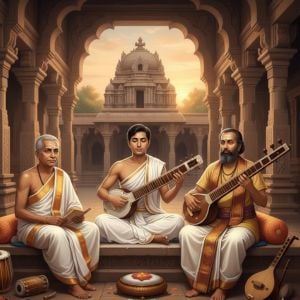
In Carnatic music, the concept of a mudra is a beautiful and deeply traditional signature system — it’s how a composer leaves a spiritual and artistic fingerprint inside a song. The word mudra literally means ‘seal’ or ‘mark’. Just as an artist signs his painting, a Carnatic composer inscribes his identity, devotion, and lineage into his composition.
But this isn’t just a name drop. A mudra in Carnatic music carries layers of meaning — personal, devotional, and stylistic. Let’s unpack that.
1. What a Mudra Really Is
A mudra is a specific word, phrase, or name that a composer inserts—usually toward the end of the kriti or in the charanam—to subtly identify who composed it. It can appear as:
The composer’s own name (e.g., Tyagaraja uses ‘Tyagaraja’).
The name of the composer’s guru (e.g., Koteeswara Iyer used ‘Kavi Kunjara Dasan’ to honor his teacher Kavi Kunjara Bharati).
The name of the favorite deity (e.g., Muthuswami Dikshitar used ‘Guruguha’, referring to Lord Subrahmanya).
The temple deity or home town’s deity (e.g., Swathi Thirunal used ‘Padmanabha’, the presiding deity of Thiruvananthapuram).
In rare cases, even a conceptual identity like ‘Paramahamsa’ (used occasionally by Sadashiva Brahmendra).
The mudra usually blends naturally into the lyrical flow — it doesn’t feel forced or like a signature tacked on. It becomes part of the prayer itself.
2. Why Composers Use Mudras
The purpose of a mudra is far more than just identification. It reflects a few key intentions:
Spiritual humility: Composers saw themselves as instruments of the divine, so they didn’t ‘sign’ their songs in pride, but as a mark of surrender.
Example: Tyagaraja’s mudra often appears in lines like ‘Tyagaraja vandanamu’ — meaning ‘the one who bows to Tyagaraja’s Lord Rama’.
Continuity of tradition: Using a guru’s or deity’s name anchors the composition in a lineage — a parampara.
Artistic identity: Just like a painter’s brushstroke reveals his style, a composer’s mudra reveals his school and devotion.
Authenticity: It helped preserve authorship in oral transmission, ensuring the composer’s name lived through generations of singers.
3. Where It Appears
Typically, the mudra is placed toward the end — in the charanam or madhyamakala portion — because that’s where the prayer culminates or the bhava (emotion) peaks.
It’s woven seamlessly, not as an external signature but as part of the lyric, like this:
‘Bhakta priyam guruguha rupam’ – in Dikshitar’s ‘Vatapi Ganapatim’
(‘I worship the form of Ganapati who pleases his devotees and who is none other than Guruguha’)
Sometimes, the entire kriti revolves around the mudra — as in Purandara Dasa’s ‘Purandara Vittala’, which expresses complete surrender to his beloved Vittala.
4. The Spirit Behind It
Every mudra carries the composer’s bhakti (devotion) and philosophy.
For Tyagaraja, the name ‘Tyagaraja’ was inseparable from Rama-bhakti.
For Dikshitar, ‘Guruguha’ symbolized the divine guru Kartikeya within.
For Swathi Thirunal, ‘Padmanabha’ expressed his personal deity and royal lineage.
For Purandara Dasa, ‘Purandara Vittala’ reflected his surrender to Krishna.
Thus, a mudra isn’t just an identifier — it’s a living declaration of faith, lineage, and purpose.
5. Legacy and Continuation
This tradition still continues today. Modern composers too insert their mudras as a homage to this age-old practice, maintaining the unbroken thread of Carnatic lineage. It’s part reverence, part identity — ensuring that centuries later, when a kriti is sung, we still remember whose heart it came from.
6. Major Composers and Their Mudras
Saint Tyagaraja
Mudra: Tyagaraja
Example : raamabhaktud'aina tyaagaraajanutuni nija daasulaina in Endharo Mahanubhavulu, vino'da mo'hanaakara tyaagaraaja vandaneeya in Samaja Vara Gamana etc.
Muthuswami Dikshitar
Mudra: Guruguha
Example : haraadi guruguha to'shita bimbam in Vathaapi Ganapathim, shankari guruguhasamudbhave' shive'vaa in Shyaamale Meenakshi etc.
Syama Sastri
Mudra: Syamakrishna
Example : shyam grishnuni sodhari kaumari in Devi Brova Samayamidhe, s'aamakrishna paripaalini jananee in Kanaka Shaila Viharini etc.
Papanasam Sivan
Mudra: Ramadasan
Example : ramadaasan vanangum mutthaiyaa in Kaa Vaa Vaa, dayaanidhe' raamadaasan pani in Shree Hare Krishna etc.
Koteeswara Iyer
Mudra: Kunjara Dasan
Example : kani tulya kavi kunyaradaasan tudi sheyyum in Gaanaamudha Paanam Seivaaye, kunjaradaasanum perave' taan nidam in Shambho Shankara etc.
Purandara Dasa
Mudra: Purandara Vittala
Example : purandara vit'halana aad'isidal'u yasho'de in Jagadoddharana, bhakta po'Saka shree purandara vit't'alam in Venkatachala Nilayam etc.
Sadashiva Brahmendra
Mudra: Paramahamsa
Example : paramahamsa mukha chandra chako're' in Manasa Sanchara, shuddha paramahamsaashrama geetam' in Pibare Rama Rasam etc.
Swathi Thirunal Rama Varma
Mudra: Padmanabha
Example : vibudha saala shree padmanaabha shaure' in Deva Deva Kalayami, vishvapaalam padmanaabham in Bhavayaami Raghuraamam etc.





English
Rare Topics
Click on any topic to open
7
30
Astrology
Bhagavad Gita
Bhagavatam
Bharat Matha
Devi
Devi Mahatmyam
Ganapathy
Garuda Puranam
Glory of Venkatesha
Hanuman
Kathopanishad
Mahabharatam
Mantra Shastra
Mystique
Practical Wisdom
Purana Stories
Radhe Radhe
Ramayana
Rare Topics
Rigveda Explained
Rituals
Sages and Saints
Shiva
Spiritual books
Sri Suktam
Story of Sri Yantra
Temples
Vedas
Vishnu Sahasranama
Yoga Vasishta
26
17
10
0


