Mrityu Vijnana — The Science of Death and Dying
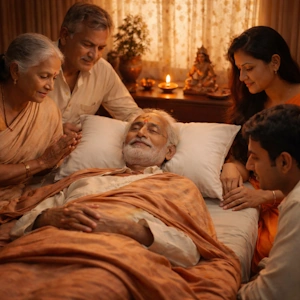
Most traditions tell you how to live. Hinduism also tells you how to die. This is not a morbid idea. It is a serious and ancient science. The ancient teachers believed the moment of death is one of the most important moments in a person's life. How you leave this world shapes what comes next.
This body of knowledge is called Mrityu Vijnana. Mrityu means death. Vijnana means deep knowledge or science. It is part of a tradition over three thousand years old. The term points to a careful study of what happens when life leaves the body.
Death Is Not the End — It Is a Transition
First, understand the foundation. Hindu philosophy does not see death as a full stop. It sees it as a doorway. The body is a temporary vehicle. The soul is called the Atman. It is the real self inside the body. It does not die when the body dies. It moves on.
Where it moves depends on several factors. Here is what this means in practice. The state of consciousness at the moment of death is the most important of these factors.
The Bhagavad Gita is one of the most sacred texts in Hindu tradition. It states this directly. Whatever state of being a person holds at the final moment, that is the state they move toward. This one idea gave rise to an entire science built around the dying moment.
The Last Moment Carries Enormous Weight
Now look at the deeper point. Throughout life the mind builds habits. It keeps returning to what it loves, fears, or regrets. At the moment of death all distractions fall away. The deepest habit of the mind rises to the surface. This final thought carries the consciousness forward. Think of a current carrying a boat.
Here is what this means for how a person lives. Every repeated thought shapes the mind's final habit. Every strong attachment does the same. Every deep fear does too. The dying moment does not create anything new. It only reveals what was already built inside.
What Is Done for the Dying Person
Here is where the practical science begins. When a person is close to death, certain things are done deliberately.
The name of God is chanted softly near the dying person. Usually the name Ram, or a personal deity. This is not empty ritual. The logic is clear. The final moments of consciousness are filled with divine sound. The mind gets pulled in that direction. It moves away from fear, pain, and unresolved emotion.
There is another important detail. The Garuda Purana is an ancient Hindu scripture. It is devoted entirely to the subject of death and what follows it. Passages from this text are read aloud near the dying person. The purpose is direct. The departing soul is being given a map before entering unknown territory.
The Role of the Subtle Body
Now understand something most people overlook. Hindu philosophy says the physical body is not the only body a person carries. There is also a subtle body. It is called the Sukshma Sharira. Think of it as an inner layer beneath the physical. It holds the impressions of all past experiences. It does not die with the physical body. It separates from it and continues the journey.
Here is what this means at the moment of death. The life force is called Prana. It withdraws from the limbs first. Then it moves toward the center of the body. Then it exits. The point of exit matters. Consciousness leaving through the top of the head is associated with a higher transition. That point is called the Brahmarandhra. This is why advanced practitioners of yoga spend their lives directing awareness upward.
Dying Consciously — The Highest Ideal
Now look at what this entire science is pointing toward. The highest ideal in Mrityu Vijnana is not a peaceful death. It is a conscious death. A person who has lived a spiritual life aims to stay fully aware during the dying process. To watch the body shut down without fear. To hold awareness steady as the senses withdraw one by one.
There is another important detail. Saints and advanced practitioners were said to leave the body at a chosen time. In full awareness. Sometimes announcing the exact moment in advance. This state is called Mahamrityu. It means the great death. Faced with complete presence and no resistance.
The Deeper Takeaway
Now look at what all five sections have in common. The chanting, the scripture, the subtle body, the point of exit, the conscious departure. Every one of these points to the same idea. The quality of your inner life determines the quality of your death.
Mrityu Vijnana teaches one powerful truth. Death is not something that happens to you suddenly at the end. It is something you prepare for throughout your entire life. Every moment of awareness you build is preparation. Every fear you face is preparation. Every attachment you loosen is preparation. The Hindu sages did not study death to become morbid. They studied it to learn how to live fully and leave gracefully.
Question 1. Why did Hindu sages study death so seriously when most traditions avoid the subject?
Answer. First understand the context. Most traditions treat death as an ending. Something to grieve. Something to fear. The Hindu sages observed nature differently. Seeds die to become trees. Night dies to become morning. Winter dies to become spring. They concluded that death is not an exception to life. It is part of the same movement. Studying death was simply studying the full cycle of existence. To them, avoiding the subject was like studying only half of a map.
Question 2. What is the connection between daily habits and the moment of death?
Answer. First understand the mechanics. The mind is not a fixed thing. It is a pattern builder. Every thought you repeat strengthens a groove in the mind. Every emotion you return to deepens that groove further. Over a lifetime these grooves become the mind's default direction. At the moment of death the body is shutting down. The will is weakening. The mind slides into its deepest groove automatically. Now look at the deeper point. How you die is determined by how you live. Day by day. Thought by thought.
Question 3. The Bhagavad Gita says the final thought determines the next destination. Does this mean a person who lived badly can escape consequences with one good final thought?
Answer. Now look at the deeper point. The final thought is not a random event. It is the product of an entire life. A person who has spent their life in greed or fear cannot simply think of God in the last moment and override everything. The final thought arises from the deepest habit of the mind. That habit was built over decades. One moment cannot undo decades of construction. Here is what this means in practice. Build the habit of awareness now. Consistently. So that at the final moment it rises naturally. Without effort. Without struggle.
Question 4. What makes the Garuda Purana different from other Hindu scriptures?
Answer. First understand the context. Most Hindu scriptures deal with how to live well. The Garuda Purana is different. It is an ancient Hindu text devoted entirely to what happens after life ends. It describes the journey of the soul in careful stages. It names the forces the soul encounters along the way. It explains what determines a smooth transition and what causes a difficult one. There is another important detail. It also contains instructions for the living. How to support a departing soul. Why these actions matter beyond mere tradition. No other Hindu text devotes itself so completely to this single subject.
Question 5. What is the real purpose of chanting near a dying person?
Answer. First understand what is happening at the moment of death. The dying person is losing grip on the physical world. The senses are withdrawing one by one. The familiar is becoming unfamiliar. In this state the mind needs an anchor. Here is what the chanting provides. It gives the dissolving awareness something steady to hold onto. It fills the room with calm and focused attention. The people doing the chanting are themselves settled and present. That calm becomes the environment the dying person moves through. The effect is both practical and profound.
Question 6. Why does the point of exit from the body matter at death?
Answer. First understand the context. Hindu philosophy maps the human body as a system of energy channels and centres. Different exit points correspond to different states of consciousness. A person whose awareness has spent years dwelling in fear or survival tends to exit through lower points in the body. A person whose awareness has been directed upward through consistent practice exits through higher points. The Brahmarandhra is a specific point at the top of the head. It is associated with expanded and liberated consciousness. Now look at the deeper point. The exit point is not a random event. It reflects the entire direction of a person's inner life.
Question 7. What is the most secret or least known aspect of Mrityu Vijnana?
Answer. There is an important detail that almost never gets discussed. The science includes a precise understanding of timing. Not all moments of death are considered equal. Ancient texts describe how the state of the cosmos at the moment of death interacts with the departing consciousness. The position of the sun. The phase of the moon. The season. This is not superstition. It reflects the understanding that the individual and the cosmos are not separate systems. The departing soul is like a drop returning to an ocean. The condition of the ocean at that moment matters. This dimension of the teaching has largely disappeared from public knowledge.
Question 8. How did advanced practitioners actually prepare for a conscious death?
Answer. First understand that the preparation was lifelong. It had three layers. The first was physical. Keeping the body light and clean so it did not create strong pulls on the departing consciousness. The second was mental. Training the mind daily to remain steady under pressure. To observe without reacting. To stay present when everything around it was changing. The third was energetic. Specific breathing practices designed to train the Prana, the life force, to move upward habitually. Here is what this means in practice. By the time death arrived the direction of exit was already established. Death was simply the final expression of a life well trained.
Question 9. Is Mrityu Vijnana only relevant to Hindus or does it carry universal principles?
Answer. Now look at the deeper point. Strip away the Sanskrit names and the specific ritual forms. What remains is a set of observations about consciousness. That it continues beyond the body. That the state of mind at death matters. That preparation throughout life is the only reliable preparation for death. Here is another important detail. These same principles appear across other traditions. Tibetan Buddhism has an ancient text called the Tibetan Book of the Dead. It covers nearly identical ground using different cultural forms. The specific expressions differ. The underlying understanding is remarkably consistent across centuries and cultures.
Question 10. What is the single most important practical teaching of Mrityu Vijnana for a person living an ordinary modern life?
Answer. Here is what this means in plain terms. You do not need to become a monk. You do not need to spend years in retreat. The most important teaching is simple. Pay attention to where your mind goes when nothing is demanding it. That default direction is your deepest habit. That habit is what will surface at the moment of death. So the practice is this. Gently and consistently redirect your mind toward what is steady and aware. Do this daily. Not dramatically. Not perfectly. Just consistently. Over years this builds the only preparation that actually matters.
Objection 1. There is no evidence that consciousness survives death. This is wishful thinking dressed up as science.
Reply. First understand what the objection is actually claiming. It is saying that because we cannot measure something with current instruments it does not exist. Now look at the deeper point. Consciousness itself cannot be measured directly even while a person is alive. Neuroscience can measure brain activity. It cannot measure the actual experience of being aware. That gap remains genuinely unsolved. The honest position is not that consciousness definitely ends at death. It is that we do not yet have tools sensitive enough to know. Mrityu Vijnana does not ask for blind faith. It asks for careful observation of what awareness actually is.
Objection 2. The idea that the final thought determines the next life is a control mechanism to keep people obedient through fear.
Reply. Now look at the deeper point. The teaching does not say behave well to get a good death. It says build genuine awareness because that awareness is what you actually are beneath the surface. The emphasis is not on fear. It is on understanding. Here is what this means in practice. A person who understands how the mind works does not need to be threatened. They see clearly that scattered and fearful habits create suffering while alive. And confusion at death. The motivation is self knowledge. Not obedience.
Objection 3. Reading scriptures to a dying person is superstition. A dying person cannot process what they are hearing.
Reply. First understand what the evidence actually shows. Modern research on dying patients consistently shows that hearing is often the last sense to leave the body. People who have recovered from deep unconsciousness have reported hearing everything in the room. There is another important detail. The chanting and reading also serve the living people present. They create a calm and focused atmosphere rather than one of panic and grief. That atmosphere itself becomes the environment the dying person moves through. The effect is real on both sides.
Objection 4. The concept of a subtle body that survives death is invented to comfort people. It has no basis in observable reality.
Reply. First understand what the subtle body actually describes. It is not a poetic invention. It is a functional concept addressing a genuine question. Where does personality reside. Where does memory live. These are not located in any single organ of the physical body. When a person loses a limb their personality does not change. When their brain chemistry shifts their sense of self is disturbed. The relationship between awareness and the physical body is far more complex than the objection assumes. The subtle body is a map of that complexity. The question it addresses remains genuinely open in modern science.
Objection 5. If dying consciously were truly possible we would have clear historical records. We do not.
Reply. There is an important detail here. The records exist. They are extensive. Ramana Maharshi was one of the most documented Indian sages of the twentieth century. He lived from 1879 to 1950. His dying process was witnessed by many people including Western observers. All accounts describe it as calm, deliberate, and fully conscious. Records of conscious dying also exist in Tibetan Buddhist tradition and in several other lineages. Here is what this means honestly. The objection reflects unfamiliarity with the documentation. Not an absence of it.
Objection 6. This teaching is only accessible to people with leisure time for spiritual practice. It is irrelevant to ordinary working people.
Reply. Now look at the deeper point. The core practice is not time consuming. It is directional. The question is not how many hours you meditate. The question is where your mind goes in the small moments of ordinary life. On a bus. Before sleep. During a meal. These moments are available to everyone. Here is what this means in practice. The teaching does not require withdrawal from life. It requires a different quality of attention within life. That is available to any person regardless of their circumstances.
Objection 7. Hindu cosmology is too culture specific to contain any universal truth about death.
Reply. First understand how all knowledge works. Every tradition wraps its deepest insights in the language and imagery of its own culture. That is unavoidable. Here is what this means. The question is not whether the cultural form is familiar. The question is whether the insight beneath it is valid. Gravity was described in English by Newton. That does not make gravity an English phenomenon. When Mrityu Vijnana says the direction of awareness at death matters it is making a claim about consciousness. Not about Indian culture. The cultural form carries the insight. It does not limit it.
Objection 8. The idea of dying at a chosen moment is a legend built around respected figures after their death.
Reply. First understand what the claim actually involves. It does not require supernatural power. It requires a degree of mastery over normally involuntary bodily functions. Modern science has documented cases of experienced meditators significantly influencing heart rate and body temperature through practice alone. Now look at the deeper point. The gap between that documented ability and the ability to consciously release the life force is a matter of degree. Not a matter of kind. Dismissing it as legend is easier than investigating it seriously.
Objection 9. Focusing on death takes attention away from improving life in the present world.
Reply. Here is what this means when examined carefully. The opposite is true. A person who understands death clearly tends to waste less time. They are less distracted by trivial concerns. They invest attention in what genuinely matters. Now look at the deeper point. Every major philosophical tradition from ancient Greece to modern existentialism has noted that confronting mortality sharpens how a person chooses to live. Mrityu Vijnana is not a distraction from life. It is one of the clearest lenses through which to see what life is actually for.
Objection 10. This science was developed thousands of years ago without modern medicine. It is simply outdated.
Reply. First understand what modern medicine has and has not solved. It understands the physical body with extraordinary precision. It does not yet have a satisfactory explanation for consciousness. For why there is subjective experience at all. For what happens to awareness as the brain shuts down. These are called the hard problems of consciousness. They remain genuinely unsolved. Here is what this means. Mrityu Vijnana was built specifically to address these questions. Through direct observation of consciousness over long periods of intensive practice. Age does not make an observation wrong. On the question of consciousness at death the ancient observers were asking exactly the right questions. Questions that modern science is only now beginning to take seriously.





English
Rare Topics
Click on any topic to open
7
30
Astrology
Bhagavad Gita
Bhagavatam
Bharat Matha
Devi
Devi Mahatmyam
Ganapathy
Garuda Puranam
Glory of Venkatesha
Hanuman
Kathopanishad
Mahabharatam
Mantra Shastra
Mystique
Practical Wisdom
Purana Stories
Radhe Radhe
Ramayana
Rare Topics
Rigveda Explained
Rituals
Sages and Saints
Shiva
Spiritual books
Sri Suktam
Story of Sri Yantra
Temples
Vedas
Vishnu Sahasranama
Yoga Vasishta
26
17
10
0


