Mahatala — The Kingdom of Fearful Indulgence
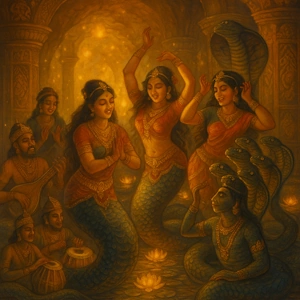
Atala, Vitala, Sutala, Talatala, Mahatala, Rasatala, and Patala — these are the seven nether realms. Of these, Mahatala is the fifth.
A land of serpents.
Not garden snakes or crawling reptiles.
These are the Kādraveya Nāgas — sons of Kadru —
endowed with multiple heads, immense coils, and unfathomable strength.
They do not slither in filth.
They dwell in palaces shaped like spirals, decorated with gems pulled from the bones of the earth, glowing with eerie light.
Each hiss echoes like a mantra across tunnels no human eye has seen.
The Lords of Mahatala
Among them rise the terrifying names:
- Takshaka — the serpent who brought down kings.
- Kaliya — the coiled ego crushed under Krishna’s dancing feet.
- Sushena — the venomous strategist.
- Kuhaka — master of deception.
These are not animals.
They are rulers, warriors, ancient forces — Nāga-chakravartins, kings of the serpentine lineage.
They have mahā-bhoga — not just coils, but luxury.
They live in fortresses of flesh, winding across the underground vastness.
They enjoy music, feasts, jewels, companionship.
There are serpent queens, dressed in silks of silver thread,
children with golden bands on their hoods,
ministers with venom flowing in their words.
Yes — they laugh. They love. They live.
But not in peace.
The Constant Shadow Above
In their hearts, one terror lingers —
The flapping of wings, the whisper of air shifting...
Garuda.
The king of birds. The mount of Vishnu. The eternal predator of serpents.
No matter how deep they dig,
no matter how lavish their underground world,
Garuda’s presence still finds them.
They are always alert, always glancing skyward,
even in their caves — as if the sky might break through stone.
They try to drown that fear.
In dance.
In intoxication.
In warm embraces.
In the smiles of their children.
They convince themselves: We are safe. Garuda will not find us here.
But the truth is etched into their blood.
The deeper the pleasure,
the louder the laughter,
the sharper the panic when silence falls.
Mahatala is not hell — it is far more tragic.
The Realm of Illusory Contentment
This is the lesson of Mahatala:
A soul may gather everything —
power, wealth, family, pleasure.
He may hide in comfort, bathe in beauty.
But if fear still rules his inner sky,
he is no king —
he is a decorated prisoner.
The serpents of Mahatala remind us:
You may build a palace over your fear, but it will always creak.
You may paint over anxiety with gold, but it will still slither beneath.
You may hold your family close, but no embrace can silence the sound of wings overhead.
And until that fear is faced —
until one seeks freedom, not comfort —
until one turns not downward into tunnels, but upward toward light —
Mahatala remains home.
- What is the exact cosmological position of Mahatala, and who are its primary inhabitants?
Mahatala is the fifth of the seven nether realms in the subterranean cosmology. Its primary inhabitants are the Kadraveya Nagas, the immensely powerful, multi-headed serpentine sons of Kadru, who rule this underground domain as ancient forces and kings rather than mere animals. - How does the text play with the dual meaning of maha-bhoga in the context of the Nagas?
The term maha-bhoga is used with a brilliant dual meaning. On a literal, physical level, it refers to the immense, powerful serpent coils of the Nagas. On a deeper, material level, it translates to great luxury, highlighting their lavish lifestyle filled with palaces, music, jewels, and royal comforts. - How does the narrative dismantle the common perception of serpents as mere crawling reptiles?
The text elevates the Nagas from mindless beasts slithering in filth to intelligent, cultured Naga-chakravartins, or emperors. It reveals their hidden, sophisticated society complete with spiral palaces, cunning ministers, elegant queens, and deep emotional lives filled with love, laughter, and strategic thought. - What does the architecture and environment of Mahatala reveal about the nature of its residents?
The spiral-shaped palaces glowing with eerie light reflect the winding, secretive, and majestic nature of the serpents themselves. Pulling gems from the bones of the earth shows their immense resourcefulness and their desire to hoard beauty in the dark, attempting to create a magnificent sanctuary away from the world above. - Despite their immense power, what is the constant, inescapable shadow that haunts the Lords of Mahatala?
The inescapable shadow is the terror of Garuda, the king of birds and the eternal predator of serpents. No matter how deep their subterranean fortresses are, the ancestral memory and dread of his flapping wings constantly loom over their minds. - How do the Nagas of Mahatala attempt to cope with their eternal dread, and what makes it tragic?
They attempt to drown their fear in intense sensory pleasures, dance, intoxication, and the warmth of family life. It is deeply tragic because this contentment is completely illusory; the deeper they indulge in pleasure to forget their reality, the sharper their underlying panic becomes the moment silence falls. - Why are the Nagas described as glancing skyward even when they are deep underground?
This imagery highlights the psychological permanence of their terror. Even beneath layers of impenetrable rock, their minds are fixated on the heavens from which Garuda strikes. It symbolizes how deeply rooted fear defies logic, physical boundaries, and the illusion of safety. - Why is Mahatala described not as a hell, but as something far more tragic?
A traditional hell involves direct, relentless punishment, but Mahatala is a realm of extreme wealth and familial warmth tainted by inescapable anxiety. It is more tragic because the inhabitants possess everything they could ever want, yet they cannot truly enjoy any of it due to the pervasive rot of unaddressed fear. - What is the profound philosophical principle that the existence of the Nagas in Mahatala teaches humanity?
It teaches that material accumulation, power, and comfort are meaningless if a person is ruled by inner fear. A person can build an empire of wealth and surround themselves with beauty, but if they have not conquered their internal anxieties, they are not a king, but merely a decorated prisoner in a golden cage. - According to the text, how does a soul escape the metaphorical Mahatala in its own life?
To escape this state, a soul must stop digging downward into deeper comforts, distractions, and illusions of safety. True liberation requires turning upward toward the light, facing one's fears directly, and seeking genuine freedom rather than settling for a comfortable, fear-laden existence.






English
Mystique
Click on any topic to open
7
30
Astrology
Bhagavad Gita
Bhagavatam
Bharat Matha
Devi
Devi Mahatmyam
Ganapathy
Garuda Puranam
Glory of Venkatesha
Hanuman
Kathopanishad
Mahabharatam
Mantra Shastra
Mystique
Practical Wisdom
Purana Stories
Radhe Radhe
Ramayana
Rare Topics
Rigveda Explained
Rituals
Sages and Saints
Shiva
Spiritual books
Sri Suktam
Story of Sri Yantra
Temples
Vedas
Vishnu Sahasranama
Yoga Vasishta
26
17
10
0


