Mahabharata Reveals Some Secrets About Nagas
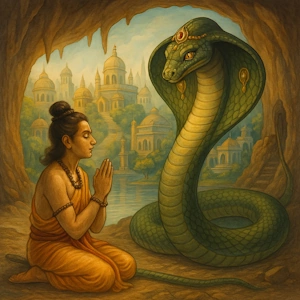
After so much of persuasion from Uttanka, his Guruji told him to ask gurupatni whether she was in need of anything. If she needs anything, get it.
That will do as guru dakshina.
We are seeing this story from Paushya Parva of Mahabharata which reveals quite a lot about guru-shishya relationship of the past.
Guru patni told that she would be happy if he can request and get the ear ornaments of the queen of King Paushya.
Accordingly, he went and requested her.
She happily gave them and said, 'Be careful, Takshaka has an eye on these ornaments.'
Uttanka said, 'Don’t worry, Takshaka won’t even dare to come near me.'
Then he left the palace and started his return journey towards the ashrama.
As he was walking, he saw that someone was following him.
It was a digambara sanyasi, naked.
Uttanka felt that he was behind him, but when he turned around to look, he would be invisible.
When he saw a lake, Uttanka kept the kundalas down and started taking bath, achamana, sandhyavandana.
At that time, the naked sanyasi rushed in, took the ear ornaments and disappeared.
Uttanka saw this.
But he didn’t stop what he was doing.
He knew that what he was doing was more important than everything else.
What do we do?
I don’t have to tell you.
That is the difference. That’s why those people were so powerful.
People complain — there are so many distractions.
The milkman comes only when I sit to pray.
The phone rings.
This is because we don’t understand the importance of what we are doing.
Uttanka was not like us.
He finished his entire routine and started going after the sanyasi.
Uttanka caught up with him. Caught hold of him.
It was not a sanyasi. It was Takshaka only.
He changed into his serpent form, wriggled out of Uttanka’s hand and disappeared into a hole on the ground.
Uttanka started digging at the mouth of that hole with his staff.
He was not successful.
Seeing this, Indra sent his vajrayudha, the thunderbolt, and enlarged the hole.
See when you are virtuous, where help comes from.
You don’t even have to ask for it. Help comes on its own.
First of all, for virtuous people, problems in life — that itself will be much less.
When others are facing 100 problems, virtuous people would hardly face one or two.
Even in that, they get help without even asking for it.
Uttanka got into the hole.
Takshaka had reached Naga Loka — his own world.
Uttanka also reached Naga Loka, the world of the serpents.
It was beautiful.
It looked endless, without any boundaries.
There were so many palaces, beautiful homes, playgrounds, gardens, public halls.
Uttanka thought he would praise the Nagas so that they return his kundalas.
He started praising.
'य ऐरावत......महात्मने'
Some very interesting facts about Nagas, Uttanka is revealing through these shlokas.
The king of Nagas is Airavata. He is their forefather. They are all born in the vamsha of Airavata.
They have so many different forms. They wear beautiful ear ornaments.
That must be the reason when Takshaka came to know that Paushya’s wife had a beautiful pair of ear ornaments, he wanted to get them.
Nagas are fond of ear ornaments.
They are very fierce fighters in the battlefield. They shower arrows like how clouds shower rain.
You know how cobras fight when they are attacked.
Airavata is the only serpent who has the courage to move freely under the intensely hot rays of Surya Deva.
Airavata’s elder brother is Dhritarashtra.
Not the Kaurava king.
The Kaurava king must have got his name after this great serpent only.
When Dhritarashtra moves, 28,008 Nagas move with him — meaning he is the commander of 28,000 serpents.
Dhritarashtra is the elder brother of Airavata.
Do you know why Airavata is not scared of the lethal sun rays?
Because Surya Deva will never hurt Nagas.
You know why?
Because these 28,008 Nagas under the command of Dhritarashtra, the elder brother of Airavata who is the king of serpents — these Nagas are the reins of the horses of Surya Deva.
These 28,008 serpents are the reins of the seven horses of Surya Deva.
The movement of Surya Deva in his chariot is dependent on these 28,008 Nagas.
Surya Deva is friendly towards Nagas.
That’s why Airavata can move about freely under the sun.
Elsewhere it is mentioned that Airavata is the clouds.
Indra’s vehicle, Airavata, are the clouds.
Airavata is both the elephant and the clouds.
And in Sanskrit, the word 'naga' stands for both serpent and elephant.
Do you see how they are all interconnected?
Clouds move about freely under the sun. Nothing happens to them.
Uttanka is praising Airavata so that he would impress upon Takshaka to return his kundalas.
Position and status of Airavata is even higher than Takshaka.
Then he tries praising Takshaka even.
Takshaka and his brother Shrutasena used to live on the banks of Ikshu Nadi in Kurukshetra and they did Suryopasana to attain position near Surya Deva in Dyuloka.
They also wanted to achieve greatness similar to Airavata and Dhritarashtra.
Uttanka realized that nothing happened. There was no use.
He didn’t get his kundalas back.
Here, there is a beautiful allegory you see.
What do the kundalas stand for?
For the guru dakshina.
The guru dakshina, in terms of value, is the repayment for what all he learned from his Guru.
The guru dakshina stands for the complete tattwas — the truth, all that he learned from his Guru.
They are equal to that.
Takshaka stole it.
Had Takshaka been righteous, he would not have done that.
Had Takshaka been worried about his future, he would not have done that.
Takshaka stands here for materialism.
The philosophy is materialism — those who are not bothered about a life after birth.
He tried to conquer that school of thought — materialism — with his own effort. That didn’t happen.
Then with the help of divine power — the thunderbolt of Indra — he broke open
the hole of materialism and started going inside, chasing to see where this is coming from.
Layer after layer, he crossed and reached the Naga Loka.
He found that it was prosperous.
These Nagas were immersed in prosperity.
These Nagas immersed in prosperity are the sensory organs.
The lure of the sensory organs — that is what makes people commit atrocities, crimes.
This is what Uttanka realized.
The Nagas in the Surya Mandala are different. They are virtuous. Respected even by Surya.
But these Nagas here, who stand for materialism, are not like that.
They are the sensory organs, always looking for pleasure.
He tried pacifying them by praising them — even pointing out the greatness of their great bandhus in the heaven.
It didn’t work.
Sensory organs will not listen, will not come under control if you pamper them.
What to do now, Uttanka thought. He has to get back his tattwa.
All that he gained over the years from his Guru.
It is gone now — in the custody of materialistic thoughts.
They have taken over.
What to do now?
He has to regain his asset. His only asset.
But Uttanka has been a perfect shishya. He has done his part very well.
God will help him. This is what Veda says.
His tapas that he observed, such as brahmacharya, is going to help him.
The summary is that, for a moment Uttanka is taken over by materialistic thoughts.
In spite of his background, he lost whatever he gained from his Guru.
He wants to regain them.
His own guru shushrusha and tapas, such as observance of brahmacharya, can help him with that.
This is the importance of discipline.
See — even the knowledge is not helping him.
Only his virtuous acts such as guru shushrusha and brahmacharya are going to help him in this fall.





English
Mahabharatam
Click on any topic to open
7
30
Astrology
Bhagavad Gita
Bhagavatam
Bharat Matha
Devi
Devi Mahatmyam
Ganapathy
Garuda Puranam
Glory of Venkatesha
Hanuman
Kathopanishad
Mahabharatam
Mantra Shastra
Mystique
Practical Wisdom
Purana Stories
Radhe Radhe
Ramayana
Rare Topics
Rigveda Explained
Rituals
Sages and Saints
Shiva
Spiritual books
Sri Suktam
Story of Sri Yantra
Temples
Vedas
Vishnu Sahasranama
Yoga Vasishta
26
17
10
0


