Madurai Veeran
Delve into the saga of Madurai Veeran, the fearless warrior whose legacy lives on.
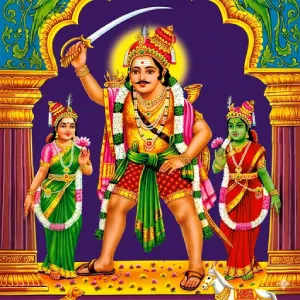
Madurai Veeran, meaning 'warrior of Madurai,' is a revered Tamil folk deity. His story is one of courage, love, and ultimate sacrifice, capturing the hearts of those who hear it.
The Birth and Early Life of Veeran
Veeran was born to aristocratic parents but was abandoned at birth. He was then adopted by a couple from the Arunthathiyar community. Growing up among them, he developed a strong sense of justice and bravery, eventually becoming a guard in the court of King Bommanna Nayakan.
The Love Story and Escape
While serving as a guard, Veeran fell in love with Bommi, the chieftain's daughter. They decided to elope, but their escape was fraught with danger. King Bommanna Nayakan pursued them with his army. Veeran, showcasing his bravery, defeated the army and killed Bommanna. The couple fled to Tiruchirappalli, where Veeran's heroism grew as he successfully fought off bandits terrorizing the local people.
Veeran's Rise to Fame in Madurai
Veeran's fame reached Madurai, which was also troubled by bandits. Thirumala Nayakar, the ruler, sought Veeran's help. In Madurai, Veeran met Vellaiyammal, a talented dancer who was captivated by his looks and skills. She asked him to teach her the Natya Shastra, the tenets of dancing. This relationship, however, stirred jealousy and suspicion in the king and his generals.
The Betrayal and Martyrdom
Jealous generals falsely accused Veeran of conspiring with the robbers. Enraged, the king ordered Veeran's execution. Veeran was brutally punished; his hands and legs were chopped off. Bommi and Vellaiyammal, heartbroken, went to the gallows to see his severed limbs and chastised the king for his injustice.
The Miraculous Resurrection
According to the legend, Veeran was brought back to life by the virtues of Bommi and Vellaiyammal. His limbs were miraculously reattached by divine intervention. In another version, Veeran himself chose to die, believing it was the will of the goddess Meenakshi. After his death, both Bommi and Vellaiyammal sacrificed themselves by jumping into his funeral pyre.
Veeran's Legacy
Madurai Veeran's legacy is honored with a shrine at the east gate of the Meenakshi Amman Temple in Madurai. Another shrine exists in the Mariamman Temple in Samayapuram. His story is kept alive through songs and street theater, celebrating his bravery, love, and sacrifice.
Conclusion
Madurai Veeran's tale teaches us about unwavering courage, the power of love, and the importance of honoring one's legacy. His story encourages us to face challenges bravely, stay true to our principles, and remember the sacrifices made by those who came before us.
- Why is Madurai Veerans birth and upbringing considered a symbol of social unity in Tamil culture?
Veeran was born into an aristocratic family but raised by a couple from the Arunthathiyar community. This narrative bridges the gap between different social strata, suggesting that heroism and divinity are not limited by birth but are shaped by character and upbringing. It highlights a hidden aspect of the legend where merit and justice transcend caste boundaries. - What does Veerans decision to elope with Bommi reveal about the nature of his courage?
His decision shows that his bravery was not just physical but also moral. By choosing love over the safety of his position in King Bommanna Nayakans court, he challenged the rigid social hierarchy of the time. This act represents the principle of staying true to ones heart despite the threat of systemic retaliation. - How did Veerans role as a protector evolve from a personal level to a societal level?
Initially, Veeran fought for his personal freedom and love. However, upon reaching Tiruchirappalli and later Madurai, he took on the responsibility of protecting the common people from bandits. This transition marks the development of a warrior into a folk guardian, showing that true greatness lies in using ones skills for the collective good. - What is the significance of the relationship between Veeran and the dancer Vellaiyammal regarding the Natya Shastra?
Their relationship adds a layer of intellectual and artistic depth to Veerans character. By teaching her the Natya Shastra, he is depicted not just as a man of the sword, but as a man of knowledge and culture. This mysterious duality suggests that a true hero possesses both the power to destroy evil and the wisdom to nurture art. - What triggered the tragic betrayal of Veeran by the king and his generals?
The betrayal was fueled by the jealousy and suspicion of the generals. This overlooked aspect of the story serves as a cautionary tale about how merit and fame can often incite envy in those in power. It highlights the principle that even the most righteous heroes can fall victim to the political insecurities of their leaders. - In what way does the punishment of Veeran reflect the intensity of his martyrdom?
The brutal order to chop off his limbs symbolizes the ultimate physical sacrifice. In folk traditions, this extreme suffering is seen as the final test of a heros spirit. His endurance and the subsequent reaction of Bommi and Vellaiyammal elevate him from a mortal soldier to a tragic martyr whose blood hallows the land. - How do the roles of Bommi and Vellaiyammal challenge the traditional narrative of passive female characters?
Both women are portrayed as strong and vocal. They confronted the king, chastised his injustice, and in some versions, their virtues were the catalyst for Veerans miraculous resurrection. Their final sacrifice on the pyre signifies a bond that transcends life, portraying them as equal participants in the legend's spiritual power. - What are the two main interpretations of Veerans death and resurrection?
One version focuses on divine intervention where his limbs are reattached due to the purity of his wives. The other, more mysterious version suggests that Veeran chose to die as an act of surrender to the goddess Meenakshi. Both versions emphasize the principle that his life was governed by a higher spiritual calling rather than just human law. - Why is the location of his shrine at the east gate of the Meenakshi Amman Temple significant?
Placing his shrine at the entrance of such a major spiritual landmark positions him as the eternal guardian of the city and the goddess. It reflects his transition from a human warrior to a Kaval Deivam or guardian deity, a hidden layer of Madurai’s spiritual geography where the protector stands watch at the threshold of the divine. - What is the primary lesson of Madurai Veerans legacy for modern society?
His legacy teaches that true immortality is achieved through sacrifice and standing up against injustice. By celebrating his story through street theater and song, the community keeps alive the principle that the protection of the weak and the pursuit of justice are the highest virtues, regardless of the personal cost.





English
Rare Topics
Click on any topic to open
7
30
Astrology
Bhagavad Gita
Bhagavatam
Bharat Matha
Devi
Devi Mahatmyam
Ganapathy
Garuda Puranam
Glory of Venkatesha
Hanuman
Kathopanishad
Mahabharatam
Mantra Shastra
Mystique
Practical Wisdom
Purana Stories
Radhe Radhe
Ramayana
Rare Topics
Rigveda Explained
Rituals
Sages and Saints
Shiva
Spiritual books
Sri Suktam
Story of Sri Yantra
Temples
Vedas
Vishnu Sahasranama
Yoga Vasishta
26
17
10
0


