Eyes Lovelier Than Lotus Petals
There are some more reasons why he is called Aditya.
अदितेरपत्यं आदित्यः – Progeny of Aditi, the mother of Devas.
Aditinandana is Vamana. After Mahabali took away the three worlds from Indra, Aditi, Kashyapa, and the Devas went to Vishnu and prayed for relief. He promised to take avatara in Aditi’s womb and restore Indra’s kingdom. So he took birth as Indra’s younger brother as Vamana. He is Aditi’s son, hence Aditya.
Bhumi also is called Aditi – इयं वा अदितिः
They are not one and the same, but another name for Bhumi is Aditi.
महीं देवीं विष्णुपत्नीम्
Bhumi (Mahee) is Vishnu’s wife.
So, he being the husband of Bhumi / Aditi, he is called Aditya.
अदितेरखण्डिताया मह्या अयं पतिः – Husband of Mahee who is not different from Aditi.
There are many pots of water. You can see the reflection of sun in all of them alike. This is the connection between Paramatma and Jeevatma. Sun here is Paramatma and the individual reflections are the Jeevatmas. He alone is the Paramatma who occupies individual bodies as individual Jeevatmas. Because of this similarity, he is called Aditya.
यथा आदित्य एक एव अनेकेषु जलभाजनेषु अनेकवत् प्रतिभासते एवं अनेकेषु शरीरेषु एक एव आत्मा अनेकवत् प्रतिभासते
Since through his form as Aditya he conveys this tatwa to us, he teaches us this tatwa, he is called Aditya.
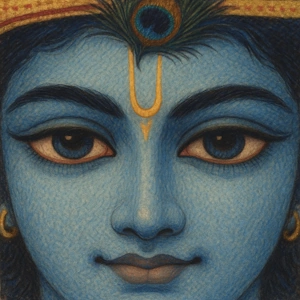
पुष्कराक्षः – पुष्करदले इवाक्षिणी अस्य – His eyes resemble lotus petals.
Even when you say, his eyes resemble lotus petals, don’t take it on face value. Lotus petals are nothing compared to the beauty of his eyes. Beauty of lotus petals is as far as our imagination can go. We are limited by the capacity of our mind and words. We have to say something, so we are saying Sri Hari’s eyes look like lotus petals. Lotus petals are nowhere near his eyes in beauty. The beauty of lotus petals is a minuscule percentage of the beauty of Sri Hari’s eyes.
He is such a perfect actor. He knows everything but pretends as if he doesn’t. Compare this to those who close their eyes and pretend to be knowing your past, present, and future through their yogic powers. Struggling to establish their credentials and credibility. Man trying to act like God. When God acts like man.
Drupada announced swayamvara of his daughter – Draupadi.
Sri Hari told Balarama, let’s go attend.
Balarama was puzzled – what is he trying to do?
Lord said – Draupadi is my sister. Yogamaya had taken three avataras –
One who was brought to the prison in the place of Krishna from Gokula, who was born as the daughter of Yashoda, whom Yashoda had not even seen once, who escaped from the hands of Kamsa.
The second – Subhadra.
And the third – Draupadi.
The Lord wanted to see who was going to marry his sister.
Or rather, pretended that he wanted to see who was going to marry her.
Drupada actually wanted to marry Draupadi to Arjuna.
But then the fire at Laksha-griha had happened.
No one was sure about what happened there.
Some thought Pandavas had perished in the fire and some thought probably they had escaped.
Only an archer capable of succeeding in Matsya-vedha could marry Draupadi.
There was a figure of a fish kept behind a rotating wheel.
The arrow had to pass between the spokes of the wheel and hit the fish.
The bow was also special.
Not only heavy — only a real expert could tie its string.
Out of all those who tried, only Karna could do it.
But then Draupadi said she wouldn’t marry the son of a charioteer.
Karna was insulted.
The Pandavas came disguised as Brahmins.
This was their first public appearance after the Laksha-griha incident.
They were staying in the house of a potter and in the swayamvara-vedi were seated along with Brahmins, not Kshatriyas.
When nobody could even lift the dhanus, and even Jarasandha failed, Arjuna stood up.
Everyone was stunned — a Brahmin going to try this?
Sri Hari asked Balarama – do you recognize him?
Arjuna easily lifted the bow and accomplished the task.
Drupada was happy. He proceeded to offer Draupadi’s hand to Arjuna.
All others, under the leadership of Duryodhana, objected and started a fight.
Arjuna and Bhima together fought them.
When the fight looked to be intensifying, Sri Hari and Balarama stood up and walked to the middle of the fight.
As they saw them walking down, everyone stopped.
Lord said, what’s wrong?
This young man has not done anything wrong.
He has accomplished complying to dharma.
What are you objecting to?
Now they knew — there is no point.
Next, the chakra will come out.
And in no time, Balarama will have his hala and musala in his hand.
Everyone left quietly.
The Lord went and touched the feet of Kunti Devi and Yudhishthira.
Mind you — Lord of the Universe touching the feet of humans.
She is his aunt.
Recognising human relationships, human values.
Teaching human values.
As Jagadguru.
Acting like a man, perfect man, complete man.
Acting as Purushottama.
Showing how to be Purushottama.
Acting as situation demands.
Not showing that he is the omnipresent, the omnipotent, the omniscient.
That is his greatness.
-
Why is the Lord called Aditya beyond just a sun reference?
-
Because he protects, nourishes, and guides like the sun, and also reveals deep truths: one supreme source reflected in many lives.
-
-
What does one sun reflected in many pots teach about the self and the Lord?
-
It shows one Paramatma shining through many bodies as individual selves. Seeing this heals envy and softens pride.
-
-
How should I relate to my own talents if forms are granted by a higher power?
-
Use them fully, credit upward, and avoid boasting. Gratitude keeps skill from turning into ego.
-
-
What does the title pushkaraksha suggest for daily living?
-
Keep your vision lotus-like: clean, kind, and steady. Practically, guard screen time, blink often, and step into morning light to rest the eyes and mind.
-
-
Why would the Lord act ordinary when he is all-knowing?
-
To teach humility, respect, and patience from within human roles. Quiet goodness shapes families better than loud miracles.
-
-
How can I bring this humility into family life without feeling small?
-
Touch elders’ feet with a real heart, share chores, and say thank you often. Humility adds dignity; it does not erase worth.
-
-
What does devotion look like at a public event or workplace decision?
-
Follow dharma calmly, avoid insult or class bias, and let results be decided by merit. Bhakti stands with fairness.
-
-
How does remembering the Lord in sunlight help health and prayer?
-
Ten minutes of morning sun sets your body clock, lifts mood, and anchors a short remembrance. Better sleep, better focus, deeper bhakti.
-
-
What is the right way to admire beauty like lotus eyes without becoming sentimental?
-
Let beauty refine conduct. Speak gently, pause before harsh words, and keep the home aesthetically simple and clean.
-
-
If the Lord can protect without showing grandeur, how should I protect my family?
-
Act early, firm, and respectfully. Stop what is wrong without humiliation. Protection is strength with softness.
-
-
How does the insight about one source and many reflections change relationships?
-
You stop treating people as rivals and start serving the one light in them. Friction drops; cooperation grows.
-
-
What monthly practice keeps pride in check while honoring the Lord’s forms?
-
Pick one virtue to polish each month: truth, punctuality, cleanliness, generosity. Track tiny wins; offer them mentally to Sri Hari.
-
-
How should I eat if the sun’s nourishment runs the food chain?
-
Favour seasonal, plant-forward meals, eat unrushed, and take a 10-minute post-meal walk. A calm gut supports a calm mind for japa.
-
-
What do I teach children so reverence stays practical?
-
One line of gratitude at sunrise, one helpful act daily, and one simple rule: kind voice, tidy space, truthful speech.
-
-
How does bhakti guide choices in friendship and marriage conversations?
-
Respect people without labels, value character and competence, and keep speech free from mockery. Devotion and dignity move together.
-
-
What do I do when I crave recognition for good work?
-
Say thank you aloud to people, hand the credit upward in the heart, and do one service quietly. The hunger fades.
-
-
How do I keep charity from turning into control?
-
Give and release. No strings, no sermons. If advice is needed, keep it short and kind.
-
-
What is a simple daily close that honors Aditya and steadies the home?
-
Step outside at dusk for a minute, breathe slowly, remember the giver, and wish peace for all. Then keep the evening calm and screen-light.
-





English
Vishnu Sahasranama
Click on any topic to open
7
30
Astrology
Bhagavad Gita
Bhagavatam
Bharat Matha
Devi
Devi Mahatmyam
Ganapathy
Garuda Puranam
Glory of Venkatesha
Hanuman
Kathopanishad
Mahabharatam
Mantra Shastra
Mystique
Practical Wisdom
Purana Stories
Radhe Radhe
Ramayana
Rare Topics
Rigveda Explained
Rituals
Sages and Saints
Shiva
Spiritual books
Sri Suktam
Story of Sri Yantra
Temples
Vedas
Vishnu Sahasranama
Yoga Vasishta
26
17
10
0


