Lord Shiva Initiates Brahma and Sri Hari into Omkara
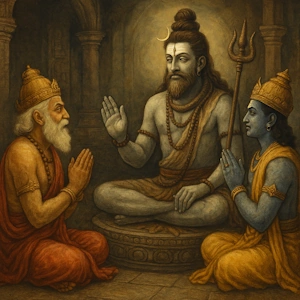
Lord Shiva has got five actions – Srishti, Stithi, Samhara, Tirobhava and Anugraha.
Creation, sustenance, elimination, keeping the universe in a hidden form from the time of Samhara to the next Srishti, which is called Tirobhava, and Anugraha which is giving moksha to his devotees.
Out of these, he delegated Srishti to Brahma, Palana to Vishnu, Samhara to Rudra, Tirobhava to Mahesha, and kept the power of Anugraha with himself.
Rudra and Mahesha were always meditating upon him. They got his Saroopya, his own form, because of this.
Brahma and Vishnu didn’t do this – they didn’t get his form.
Lord Shiva told them, 'You start chanting Omkara, which is my mantra in totality, as my complete representation in sound form, which has originated from me only. Then you will also get my form.'
Then Lord Shiva initiated Brahma and Vishnu into Pranava, Omkara.
They both received their Deeksha of Omkara from Lord Shiva.
There is a formal procedure for receiving mantra.
You may have seen this during Upanayana Samskara when Gayatri Mantra is given.
The Guru, along with his wife and the Shishya, they put a cloth above their head like a canopy.
This is because the mantra given is a secret. Others should not hear it.
This also shows another thing — mantra grahana, or receiving mantra, is the best when it is coming from a householder, grihastha, and the Guru’s wife is also part of this.
Shiva and Shakti together, Purusha and Prakriti together — that is how initiation should be given. Then it works the best.
Here you see, Lord Shiva could have given the mantra all by himself, alone.
He didn’t do that.
There are many things only a husband and wife can do together.
Another one is Yajna. Remember, in the absence of Seetha Mata, whenever Lord Rama had to do a Yajna, he had to make a statue of her in gold and keep it in her place.
Then only he had the right to do Yajna.
Shloka says – Sahambikaḥ — along with Ambika, he initiated them into Omkara.
Here, there were two Shishyas — Brahma and Vishnu.
Under the canopy were Shiva, Parvathy, Brahma and Vishnu.
Brahma and Vishnu were facing north. Then Bhagawan Mahadeva placed his hands upon their heads and said the mantra — Omkara — three times. This is the procedure.
Why three times? Why not just once or ten times?
Because there are three bodies – Sthoola Shareera, Sookshma Shareera and Karana Shareera.
This is why we do Achamana also three times — one meant for each body.
This procedure is called Mantra Grahana or Mantra Deeksha.
Then the Shishyas have to offer Guru Dakshina.
Here, Brahma and Vishnu offered themselves as dakshina — complete surrender to the will of Mahadeva.
What better dakshina can you give?
When you give, let’s say, a gold coin as dakshina, what does it mean?
Where did that coin come from — either from your effort or you inherited it.
When you give it, it means you are giving some part of your effort or some part of your fortune.
Here, they both completely dedicated themselves to Mahadeva.
Tau dakshinaayaam aatmaanam cha samaarpayat —
Brahma and Vishnu became so happy that they started praising the Lord:
Namo nishkalarupaaya namo nishkalatejase
Namah sakalanaathaaya namaste sakalaatmane
Nishkala means without form — form like hands, legs, eyes.
The Lord is formless.
While we also see him as wearing jata, having three eyes, holding trishoola, he is also formless.
He also exists as formless lightness, formless brightness.
He is the Lord of everything, he rules over everything.
There is nothing, no one, that is not under his rulership.
He is the Atma of everything, everyone.
He is inside everything, inside everyone.
Namah pranavavaachyaaya namah pranavalingine
Namah srishtyaadikartre cha namah panchamukhaaya te
Pranava, Omkara, talks about him only.
Pranava represents him only.
He only does creation, sustenance, elimination, Tirobhava and Anugraha.
He has got five faces, five heads – Tatpurusha, Sadyojaata, Ishaana, Aghora and Vamadeva.
Panchabrahmaswaroopaaya panchakrityaaya te namah
Aatmane brahmane tubhyam anantagunashaktaye
The Lord’s five forms themselves are called Pancha Brahma.
The five actions called Pancha Kritya are his only.
He is Parabrahma. He is Paramatma.
His qualities are countless. His power is limitless.
Sakalaakalarupaaya Shambhave Gurave namah
He has got two aspects — with form and without form.
He is called Shambhu because everything auspicious, sham, mangalam, they all come from him, originate from him.
Brahma and Vishnu thus accept Lord Shiva as their Guru.
This is the relationship between them.
The Lord told them,
'I have told you the biggest of all Tatwas — how Omkara is the root of everything and how Omkara has come out of me.
I have shown you the path.
Now you should start chanting Omkara.
By the chanting of Omkara, jnana comes — jnana which doesn’t dwindle.
Fortune comes — fortune that doesn’t go away.'
'You should necessarily chant Omkara on the days of Chaturdashi and Ardra Nakshatra.
The result of this will be endless.
Chaturdashi is when it is there up to midnight, or one which occurs on the same day as Pradosha.
Ardra Nakshatra means when Moon is in Ardra Nakshatra. You can find out all these from Panchanga.'
'The period when Surya transits through Ardra Nakshatra also is very auspicious for chanting Omkara — this period is from 21st of June to 5th of July every year.'
'Once you receive Deeksha, you are supposed to chant that mantra every day. These are periods when you can undertake special, more intense Anushthana.
The last quarter or charana of Nakshatra Mrigashira and the first charana of the Nakshatra of Punarvasu are equally auspicious for the worship of Lord Shiva — be it puja, be it homa, be it abhisheka.
These periods come every month.'
'The best time for darshana of Lord Shiva is in the morning or during Sandhya Kaala – the two twilights.
Bhagawan says — for me, my Linga or idol — they are one and the same.
But the devotee will get more benefit by worshipping Linga than idol.
If you desire moksha, then only Linga should be worshipped, not idol.'
Nowadays, more and more idols of Lord Shiva are being created — installed in public places also.
But if your goal is jnana, realization — then you should worship Shiva Linga, not idol.
Only for worldly needs like health, wealth — you should worship the Lord’s idol.
Shiva Purana says this clearly:
Lingam param poojyam vairaadapi mumukshubhih
It is ideal to worship Linga with Omkara and idol with Panchakshara Mantra.
There is no problem even if the Linga has been installed by others — like a temple.
It is not necessary that you have to install it yourself.
Through worship of Linga, Shiva Pada can be attained.





English
Shiva
Click on any topic to open
7
30
Astrology
Bhagavad Gita
Bhagavatam
Bharat Matha
Devi
Devi Mahatmyam
Ganapathy
Garuda Puranam
Glory of Venkatesha
Hanuman
Kathopanishad
Mahabharatam
Mantra Shastra
Mystique
Practical Wisdom
Purana Stories
Radhe Radhe
Ramayana
Rare Topics
Rigveda Explained
Rituals
Sages and Saints
Shiva
Spiritual books
Sri Suktam
Story of Sri Yantra
Temples
Vedas
Vishnu Sahasranama
Yoga Vasishta
26
17
10
0


