A Mind in Turmoil
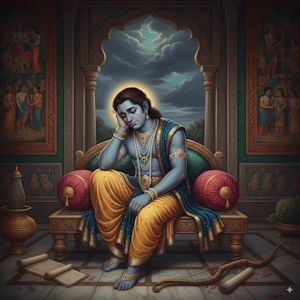
Lord Rama was approaching the age of sixteen. Lakshmana and Shatrughna were always with him. Bharata was in his maternal grandfather’s place.
The lord apparently fell into depression. He was always sitting gloomy. Looking worried. His face was turning pale day by day. He was losing weight day by day. Silent, not interested in any activity. Even taking food, taking bath, Sandhya Vandana, had to force him.
Dasharatha asked him repeatedly, what is wrong. Lord said nothing. Everyone became worried. Typically what modern psychology calls depression. All the symptoms of depression. Had it been today’s time, a psychiatrist's intervention definitely would have been sought.
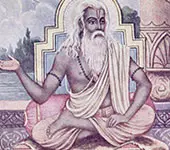
King Dasaratha went to sage Vasishta instead and expressed his anguish over what was happening with the lord.
The sage said –
अस्त्यत्र कारणं श्रीमन्मा राजन् दुःखमस्तु ते
कोपं विषादकलनां विततं च हर्षं नाल्पेन कारणवशेन वहन्ति सन्तः
सर्गेण संहृतिजवेन विना जगत्यां भूतानि भूप न महान्ति विकारवन्ति
See what comparison Vasishta has made. Great beings, santaha – they don’t show anger or sadness or happiness for silly reasons. There should be sufficient reason, then only they express these emotions.
People say I am forthright, I call a spade a spade. If there is something wrong I tell on the face. They think it is courage. Here the sage says, expressing emotions for silly reasons is not in the nature of great beings. Sign of greatness is controlling emotions. To be able to control emotions.
Not to express emotions as and when you want. It doesn't mean suppressing. It means establishing control over emotions. If you want to evolve this is one thing you have to learn. To control emotions. Expressing emotions as they come is not a sign of strength, it is a sign of weakness.
The maha bhutas, they agitate themselves only when it is time for something as big as creation or elimination. So, the lord shows this emotion means, there should be big enough reason behind it. Something is going to happen. But don’t worry about it, don’t bother about it.
Sage is addressing the king, Shreeman, it has significance here. It is not a casual usage. This is what we have to understand. Every word in these scriptures is important. It is not put there for poetic beauty.
The sage by calling Dasharatha, shreeman here, when he has come expressing his anxiety and worry over Lord Rama's condition, means, the outcome of this state of the lord is for collective good. The result is going to be good. It is going to lead to something good. So don’t worry about it.
मा राजन् दुःखमस्तु ते
One more thing that the lord is showing us here – for no apparent reason he fell into depression. There is a reason behind it. But for an onlooker, even his father could not make out what was the reason. He kept on asking.
Until then the lord never faced any problem in life. So, it may not be always a psychoanalysis, a doctor’s intervention that is required. Everything may not be related to a childhood trauma. This is a problem with us, we want to analyze everything and find out reasons. Finding out a reason does not mean we have found out the solution, even if the reason is correct.
Still, we are more comfortable when we have found out a reason or held somebody accountable. Even as a society this is what we do. If a bridge falls, the first knee-jerk reaction is - arrest the contractor. If there is a fire in a building, arrest the owner of the building. If there is a train accident, the minister should resign. This may not be always the right way to handle things.
We want to show that we are dynamic, responsive, so we do something and leave it there.
What did Vasishta do, Dasaratha asked why is Rama depressed, he said, don't worry. There is reason behind it. He didn’t speak out the reason. He said there is reason. He didn’t speak that out. Even when he knew.
So doing a psychoanalysis and telling someone, ok this is why you have this problem, may not be the solution. Wise men don’t always stick to protocols, especially when you are dealing with the human mind. One mind is different from another, the same mind itself responds differently from time to time. So finding a reason or an answer may not be always the correct strategy.
Certain things are better off if left unexplored.
-
Lord Rama entered a state of emotional withdrawal at a young age, showing disinterest in daily activities, food, and rituals. His behavior reflected deep inner disturbance, though he shared no explanation for it.
-
Despite repeated questioning from Dasharatha, Rama remained silent. This lack of communication caused concern among everyone, but no one could pinpoint a cause.
-
Sage Vasishta advised against panic, suggesting that great beings do not experience intense emotions without a meaningful reason.
-
Vasishta emphasized that saints and evolved souls express emotions only when the cause is significant — they don’t react to trivial triggers.
-
Emotional restraint, not impulsive expression, is a sign of maturity. Controlled emotion is a strength, not suppression, and is central to spiritual evolution.
-
Natural elements like earth and water also stay calm until great cosmic events like creation or dissolution — this serves as a metaphor for the self-restraint of higher beings.
-
The sage subtly reassured Dasharatha that Rama’s condition, though concerning, would eventually lead to a greater good and must not be feared.
-
The use of the word 'Shreeman' to address Dasharatha hinted that he was still in divine favor, and the outcome of the situation would be auspicious.
-
Modern psychology would classify Rama’s state as clinical depression, but the deeper cause lay beyond physical or mental health frameworks.
-
Seeking to label or explain everything through psychoanalysis or blame does not always resolve real human distress.
-
Society often rushes to assign fault after a crisis, but sometimes the most compassionate response is to remain still, observe, and wait.
-
Vasishta knew the cause behind Rama’s state but chose not to reveal it, showing that truth must be timed wisely, not forced into the open.
-
Each human mind is unique and changeable — what works for one does not work for another. Protocols fail where wisdom is absent.
-
Not all mysteries of the mind need to be solved. Some inner movements serve a greater design and should be allowed to unfold silently.
What makes someone a saint or great being?
A great being is someone who doesn't let emotions like joy, grief, or anger take over unless there's a weighty reason. Their inner balance remains steady. They aren't cold or numb — they simply operate from a deeper understanding of when and how to respond. It's not about suppression, it's about mastery.
Can anyone learn to control emotions like that?
Yes, but it takes steady effort and inner reflection. Start by watching your reactions without judging them. Slowly, that awareness turns into choice — whether to speak, act, or stay silent. Over time, restraint becomes natural.
Isn't hiding emotions unhealthy?
There's a difference between hiding and mastering. Hiding means fear or shame. Mastery means conscious choice. The sage wasn’t endorsing bottling things up; he was urging us to rise above needless emotional waste.
Why didn’t Rama explain what he was going through?
Because what was happening inside him wasn't a passing mood — it was a deeper spiritual shift that words couldn't capture. Even he might not have fully grasped it at that moment. Some experiences aren't for external sharing; they’re meant to break something open within.
How can others help when someone goes silent like that?
By being patient, supportive, and not rushing to fix them. Just being present matters more than advice. Often, the mind is still forming the insight it needs. Interfering too soon can make things worse.
Isn’t it risky to ignore such signs in today’s world?
Modern mental health care is important. But in some rare cases, a spiritual disturbance can look similar. The key is discernment — is the person drowning or transforming? That answer lies in how deeply you understand them.
Why did Vasishta avoid revealing the reason to Dasharatha?
Because timing matters. Speaking the truth too soon can confuse or disturb people. Sometimes, the wise hold silence until others are ready to understand. It’s not deception — it’s protection.
How do you know when not to speak the truth?
When your words won’t lead to clarity or strength, but only to panic or resistance. Silence, when rooted in insight, carries more power than poorly timed honesty.
Isn’t that manipulation?
No, it’s compassion with perspective. Manipulation serves self-interest. Wise silence serves the other person’s growth. The two look similar but come from completely different places.
Why is society obsessed with finding someone to blame?
Because assigning blame gives an illusion of control. It makes people feel like they’ve acted, even when they haven’t solved anything. It's emotional closure without real resolution.
What’s a better response to failure or crisis?
To step back, understand the chain of events deeply, and fix root causes. Not just fire someone or pass a new rule. True change needs wisdom, not impulse.
But isn't doing something better than doing nothing?
Not always. Action for the sake of optics is noise. Sometimes, calm observation and quiet intervention do far more than public drama.
Isn’t psychoanalysis useful to heal emotional wounds?
It can be, but it’s not a universal cure. Knowing the cause doesn’t always solve the pain. Sometimes healing needs silence, grace, or time — not just explanation.
Why do we feel relief when we find a reason?
Because it makes chaos feel organized. But that relief is temporary if the core problem stays. We love clarity, even if it doesn’t fix anything.
So should we stop trying to understand our pain?
No — but don’t get stuck in overanalysis. Understanding is good if it helps you move forward. But if you’re just circling the pain, it’s time to let go and trust a deeper process.
Can every mind be healed the same way?
No. Each person’s mind is wired differently. What comforts one might agitate another. That’s why wisdom is needed — not one-size-fits-all solutions.
How do you approach someone in mental distress wisely?
By respecting their uniqueness. Don’t force advice or interpretation. Offer space, presence, and a gentle invitation to share when they’re ready.
But aren’t there best practices in mental health?
Yes, but even best practices need adjustment. Wise care always looks at the person before the protocol. Minds aren’t machines — they’re living, shifting fields.
Are there situations where silence is the only answer?
Yes. When nothing external can change the process unfolding inside. Silence isn’t indifference — it’s a sacred pause. In such moments, words are too small.
How can we know when to speak or stay silent?
By tuning in to what’s really needed — not what feels urgent. If your speech brings light, speak. If not, wait. Stillness has its own wisdom.
Doesn't silence risk misunderstanding?
Sometimes, yes. But forced explanation risks distortion. The mind doesn’t always need to be decoded — it sometimes just needs to be held.





English
Yoga Vasishta
Click on any topic to open
7
30
Astrology
Bhagavad Gita
Bhagavatam
Bharat Matha
Devi
Devi Mahatmyam
Ganapathy
Garuda Puranam
Glory of Venkatesha
Hanuman
Kathopanishad
Mahabharatam
Mantra Shastra
Mystique
Practical Wisdom
Purana Stories
Radhe Radhe
Ramayana
Rare Topics
Rigveda Explained
Rituals
Sages and Saints
Shiva
Spiritual books
Sri Suktam
Story of Sri Yantra
Temples
Vedas
Vishnu Sahasranama
Yoga Vasishta
26
17
10
0


