Laws Guide, Values Transform
There are two kinds of regulations that govern a person’s life in a modern society: laws and values.
Laws are laws of the land which every citizen is expected to comply with. They are, in India, secular by nature. It could be different depending on which country you are living in. If you are living in an Islamic country, then Islamic laws apply.
Values are mostly derived from the particular religion or faith that you follow, or a particular community of which you are a part. But you will see that even among those who do not follow any particular religion, consider themselves to be agnostic or even non-believers — even the values that they observe have their roots in some religion. No other discipline teaches values.
Of course, there are secular values taught in schools, but they also are based on religious principles. A secular book can tell you: 'Follow this. This is great.'
But why? Why is it great? Why spend your hard-earned money to feed another person?
This answer — a secular book cannot give.
It can say, 'Do this, it is great.'
The answer to the question why — only some religious scripture can give.
So, indirectly, those who disown God and religion — they are also practising religious principles only. Doesn’t matter.
There are some differences between laws and values.
When does a child get exposure to the laws of the land?
Or does a child even get exposure to the laws of the land?
A child, till the age of 18 or 20 or 22, has exposure to discipline — discipline in school and college. In normal day-to-day living, laws are almost invisible.
You realize that there is a law pertaining to something only when you come to conflict with it. Even lawyers cannot keep themselves up to date about laws being enacted and modified.
So, a normal person comes to realize that there is a law only upon coming to conflict with it — only when challenged — and that too with the help of an expert.
The natural reaction in such a situation would be: how to get out of it.
If the tax man has sent you a notice for evasion — how to go to a court or tribunal and get a stay.
This is the natural reaction.
You want to end the discomfort as early as possible — whatever be the means.
So our approach to law is mostly not very friendly.
That is why we have to enforce laws — there are law enforcement agencies.
There is one more thing about laws — their ever-changing nature.
They keep on changing.
Till a couple of years ago, if you had an annual income of 4 lakhs and you didn’t pay income tax, it was an offence. Now they have raised the threshold to 5 lakhs — it is no longer an offence.
Till the time laws pertaining to cruelty towards animals were enacted, harming an animal was not an offence. Then it became an offence.
Now the Honourable Supreme Court says — you don’t need to be faithful towards your spouse. You have the liberty to engage in extra-marital affairs if you desire so. It was a punishable offence earlier.
This can also change later, because in our judicial system we have provisions for appeals and reviews.
All laws are subject to interpretation. A lower court can interpret in some way. The higher court can say — no, that is not correct, it should be the other way around.
Also, once a decision is given, you can ask the same issue to be considered by a bigger bench, or ask the same judges to rethink, file for a review.
Even when it looks like absolutely final, a government with majority can enact new laws, amend laws, amend the Constitution even. Then the judges will have to change everything.
So, laws are very uncertain — not sufficient to guide lives.
And by the time a child gets some idea about what the laws of the land are, it will be too late.
His or her character is already formed.
Laws are not sufficient also — you can’t make a law that whenever you see a blind person trying to cross a road, you should help, or else a fine will be imposed.
This is not possible. How many laws will you make? The situations are countless.
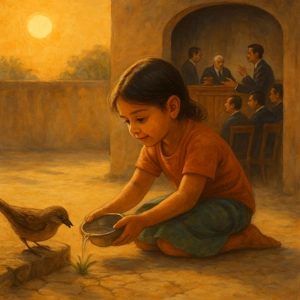
You can’t say that if you don’t keep water for birds during summer, you will be put in prison.
You can say: if you harm a bird, it is an offence.
But not — if you don’t give water, you will be punished.
There is one more difference — laws scare you. You observe laws for fear of punishment — not to get punished.
When you hear about a law, it is fear — a negative emotion — that comes to the mind.
Values are not like that. Values are positive. They make you feel good about yourself.
And if you have values, then you will never break a law.
We need values that can be inculcated right from a young age.
Then they get deeply ingrained in the child.
And these invariably come from religion.
The most accessible and easiest source of values is religion.
What is unique about Sanatana Dharma is — it just doesn’t give you rules to follow.
Sanatana Dharma also tells you the logic behind every rule, every value — how it is put in place for individual and collective good, welfare.
And as I have always been telling — you can only inculcate values in children by demonstrating.
Living by those values yourselves.
You can’t scream at your spouse at home and expect your child to be well-behaved in school.






Children's Section
Parenting
Click on any topic to open
7
30
Astrology
Bhagavad Gita
Bhagavatam
Bharat Matha
Devi
Devi Mahatmyam
Ganapathy
Garuda Puranam
Glory of Venkatesha
Hanuman
Kathopanishad
Mahabharatam
Mantra Shastra
Mystique
Practical Wisdom
Purana Stories
Radhe Radhe
Ramayana
Rare Topics
Rigveda Explained
Rituals
Sages and Saints
Shiva
Spiritual books
Sri Suktam
Story of Sri Yantra
Temples
Vedas
Vishnu Sahasranama
Yoga Vasishta
26
17
10
0


