Ashtameechandravibhraajat.... - Lalita Sahasranama Part 5
अष्टमीचन्द्र-विभ्राज-दलिकस्थल-शोभिता ।
मुखचन्द्र-कलङ्काभ-मृगनाभि-विशेषका ॥ ५॥
ashtamee-chandra-vibhraaja-dalika-sthala-shobhitaa ।
mukha-chandra-kalankaabha-mriga-naabhi-visheshakaa ॥5॥
ॐ अष्टमीचन्द्र-विभ्राज-दलिकस्थल-शोभितायै नमः
Om ashtamee-chandra-vibhraaja-dalika-sthala-shobhitaayai namah
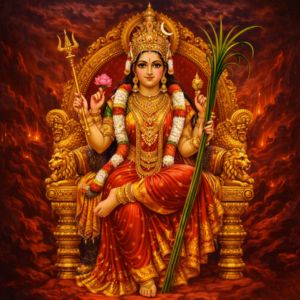
This line zooms into her forehead. It says that the central part of her forehead shines like the crescent moon of the eighth lunar day. The Ashtami moon is slender, graceful, and softly radiant. That is the comparison. Her forehead carries that same calm curve and cool brilliance. It is not harsh light. It is the kind of glow that feels soothing and auspicious, like the gentle moon appearing in the early night sky.
ॐ मुखचन्द्र-कलङ्काभ-मृगनाभि-विशेषकायै नमः
Om mukha-chandra-kalankaabha-mriga-naabhi-visheshakaayai namah
Now the verse shifts to the tilaka on her forehead. Her face itself is compared to the full moon. On that moon-like face sits a mark made of musk — mriga-nabhi. The poet compares this dark musk mark to the natural spot seen on the moon. Just as the moon has its distinctive mark that makes it recognizable and beautiful, her moon-like face carries a delicate musk tilaka that adds charm and depth to her appearance.
The verse is building a visual portrait. First the gentle crescent glow of her forehead, then the musk tilaka resting on her moon-like face. The image is of a queenly divine presence where even the smallest detail — a simple tilaka — becomes a poetic symbol of beauty and grace.





English
Devi
Click on any topic to open
7
30
Astrology
Bhagavad Gita
Bhagavatam
Bharat Matha
Devi
Devi Mahatmyam
Ganapathy
Garuda Puranam
Glory of Venkatesha
Hanuman
Kathopanishad
Mahabharatam
Mantra Shastra
Mystique
Practical Wisdom
Purana Stories
Radhe Radhe
Ramayana
Rare Topics
Rigveda Explained
Rituals
Sages and Saints
Shiva
Spiritual books
Sri Suktam
Story of Sri Yantra
Temples
Vedas
Vishnu Sahasranama
Yoga Vasishta
26
17
10
0


