Kunti Narrates Vyushitashva's Story
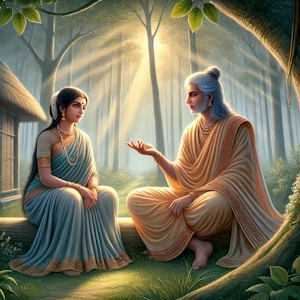
Pandu, noble king of the Kuru lineage, was cursed by a muni who was disguised as a deer. The curse decreed that if he ever touched a woman, both he and the woman would die. Overcome with remorse, Pandu renounced his kingdom and retreated to the forest with his wives, Kunti and Madri, seeking emancipation through penance and detachment. However, in the forest, Pandu realized that a man without children could not attain swarga. To fulfill this vital duty, he urged Kunti to conceive children with a noble person, as permitted by the dharma shastras. Such children would be considered his own, ensuring his path to swarga.
To convince Pandu of an alternative, Kunti recounted the story of King Vyushitashva. Vyushitashva was a righteous ruler of the Puru lineage, known for his unwavering devotion to dharma and his deep love for his wife, Bhadra. The king performed great yajnas, conquered many lands, and earned the respect of both gods and men. However, his excessive desire for Bhadra led to his untimely death due to illness.
Stricken with grief, Bhadra lamented her loss, expressing a desire to join her husband in death. Her unwavering devotion moved Vyushitashva, even in his disembodied state. From beyond death, his voice addressed Bhadra, offering her solace and a promise. He assured her that he would father children on her, despite his passing. He instructed her to bathe after her periods and lie on her bed on the eighth or fourteenth day, promising to unite with her in spirit. This miraculous act demonstrated the transcendence of marital bonds beyond physical existence.
Bhadra, devoted to her husband and determined to fulfill his wishes, followed his instructions. Through this extraordinary union, she gave birth to seven sons—three Shalvas and four Madras. These children became a testament to the couple’s unwavering love and faith, symbolizing the enduring connection between husband and wife, even beyond death.
After narrating this tale, Kunti turned to Pandu and said, 'Just as Vyushitashva fathered children on Bhadra without physical contact, you too can transcend your limitations. The power of yoga resides in your mind. Through your yogic power, you can ensure the continuation of your lineage without breaking dharma or risking the curse. Just as Vyushitashva’s love brought forth sons, your yogic power can fulfill this noble purpose.'
- What fundamental conflict does Pandu face between his personal curse and his spiritual obligations?
Pandu is caught in a profound dilemma between the biological restriction of the muni’s curse, which threatens immediate death upon physical intimacy, and the dharmic requirement of producing an heir to attain swarga. This highlights a recurring theme in ancient texts where a person must find a metaphysical solution to a physical limitation to fulfill their destiny. - How does Kunti’s choice of the story of King Vyushitashva serve as a strategic psychological intervention?
Kunti uses the story to shift Pandu’s perspective from despair to possibility. By citing a precedent within the Puru lineage where life was created beyond the physical body, she validates Pandu’s royal dignity while offering a path to fatherhood that bypasses the fatal conditions of his curse. - What does the disembodied voice of Vyushitashva reveal about the nature of marital bonds in this context?
The story suggests that the union between husband and wife is not merely a physical contract but a spiritual alignment. Vyushitashva’s ability to father children after death indicates that the intention, the word, and the spiritual essence of a partner can transcend the decay or absence of the physical form. - What hidden principle of yoga is Kunti referencing when she speaks of fathering children without physical contact?
She is referring to the concept of Sankalpa, or the power of focused will and intent. In this mysterious aspect of ancient science, the mind is seen as the primary creative force, capable of manifesting physical results through spiritual energy and adherence to specific cosmic timings, such as the eighth or fourteenth day. - Why is the mention of specific lunar days like the eighth or fourteenth significant in Bhadra’s instructions?
These specific days signify an understanding of subtle energies and timing within the dharma shastras. It suggests that for a "miraculous" or non-physical conception to occur, one must align with the natural and celestial rhythms that facilitate the bridge between the seen and unseen worlds. - In what way does the birth of the seven sons symbolize the success of faith over biological law?
The three Shalvas and four Madras stand as living proof that dharma and unwavering devotion can rewrite the laws of nature. Their existence confirms that when a higher purpose is pursued with total faith, the universe provides a mechanism for its fulfillment, even if it defies conventional logic. - What is the significance of Pandu’s initial desire to have Kunti conceive with a noble person versus Kunti’s suggestion?
Pandu initially seeks a solution through Niyoga, a socially and legally accepted practice of his time. Kunti’s counter-suggestion of using yogic power represents a "higher" or more mysterious path, placing the creative responsibility back onto Pandu’s own spiritual merit rather than a third party. - How does the narrative explore the concept of emancipation or penance during Pandu’s retreat?
Pandu’s retreat to the forest is an attempt to balance the heavy debt of his curse with the pursuit of spiritual liberation. It shows that even a king seeking detachment cannot fully abandon his worldly duties toward his ancestors until the lineage is secured, emphasizing that dharma follows a person even into renunciation. - What overlooked role does grief play in the manifestation of Vyushitashva’s spirit?
Bhadra’s grief was not merely an emotion but a potent invocation. Her "unwavering devotion" acted as the catalyst that pulled Vyushitashva’s consciousness back to the earthly plane, suggesting that intense, selfless love can act as a bridge between life and the afterlife. - What is the ultimate lesson regarding the power of the mind over the limitations of the body in this tale?
The story teaches that the body is a vehicle but the mind is the driver. By suggesting that Pandu use his yogic power, Kunti emphasizes that human limitations are often perceived as physical, but the solutions are frequently found in the mental and spiritual realms, where curses have no authority.





English
Mahabharatam
Click on any topic to open
7
30
Astrology
Bhagavad Gita
Bhagavatam
Bharat Matha
Devi
Devi Mahatmyam
Ganapathy
Garuda Puranam
Glory of Venkatesha
Hanuman
Kathopanishad
Mahabharatam
Mantra Shastra
Mystique
Practical Wisdom
Purana Stories
Radhe Radhe
Ramayana
Rare Topics
Rigveda Explained
Rituals
Sages and Saints
Shiva
Spiritual books
Sri Suktam
Story of Sri Yantra
Temples
Vedas
Vishnu Sahasranama
Yoga Vasishta
26
17
10
0


