Krita Yuga: The Golden Dawn of Humanity
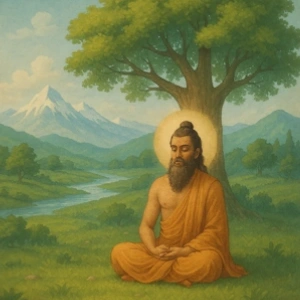
Krita Yuga, also called Satya Yuga, is the first and purest of the four Yugas in Hindu time cycles. It spans 1,728,000 years and is often referred to as the Golden Age. In this era, truth, righteousness, and virtue dominate every aspect of life. Dharma stands firm on all four legs, symbolizing a time of perfect moral order. People live simple, honest lives, deeply connected to nature and the divine. There is no deceit, war, or suffering. Everyone naturally follows spiritual paths without needing scriptures or temples. Krita Yuga sets the highest standard of human values and ideal living.
Early Human Life
- Human birth (as per tradition) occurred long after the Earth was formed.
- The first humans appeared in the Krita Yuga (also known as Satya Yuga).
- Brahma was present on earth together with the 21 prajapatis (progenitors). Various gotras originated from the saptarishis.
- The duration of Krita Yuga is about 1,728,000 years.
- Deities worshipped were natural forces: Indra (rain), Agni (fire), Vayu (wind), and Varuna (water).
The Great Age of Meditation and Tapas
- It was a time of meditation and self-discipline.
- Organized religion didn’t exist.
- People did not perform rituals like puja.
- There were no temples or idols.
- Birth, death, disease, sorrow, jealousy — all these were rare or nonexistent.
- Truth, renunciation, non-violence, compassion, and knowledge were the guiding values.
- People didn’t harm others or deceive.
- There was no theft.
- Whatever little was needed, people would gather from the forest and live simply.
Life in Towns and Villages
- People lived in forests and did not form towns or villages.
- They stayed inside hollow tree trunks or caves.
- Trees during this time were massive — sometimes 150 to 200 feet tall.
- Tools were made of stone, bamboo, etc.
- These were used to carve or cut other materials.
- No buildings or homes were constructed.
- Urban and rural life, as we know it, did not exist during this time.
Clean and Fertile Earth
- The earth during this time was very clean and fertile.
- Vegetation grew on its own without farming.
- Forests were vast and untouched.
- Trees, herbs, and fruits grew naturally and abundantly.
- Humans lived by gathering what they needed — no farming or ploughing.
- The land was so fertile that no effort was needed for food.
- Food was available in trees and forests.
No Religious Institutions
- In this age, there were no temples, rituals, or religious establishments.
- People didn't have organized places to worship.
- The concept of scriptures, temples, or priesthood had not evolved.
- People lived purely, and truth and simplicity guided their lives.
- The guru-disciple tradition had just begun to emerge.
- People lived with humility and wisdom.
- How does the imagery of Dharma standing firm on all four legs reflect the moral fabric of the Krita Yuga?
It symbolizes a state of perfect moral order where truth, righteousness, and virtue dominate every aspect of life, resulting in an era entirely free from deceit, war, and suffering. - What is the significance of the physical presence of Brahma and the 21 prajapatis during early human life?
Their presence indicates a direct, unbroken link between the divine creators and the first humans, establishing the foundational lineage and the origin of various gotras through the saptarishis. - Why were temples, scriptures, and idols considered unnecessary for spiritual fulfillment during this age?
People naturally followed spiritual paths through meditation, tapas, and a deep connection to nature. Because they lived with inherent truth and simplicity, the external structures of organized religion were simply not needed to connect with the divine. - How did early humans in the Krita Yuga interact with the divine forces, given the absence of formal puja or rituals?
Instead of performing formal rituals, they worshipped and deeply revered the raw natural forces that sustained them, such as Indra for rain, Agni for fire, Vayu for wind, and Varuna for water. - What made the human experience in the Krita Yuga radically different from the modern understanding of the human life cycle?
The typical human struggles like disease, sorrow, jealousy, and even the cycle of birth and frequent death were extremely rare or entirely nonexistent, allowing humans to exist in a state of continuous peace and spiritual elevation. - In the absence of towns and constructed homes, how did the physical environment uniquely accommodate early humans?
Humans found shelter in naturally formed spaces like caves and the hollow trunks of massive trees that grew up to 150 to 200 feet tall, showing a life perfectly integrated with the immense scale of ancient nature. - How does the complete absence of farming and ploughing highlight the earth's condition during the Krita Yuga?
It reveals an incredibly clean, untouched, and fertile earth where vast forests provided abundant vegetation, herbs, and fruits naturally, completely eliminating the need for human agricultural effort or manipulation of the land. - Considering their guiding values of non-violence and compassion, what was the primary purpose of the primitive tools they used?
Made from natural materials like stone and bamboo, these tools were used gently to carve or cut necessary materials gathered from the forest, rather than for hunting, harming others, or destructive building practices. - How did the societal structure function so harmoniously without the existence of urban centers, rural villages, or personal property?
Society functioned smoothly because individuals were guided by absolute values like renunciation and truth. Without theft or jealousy, whatever little was needed was simply gathered from the forest, making complex societal laws and boundaries redundant. - Since there were no scriptures or formal priesthood, how did profound knowledge and wisdom begin to be passed down in the Krita Yuga?
The transmission of wisdom occurred through the very early emergence of the guru-disciple tradition, relying on direct personal guidance, profound humility, and the lived example of meditation and self-discipline rather than written texts.





English
Bharat Matha
Click on any topic to open
7
30
Astrology
Bhagavad Gita
Bhagavatam
Bharat Matha
Devi
Devi Mahatmyam
Ganapathy
Garuda Puranam
Glory of Venkatesha
Hanuman
Kathopanishad
Mahabharatam
Mantra Shastra
Mystique
Practical Wisdom
Purana Stories
Radhe Radhe
Ramayana
Rare Topics
Rigveda Explained
Rituals
Sages and Saints
Shiva
Spiritual books
Sri Suktam
Story of Sri Yantra
Temples
Vedas
Vishnu Sahasranama
Yoga Vasishta
26
17
10
0


