Khandavaprastha: The Jungle that Became a Capital
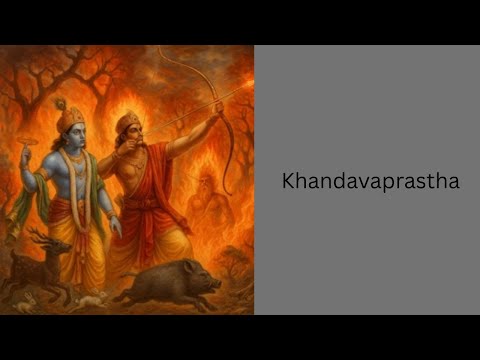
Khandavaprastha was the forest land allotted to the Pandavas when the kingdom was divided. It lay near the Yamuna river, not far from Hastinapura, in what is now identified with the Delhi region. At that time, it was wild and uninhabitable. Krishna and Arjuna together assisted Agni, the fire god, in burning down the Khandava forest. From the cleared land, the Pandavas built the magnificent city of Indraprastha, which became their capital.
Khandavaprastha was strategically located on the western bank of the Yamuna, near today’s Delhi. This meant it was right in the middle of the north Indian trade and travel routes. Whoever controlled this region could control movement between the fertile Ganga plains and the north-west passes.
When the Pandavas built Indraprastha there, it wasn’t just a capital city — it was a political statement. They were no longer dependent on Hastinapura’s goodwill; they had their own flourishing hub. The location also gave them economic strength because traders, travelers, and pilgrims naturally passed through, bringing wealth and recognition.
So Indraprastha was both a divine creation and a strategic masterstroke — placing the Pandavas on equal, even competitive, footing with the Kauravas in Hastinapura.
Dhritarashtra didn’t intend to empower the Pandavas by giving them Khandavaprastha. Here’s how it worked:
- Seemingly a bad deal: Khandavaprastha was a dense, wild forest — barren, full of snakes, demons, and wasteland patches. Dhritarashtra likely thought he was being generous by offering land but actually gave them something useless. Keeping Hastinapura (prosperous, established, and central) for his own sons looked like the safer option.
- Underestimation: He never imagined the Pandavas could transform this jungle into a rival capital. Dhritarashtra believed they would struggle just to survive there.
- The twist: With Krishna’s support and Arjuna’s prowess, the Pandavas turned that cursed land into Indraprastha — a city so splendid that it rivaled Amaravati, the capital of Indra himself. What Dhritarashtra gave as a scrap of forest became the very base of Pandava power.
So in short, Dhritarashtra allowed it because he underestimated them. He thought he was giving them a burden, but the Pandavas turned it into a blessing.





English
Mahabharatam
Click on any topic to open
7
30
Astrology
Bhagavad Gita
Bhagavatam
Bharat Matha
Devi
Devi Mahatmyam
Ganapathy
Garuda Puranam
Glory of Venkatesha
Hanuman
Kathopanishad
Mahabharatam
Mantra Shastra
Mystique
Practical Wisdom
Purana Stories
Radhe Radhe
Ramayana
Rare Topics
Rigveda Explained
Rituals
Sages and Saints
Shiva
Spiritual books
Sri Suktam
Story of Sri Yantra
Temples
Vedas
Vishnu Sahasranama
Yoga Vasishta
26
17
10
0


