Kaikeyi’s Change of Heart
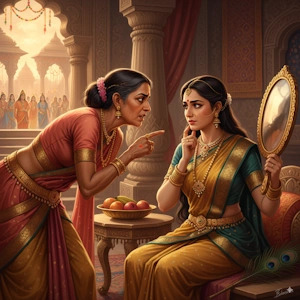
Rama’s coronation delights Ayodhya, as Dasharatha declares him heir. But Manthara, seeing the festive city, feels threatened. She manipulates Kaikeyi with fear — warning that Rama’s rule means Bharata’s downfall. Kaikeyi, at first joyful, gradually succumbs. Poisoned by Manthara’s words, she recalls two boons Dasharatha once owed her. Her mind hardens. She decides: Rama must go to the forest, and Bharata must be crowned. Thus begins the plot that will shake the soul of Ayodhya.
Kaikeyi’s face flushed like fire.
Anger lit her eyes, breath scorched her lips.
She hissed a long sigh and burst out:
‘Enough waiting. I’ve made up my mind.’
‘Today itself, I will send Rama to the forest.
And crown Bharata with the royal waters.
Quickly. No delay. This very day!’
‘Now tell me, Manthara, the way — the method — the trick.
How do I make sure Bharata gets the crown,
and Rama is denied it — completely, irreversibly?’
Manthara, whose heart saw Rama as a threat,
whose mind was shaped by poison and plots,
leaned closer to the queen and said —
‘Now, Kaikeyi, open your ears wide.
I shall speak the one path that will secure your son the throne —
and no one else. No Rama. Only Bharata. Forever.’
'O Kaikeyi! Have you truly forgotten? Or are you just pretending?
You ask me now for a way — but didn’t I already tell you once, for your own good?
Are you blind to your own protection?'
'If you’re ready now to really listen, O graceful queen,
then hear what I say — without flinching, without delay —
and do exactly as I tell you.'
Kaikeyi stirred — like a lioness stretching from slumber.
Half-risen, her pride bruised, her patience thin,
she looked at Manthara and said coldly:
'Tell me. Tell me how.
How shall Bharata gain the throne, and Rama lose it — once and for all?
Speak, Manthara! I will do it — whatever it takes.'
Manthara, the schemer, the seer of destruction,
whose heart throbbed not for justice but jealousy,
smiled — and began to unravel her venom-laced plan.
Once, when Devas and Asuras clashed like storm and lightning,
your husband, King Dasharatha, marched to war.
Not alone. He took you, Kaikeyi —
his strength, his pride, his right hand.
He fought not for himself,
but to aid Indra, king of the gods.
Southward he rode,
deep into the Dandaka forest,
towards the dread city of Vaijayanta.
There ruled the demon Timidhvaja —
his banner bore a shark,
his laughter mocked heaven.
This was Shambara — a master of a hundred illusions.
Not even the gods, with all their might, could crush him.
He dared to battle Indra himself —
and nearly shattered him.
That war was like the end of days.
By night, demons stalked sleeping soldiers,
piercing hearts, tearing flesh,
leaving blood-soaked silence behind.
The bravest fell like leaves in a storm.
And there, in that storm of death,
Dasharatha stood firm.
Wounded, bleeding — yet unyielding.
With his mighty arms and rain of arrows,
he shattered the demon hordes,
like Rudra destroying adharma.
Kaikeyi! Do you not remember?
In that battle, your king — your Dasharatha — collapsed,
bloody and broken, unconscious amidst chaos.
You — not fate, not gods — you dragged him out of death’s mouth.
You saved his life with your own hands.
Grateful, glowing with joy, he gave you two boons —
not asked, not bargained — offered from his heart.
And you? You smiled, you said,
‘When I wish, I’ll ask.’
He bowed to your will. So did destiny.
I knew nothing of this before.
You once told me, and since then,
this memory — your unclaimed right —
I have carried in my heart like sacred fire.
Now is the time, O Queen!
Break the arrangements for Rama’s coronation.
Undo it — with fire in your gaze and firmness in your voice.
Ask for your right.
Demand these two boons now —
Bharata to be crowned king,
and Rama… to be exiled to the forest,
for fourteen long years.
Let Rama vanish into the forest for fourteen years.
That’s all it takes.
In his absence, the people’s love will shift.
Bharata will root himself like a banyan.
He’ll become unshakable. The throne will be his — by love and law.
Today itself, enter the chamber of wrath.
Play the role well — a queen wronged, a wife scorned.
Throw off your ornaments.
Lie on the floor in tattered robes. Be fury incarnate, silent like fire waiting to burn.
Don’t greet the king when he comes.
Don’t speak to him.
Let him see you weep — not with weakness, but with fury.
Let your silence scream, ‘I am broken.’
You are his heart, Kaikeyi. That’s the secret.
There’s no doubt — if needed, the king would walk into fire for you.
Use that love. Wield it like a sword.
He cannot bear to see you angry.
He cannot look into your blazing eyes.
To keep you happy, Kaikeyi… he would give up breath itself.
Kaikeyi, don’t you know? The king cannot defy your word.
You hold him captive — not by force, but by affection.
You’ve always played meek, but you carry the might of your beauty and fortune. Use it now.
He may offer you gold, gems, pearls, palaces —
but don’t let your heart wander.
Reject it all. You don’t need riches.
You need Rama gone and Bharata crowned.
Remember those two boons, Kaikeyi?
The ones your husband promised you during the war?
This is the time. Remind him.
They were not just words — they were a royal bond.
Wait till the moment he lifts you with love,
begging you to speak your heart.
Then strike. Ask for the two boons —
Rama's exile, and Bharata's coronation.
Send Rama away for fourteen years.
Not ten. Not twelve.
Fourteen — enough time for Bharata to rise, to root, to reign.
Let Rama be forgotten. Let Bharata become the king.
Fourteen years in the forest — not less, not more.
That’s how long Rama must be gone.
By then, Bharata will have taken root —
firm, accepted, unshakeable.
So ask, Kaikeyi — ask for Rama’s exile as your boon.
That one demand will carve the path.
All your dreams for your son… will bloom.
Once exiled, Rama will no longer be Rama.
He’ll become distant… forgotten.
And Bharata — your Bharata —
will shine without rival, feared by no foe.
When the forest years end and Rama dares return,
your son won’t just be king —
he’ll be rooted deep, inside the throne and outside.
The people’s heart will beat with his name.
He’ll have friends, loyal men, power in every limb.
No longer a boy — he’ll be a lion.
That’s the moment, Kaikeyi.
Don’t wait. Strike now, without fear.
Break the preparations, Kaikeyi.
Stop the coronation before it breathes.
What looks like gain — is poison in disguise.
Manthara has shown it.
Kaikeyi heard. And something cracked.
A dangerous joy lit her face.
Like a naive girl drawn into the wrong path…
she stepped onto it, willingly.
'Manthara!' she gasped. 'Your mind… your clarity…
I underestimated you.'
This wasn't just a hunchback speaking —
this was strategy, fire-wrapped in foresight.
'Of all the maids in the land,
you are the queen of cunning.
Always thinking, always planning —
always loyal to me alone.'
'I thought you were just another crooked servant.
But I see it now — your body may be bent,
but your mind stands tall —
sharper than any king’s advisor.'
'You, Manthara,' Kaikeyi says,
'bent like a lotus swaying in the wind,
but beautiful still —
from your chest rising firm
to your shoulders proud.'
'Below that — your belly, calm like a lotus bud,
your hips full and flawless,
your bosom like twin dreams —
shaped with grace.'
'Your face — oh, your face —
shines like the full moon!
Your hips, adorned with jeweled belts,
gleam like polished gold.'
'Those strong legs — stretched and poised.
Even your steps, Manthara, wrapped in fine cloth,
radiate a strange royalty
when you walk ahead of me.'
'The asura Shambara had a thousand illusions —
but you, dear Manthara…
you carry ten thousand more
hidden in that clever heart of yours.'
'O Manthara, your chest hides those thousand illusions.
And more… so many more.
Even your crooked back —
long and raised like the front of a chariot —
holds strategy, sorcery, and royal craft!'
'I will deck that very back of yours
with a golden garland,
O bent one with the sharpest mind.'
'When Bharata is crowned,
and Rama banished to the forest —
I will smear your hump with molten gold,
refined, shining, worthy of queens.'
'I’ll place a tilaka of pure gold on your forehead,
a mark of victory, of cleverness.
You shall wear jewels,
the finest that suit your cunning beauty.'
'With silken robes wrapped around you,
you will move like a goddess,
glistening with glory,
while others whisper in awe.'
'With a face like the rising moon,
you’ll walk like a queen among queens —
prideful, glowing,
your enemies left speechless in jealousy.'
'Even the other hunchbacks,
decked in jewels like you,
shall bow at your feet,
as you now bow at mine.'
Hearing such praise,
Kaikeyi gleamed like sacred fire
on a white altar —
bright, powerful, and dangerous.
Said Manthara:
'A dam on a dried river is useless.
Act now, my queen!
Rise and seize your moment.
Show the king your will!'
Urged on, swollen with pride and purpose,
Kaikeyi — eyes wide like victory’s banner —
stormed into the chamber of wrath,
Manthara by her side.
The queen of radiant limbs,
stripped off garlands worth thousands of pearls,
unclasped every jewel fit for gods—
to descend into darkness,
as if shedding heaven itself.
Looking like molten gold,
ruled now by a hunchback’s cunning words,
Kaikeyi lay on the floor—
a queen in silk, fallen to stone.
She whispered,
‘Either I die here, Manthara,
or you tell the king—
only if Rama is exiled
will Bharata wear the crown.’
‘I care not for gold, nor gems,
nor food fit for kings.
If Rama is crowned,
my life ends that moment.’
Then Manthara,
with venom masked as concern,
told the queen with honeyed daggers—
‘Rama’s rise is your ruin.
Strike now, for Bharata's sake!’
‘If Rama takes the throne, O queen,
then mark my words —
you and your son will live a life of grief.
So act now, dear Kaikeyi,
make Bharata the king before it’s too late.’
Wounded again and again
by Manthara’s piercing words,
Kaikeyi clutched her heart,
shocked by the force of this scheme,
yet driven by rage, she barked again —
'So be it!'
‘Tell the king I am as good as dead,
unless Rama goes to the forest.
If that happens, Bharata will thrive,
our wishes will bloom like spring.'
‘I want no garlands,
no silks, no sandal, no wine.
I want nothing—
not even life—
if Rama stays and is crowned!’
Saying this, the fiery queen
removed every last jewel,
threw herself on the bare floor,
like a cursed apsara fallen from the heavens.
Her face now darkened by wrath and obsession,
without ornaments, without light—
the royal queen looked like the night sky
when stars are swallowed by a storm.
Thus ends the ninth sarga of Ayodhya Kanda of Valmiki Ramayana — with Kaikeyi, once the king’s jewel, now burning with ambition. The queen has chosen her path, and the storm begins to gather.
-
Manthara feels threatened by Rama's coronation and uses fear to manipulate Kaikeyi into opposing it.
-
Kaikeyi, though initially happy about Rama’s future, becomes disturbed by Manthara’s suggestion that Bharata’s future is at risk.
-
Manthara reminds Kaikeyi of the two unclaimed boons Dasharatha once granted her after she saved his life in battle.
-
With growing resentment, Kaikeyi decides to use the boons to exile Rama and crown Bharata.
-
Manthara advises her to act theatrically—showing grief, rage, and rejection—to emotionally trap Dasharatha.
-
She lays out a plan: ask for Rama’s exile for exactly fourteen years and demand Bharata’s immediate coronation.
-
Manthara claims that this time apart will erase Rama’s popularity and allow Bharata to fully cement his rule.
-
Kaikeyi praises Manthara’s cunning and begins to glorify her, even describing her body with admiration and devotion.
-
The queen, once royal and regal, strips herself of ornaments and descends into calculated madness, driven by desire.
-
She prepares to confront Dasharatha in the chamber of wrath, willing to risk everything to get her way.
-
Kaikeyi insists she no longer values life or luxury—only Bharata’s rise and Rama’s removal matter to her now.
-
The ninth sarga ends with Kaikeyi transformed into a vessel of ambition, ready to break Ayodhya’s peace with her demand.
What was the emotional turning point for Kaikeyi in this episode?
Kaikeyi’s turning point comes when Manthara reminds her of the two unclaimed boons. That forgotten promise becomes her weapon. As soon as she realizes she has legal ground to demand anything, she abandons all joy and turns fiercely against Rama’s coronation.
Why did Manthara target Kaikeyi specifically?
Kaikeyi held emotional power over Dasharatha and had access to past boons. Manthara knew that if anyone could halt Rama’s coronation and install Bharata instead, it was her — not through force, but emotional pressure.
Was Kaikeyi entirely manipulated, or did she have her own motivations?
Kaikeyi was influenced, but not innocent. The seed of insecurity grew because she allowed it to. Once fear for Bharata’s future took root, her pride and possessiveness took over, making her a willing participant in the plan.
Why does Manthara suggest exactly fourteen years of exile?
Fourteen years is long enough to sever people’s emotional memory of Rama and allow Bharata to fully establish his rule. It's not a random number — it's a psychological calculation meant to secure a permanent shift in loyalty and power.
Why not a shorter exile for Rama?
A short exile wouldn't weaken Rama’s public image. The people might still wait and expect his return. Fourteen years makes it feel permanent — long enough for Bharata to become indispensable and undisputed.
Isn’t it risky to assume people will forget Rama after so many years?
It is a gamble, but Manthara believes that absence reshapes loyalty. Power, familiarity, and daily rule build authority. Over time, people tend to settle with what they see — not what they remember.
Why did Kaikeyi remove her ornaments and lie on the floor?
It was part of Manthara’s script. The drama was essential to emotionally blackmail Dasharatha. By acting devastated and broken, Kaikeyi turns the king’s love into her weapon.
Why was Dasharatha expected to give in to such behavior?
Dasharatha adored Kaikeyi deeply. Her pain was his weakness. Manthara knew that emotional guilt would overpower his reason, especially if she played the part of a suffering wife.
Could Dasharatha not have resisted this manipulation?
He could have, if he were less attached. But his emotional bond with Kaikeyi blinded him. His sense of duty to his word and his affection made him a perfect target for this emotional trap.
Why does Kaikeyi suddenly praise Manthara’s beauty and form?
It reflects Kaikeyi’s intoxication with the plan. Her admiration of Manthara is not romantic — it’s symbolic. She sees Manthara not as a servant anymore, but as the architect of her son’s rise.
Isn’t that an odd reaction to manipulation?
It shows how deeply Kaikeyi has fallen into the trap. Instead of questioning Manthara’s motives, she becomes grateful. That shift shows her descent into ambition and the loss of her earlier clarity.
Was Kaikeyi under a spell, or was this all psychological?
Pure psychology. Fear for her son, bruised ego, and years of being sidelined came together. Manthara didn’t cast a spell — she simply lit the fire that Kaikeyi was already capable of feeding.
What does Kaikeyi ultimately demand from the king?
She will ask Dasharatha to banish Rama to the forest for fourteen years and crown Bharata in his place. These were the two boons she had stored away from the past.
Why does she link Rama’s exile with Bharata’s crowning?
Because one without the other is incomplete. If Rama stays in Ayodhya, he’ll still hold sway. His presence itself is a threat. Removal ensures Bharata’s uncontested rule.
Isn’t exile a harsh punishment for someone innocent?
Yes, but this isn’t about justice. It’s about power and survival. In Kaikeyi’s mind, exile is not punishment — it’s strategy.
How does the ninth sarga end emotionally?
It ends with a heavy, dark mood. Kaikeyi, once regal and joyful, has now transformed into someone burning with ambition. Her fall isn’t loud — it’s cold, calculated, and dangerous.
What makes this fall so tragic?
Kaikeyi was once noble and brave — she had saved the king’s life. Now she’s using that same loyalty as a weapon. It’s not just a fall from grace — it’s a betrayal of her own strength.
Does this mark the point of no return?
Yes. Once she commits to the demand and enters the chamber, the wheels are set in motion. Ayodhya will never be the same again.





English
Ramayana
Click on any topic to open
7
30
Astrology
Bhagavad Gita
Bhagavatam
Bharat Matha
Devi
Devi Mahatmyam
Ganapathy
Garuda Puranam
Glory of Venkatesha
Hanuman
Kathopanishad
Mahabharatam
Mantra Shastra
Mystique
Practical Wisdom
Purana Stories
Radhe Radhe
Ramayana
Rare Topics
Rigveda Explained
Rituals
Sages and Saints
Shiva
Spiritual books
Sri Suktam
Story of Sri Yantra
Temples
Vedas
Vishnu Sahasranama
Yoga Vasishta
26
17
10
0


