Jayadev’s Gita-Govinda and King Satvik’s Book
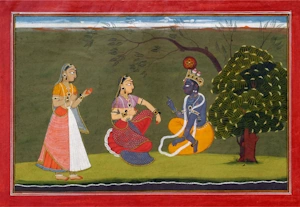
Lord Krishna once told Uddhava, ‘In the Kali Yuga, I wish to be worshiped through songs of my praise.’ Inspired by this, the poet Jayadev composed the Gita-Govinda. The poem’s theme is based on the Padma Purana. It describes the divine love between Lord Krishna and Radha, as well as his playful acts in Gokul during his Krishna avatar. Jayadev beautifully portrayed the enchanting deeds of Lord Hari through his poetry. His work is compared to setting a diamond in a golden bracelet for its elegance and devotion.
The Gita-Govinda became widely popular. People copied it, memorized it, and joyfully sang it in their homes. Like flowers spreading fragrance far and wide, the fame of the Gita-Govinda reached every corner of the world. In Jagannath, there was a king named Satvik, who also composed a book similar to Jayadev’s. King Satvik distributed copies of his book and instructed people to read and memorize it.
The learned Brahmins were displeased by the king’s actions. They gathered in Jagannath and confronted him. They said, ‘You have composed a book that pleases you, and you are equating it with Jayadev’s work. This is foolishness. Wise men do not praise their own creations. Yet you are commanding others to memorize your work, which diminishes its value.’ The Brahmins added, ‘Praising one’s own work is as absurd as extolling the musk of a deer, the fragrance of sandalwood, or the natural beauty of saffron. True worth does not need self-promotion.’
They further remarked, ‘How can the babul tree and the sandalwood tree, or the fruits of the hibiscus and sandalwood of Mount Malaya, be considered equal? How can a saint and a reviler, or a good man and a bad man, be evenly matched? Just as a royal swan and a crow, or gold and tin, cannot be considered equal, so too is the case with these two books. Your actions stem from pride, not devotion to God. Such pride is unpleasing to the Divine.’
The king replied, ‘Let us place both books before the idol of Lord Jagannath overnight. The one accepted by God will remain; the other will be rejected.’ Both books were placed before the deity, and the temple doors were locked for the night.
The next morning, the priests and Brahmins entered the temple and found Jayadev’s Gita-Govinda near the deity. The king’s book was thrown outside. The Brahmins celebrated, exclaiming, ‘Victory! Victory!’ The king hung his head in shame. They declared, ‘Milk and water have been separated. How can a book of Vedantic philosophy and one lacking morality be compared?’
The king, deeply ashamed, stood before the idol of Lord Jagannath with folded hands. He pleaded, ‘O Jagannath, I now understand your name as the Purifier of the Sinful. Yet I feel disheartened. Are you not the same for all beings? Just as the sun shines on every vessel, and the moon is the same for a king and a pauper, are you not alike to everyone?’
He continued, ‘You caused Jayadev to write his poem, and you inspired my heart too. Yet, you threw my book outside. I feel rejected, and I can no longer bear this shame. I shall take my own life.’ Hearing the king’s heartfelt plea, Lord Jagannath was moved. He took twenty-four verses from the king’s book and incorporated them into Jayadev’s Gita-Govinda. The king was comforted by this divine act, and his heart found peace.





English
Sages and Saints
Click on any topic to open
7
30
Astrology
Bhagavad Gita
Bhagavatam
Bharat Matha
Devi
Devi Mahatmyam
Ganapathy
Garuda Puranam
Glory of Venkatesha
Hanuman
Kathopanishad
Mahabharatam
Mantra Shastra
Mystique
Practical Wisdom
Purana Stories
Radhe Radhe
Ramayana
Rare Topics
Rigveda Explained
Rituals
Sages and Saints
Shiva
Spiritual books
Sri Suktam
Story of Sri Yantra
Temples
Vedas
Vishnu Sahasranama
Yoga Vasishta
26
17
10
0


