Is It Possible to Talk to God Like How You Talk to a Person?
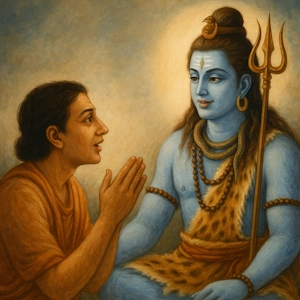
We said that the path to achieve Lord Shiva, Shiva pada, is through his seva.
And this seva is in the form of shravana, keertana, and manana — listening to his greatness as much as possible, as often as possible; telling about his greatness to others, sharing with others his greatness; and contemplating internally whatever you have heard about him.
This is the threefold path.
But who says this is what should be done?
Is this the right path?
Once, Vyasa Maharshi was observing tapas on the banks of river Saraswati.
Suddenly, Sanatkumara appeared there in a brilliant vimana.
Sanatkumara is one among the four Kumaras.
Kumaras are great yogis. They were the first ones ever to be created by Brahma.
Brahma asked them to engage themselves in creation. They were not interested.
They opted to be brahmacharis forever and engage exclusively in spiritual pursuit — the pursuit of brahma jnana, the ultimate knowledge.
Sanatkumara came there because he saw Vyasa Maharshi engaged in tapas and wanted to help Vyasa Maharshi in doing the right kind of tapas.
As soon as Vyasa Maharshi saw Sanatkumara in front of him, he hurriedly got up and offered pranama to him.
Sanatkumara told Vyasa Maharshi – engage yourself in the pursuit of the ultimate truth.
This ultimate truth is Lord Shiva.
It is Lord Shiva’s sakshatkara that you have to do.
What is sakshatkara?
Sakshat means pratyaksha — visible, physically present.
When you do sadhana or tapas, this is the destination — to make the devata whose sadhana you are doing real, pratyaksha, visible to you.
To make interaction with that devata possible, like how you interact with a person — to talk to that devata, to get a reply from that devata, just like how you interact with a person.
This is the purpose of sadhana. This is called sakshatkara.
Sakshatkara means – making real.
This is possible.
When we hear stories from the Puranas and Itihasas where it says — this rishi spoke to Mahadeva, this person went to Kailasa — we should understand that they have all done sadhana and tapas and done sakshatkara of devatas.
For them, Swarga is a real place they can walk into. Kailasa is a real place they can walk into.
They can offer namaskaras to Mahadeva in pratyaksha.
They can converse with Mahadeva for real.
When you are at the beginning of your sadhana, your ishta devata is only a vague concept in your mind — based on a dhyana shloka or something or description that you have heard.
But as your sadhana progresses, intensifies, this image becomes clearer and clearer.
And when your sadhana becomes successful, your god is there for real — right in front of you.
This is what the stories say: so-and-so did tapas and god appeared before him.
It is this sakshatkara itself which is referred to here.
Sanatkumara tells Vyasa Maharshi to do sakshatkara of Lord Shiva — engage in his tapasya.
Sanatkumara says – at the beginning even I didn’t know whom to worship.
There are so many devatas, so many different methods — which one to follow?
Sanatkumara was confused. He went to Mandarachala.
There, Nandikeswara came to him and told him:
If you are desirous of the ultimate goal, do the threefold sadhana of Lord Shiva himself — as shravana, keertana, and manana.
This is what the Veda speaks about.
And this is what is told to me by Lord Mahadeva himself.
So see what is the authority of the threefold path of shravana–keertana–manana of Mahadeva.
It is mentioned in the Vedas.
This is told by Mahadeva himself.
Nandikeswara told this to Sanatkumara, and Sanatkumara told this to Vyasa Maharshi.
From Vyasa Maharshi, in the form of Purana, it has reached us.
This is the validity and authority of this method.
But then what if you don’t have the opportunity to follow this method?
You can listen to his greatness only if there are people around you who can tell you this.
Suppose you are living in a place where such opportunities are not available?
Then what to do?
Then you can worship Mahadeva in a shivalinga or a vigraha in the traditional way.
This is also an equally fruitful and effective method.





English
Shiva
Click on any topic to open
7
30
Astrology
Bhagavad Gita
Bhagavatam
Bharat Matha
Devi
Devi Mahatmyam
Ganapathy
Garuda Puranam
Glory of Venkatesha
Hanuman
Kathopanishad
Mahabharatam
Mantra Shastra
Mystique
Practical Wisdom
Purana Stories
Radhe Radhe
Ramayana
Rare Topics
Rigveda Explained
Rituals
Sages and Saints
Shiva
Spiritual books
Sri Suktam
Story of Sri Yantra
Temples
Vedas
Vishnu Sahasranama
Yoga Vasishta
26
17
10
0


