Importance of Bhakti
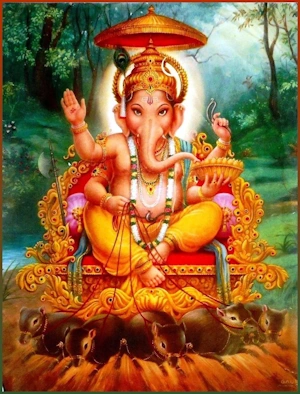
Matsarasura got a boon from Lord Shiva that he would become the emperor of the universe. With the help of that boon, he defeated Lord Shiva himself and conquered Kailasa, along with all the other worlds such as Swarga, Patala, and Kuberaloka.
All the devas were forced to stay in Kailasa. They were advised by Mahayogi Dattatreya that they should do upasana of Lord Ganesha. Only Lord Ganesha would be able to save them. They worshiped Lord Ganesha with his ekakshara mantra, and after 1,000 years of upasana—1,000 years according to the time scale of the devas, not 1,000 human years—Lord Ganesha appeared before them, seated on a lion.
The devas praised him with a stotra. The lord became happy. Here, the lord specifically tells the devas:
'भवतां भक्तियोगेन प्रसन्नः पूर्णतां गतः'
The upasana was with the ekakshara mantra. The devas and rishis did not follow one particular method. Somebody did fasting, somebody did bahya puja, but still, bhakti was at the core of all these methods. The lord became prasanna, seeing the bhakti.
The lord is pointing out that none of these paths will work unless bhakti is there. Merely doing a Veda parayanam was sufficient earlier. The Veda itself says this—you just read the Veda, and whatever effects those mantras are supposed to produce, they will be produced.
If you see the original shrauta yajnas, most of the mantras were said only once, and the ahuti was given. They were not like 1,008 ahutis of the Mrityunjaya mantra or 10,000 ahutis of Shri Sukta. Just chanting the mantra once and giving the offering in agni was sufficient to produce the desired effect. This was because people followed the Vedic system 100% on a daily basis.
All the samskaras were properly performed. From the time of getting up to going to sleep, every single act during the day was accompanied by a mantra. For touching the feet on the ground, for taking a bath, for wearing clothes, for eating food, for giving something, for receiving something—there were mantras for everything. Their day was filled with mantras.
They all went to gurukulas at the age of five, six, or seven and learned the Vedas the proper way. They observed brahmacharya and got married only with the purpose of observing dharma, husband and wife together. Then, as the yugas progressed, the system started changing. The intensity started getting less and less.
The veerya of their own mantras decreased. By veerya, what I mean is not the veerya of the mantra itself. There are two batteries—one is a 12V battery of an inverter, which can run an entire house for a few hours. Then there is a small 1.5V cell, which can probably power a remote or light a torch. The electricity is still the same, but how much you have stored is what matters.
In the same way, mantras are still the same, still very powerful. But our capability of using them has reduced because our lifestyle has changed. The effect that a single chanting of the Mrityunjaya mantra produced in the past—now we have to chant the same mantra 10,000 times or 1 lakh times to get the same effect.
The mind was focused then. Now, there are many distractions—money, property, success—the mind is running after all these things. As a result, even if you are chanting the Mrityunjaya mantra 10,000 times, because of the distracted mind, only one or two of them will be perfect.
That is why mantra shastra came with its own methods, such as purascharana. Your mantra—you have to chant it so many times, 5 lakhs, 25 lakhs, as many lakhs as the number of syllables in the mantra. This is called akshara laksha, followed by homa, tarpana, marjana, and brahmana bhojana—only then will the mantra work for you.
Or a person who has done all these can make the mantra work for somebody else. If you have siddhi in a mantra, then you can use it for the benefit of another person as well. If your car battery is down, I can bring my battery and start your car with it.
Even this, we do not want to do now. We have time to chant only eight times, twelve times, and yet we want mantras to do miracles for us. They still can—that is what the lord says.
For all these defects, deficiencies, and shortfalls in our method—be it Vedic, Tantric, or Mantric—all the shortfalls should be compensated by bhakti. Divinity has also realized that people are not going to do anything the proper way. They do not have the knowledge. They do not have the commitment.
They just want results in the easiest and fastest way. So, the lord says, 'I will not evaluate them on the basis of their perfection. I will only see if they have bhakti. I will only look for bhakti.'
If you want to get recruited into the army, what do they see? Primarily your health, your physical strength. They are not going to see whether you can write poems. They are not going to see whether you can play the tabla. They are not going to see whether you are as handsome as a model.
In the same way, in Kaliyuga, divinity primarily looks for bhakti in you. If you have bhakti, then divinity is pleased with you.





English
Ganapathy
Click on any topic to open
7
30
Astrology
Bhagavad Gita
Bhagavatam
Bharat Matha
Devi
Devi Mahatmyam
Ganapathy
Garuda Puranam
Glory of Venkatesha
Hanuman
Kathopanishad
Mahabharatam
Mantra Shastra
Mystique
Practical Wisdom
Purana Stories
Radhe Radhe
Ramayana
Rare Topics
Rigveda Explained
Rituals
Sages and Saints
Shiva
Spiritual books
Sri Suktam
Story of Sri Yantra
Temples
Vedas
Vishnu Sahasranama
Yoga Vasishta
26
17
10
0


