Importance of Annadaana Explained in Veda
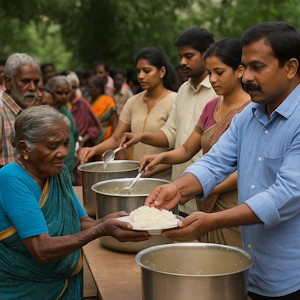
Puranas extol the virtues of anna daanam. But for the Purana to say something, it should be validated by the Vedas. We will look at some mantras in the Veda about anna daanam.
Taittireeya Brahmana – Second Kanda – 8th Prasna – 8th Anuvaka
अहमस्मि – Annam is describing itself, calling itself a devata.
देवा ह्यमृतमुपजीवन्ति – Devas are immortals because of amruta. Their devatva depends on amruta, and annam connects them to amruta — they get amruta through annam, what they consume.
पूर्वं देवेभ्यो अमृतस्य नाभिः – Naabhi means link, connection.
शस्यं क्षेत्रगतं प्राहुः सतुषं धान्यमुच्यते। आमं वितुषमित्युक्तं स्विन्नमन्नमुदाहृतम्
Plants in the field are called sasya, grains with husk are called dhaanya, when the husk is removed it is called aama (raw grains like raw rice), and when cooked it is called annam. Essentially, cooked food is called annam.
Even in the Purana, after amruta came out of ksheera sagara, Mohini served them amruta and they consumed it and became immortals. So this amruta is also annam. That is the connection between amruta and annam. Devas get amruta as annam.
यो मा ददाति ... माऽवाः – Whoever gives me becomes like me, becomes a devata, he gets a place in Swarga.
द्वई हि लोके... अदातुः – There are two kinds of people in this world – those who give annam to others and those who do not.
Some don’t give – they store up for themselves, they amass for themselves. In fact, it is quite the opposite.
Someone who gives away annam is actually the one who is saving for himself. Because to him, in the future, I will be there increased 100 times, says anna devata.
Someone who doesn’t give me to others and keeps me for himself – I will not be there for him in the future. I will myself destroy him by not being available to him in the future.
पूर्वमग्नेरपि
Not only to others, but annam should also be offered to Agni before it is taken. The deva bhaga — share of gods — should be given first. Agni will take it to them. This is called deva yajna, to be done every day as part of the pancha maha yajnas, like Vaiswadeva and other rites.
Before giving to Agni, if someone takes annam, then that annam — पूर्वमग्नेरपि दहत्यन्नम् — will burn such a person who consumes it.
Normally, food would be digested by the Agni in the stomach (jatharagni), but if someone eats without offering to Agni, then that annam itself would become Agni — meaning it causes him to burn in Naraka.
Today, it may not be practical for everyone to do Vaiswadeva homa daily. But the principle remains — offer to divinity before you take your food.
Shastra says – अदाता विषमश्नुते
Be it offering to God or sharing with others, someone who doesn’t do that is eating poison. It can spoil his health and affect his life.
Mantra says – यचौ हाऽऽसते अहमुत्तरेषु
There are two kinds of people – daata and adaata.
Daata is someone who makes effort to give to Gods and fellow beings.
Adaata is someone who doesn’t do that.
The devata annam says: Among these two types of people, I only stay with those who give, who share. Those who don’t give or share are pashus, like animals. For them, I — devata annam — stand with my mouth wide open with sharp teeth. I myself consume them.
व्यात्तमस्य पशवः सुजम्भम् – Wise men share, give. Those who do not are paakaa – fools.
जहाम्यन्नं
Devata annam says – I have a policy. I desert, leave those who don’t give me to divinity and others. I never leave someone who gives – जहाम्यन्यं न जहाम्यन्यं.
Man should enjoy and at the same time give to others also. I am in favour of such people. I stay only with such people.
पराके
The devata annam elaborates its mahatmyam. I have different forms – I exist here and in paraloka.
Whatever annam is offered to Gods and in charity, that annam waits for the giver in paraloka. It is protected there by devas and piturs so that when the giver reaches, he can avail it.
If you don’t offer to Gods or give in charity here, there will be nothing for you in paraloka.
Here in the world, annam exists as what is consumed and what is stored. What is stored beyond need only gets spoiled.
There is another kind of annam given just to show off – यत् परोप्यते.
महान्तौ
Annam rightly offered in Agni and in charity multiplies manifold.
दानपूर्वकं भक्षणं स्म्यग्भक्षणं भवति – तत्कुर्वन्तः अन्नं न हिंसन्ति स्वात्मानमपि न हिंसन्ति
Proper way to eat is after giving to Gods and sharing with others. Those who do this never offend the devata called annam, and they never harm themselves.
There is also a point about how much to eat – नैतद्भूयो भव्ति
This is echoed in the Gita – नात्यश्नतस्तु योगोऽस्ति न चैकान्तमनश्नतः – not more, not less.
So, don’t eat more, don’t eat less, and don’t eat without giving or sharing.
अन्नं प्राणं
The mahatmyam of annam is stated further.
Prana and apana — the forces within the body — operate from the energy of food. Wrong food or wrong way of eating causes disease, causes death. Hence:
अन्नं मृत्युं तमउ जीवातुमाहुः – Annam itself is death – mrityu devata.
But medicines that restore life are also consumed — they too are annam.
So, annam is behind both life and death.
अन्नं ब्रह्माणो
Annam causes jaraa — old age, as per Ayurvedic scholars. Through annam, symptoms of old age are removed — this is the principle of kaya kalpa.
Annam also leads to prajanana — procreation — by nourishing dhatus and indriyas.
मोघमन्नं
Someone who doesn’t offer annam to Gods or fellow beings, for him annam becomes vadha — each time he eats, he is killing himself.
Getting annam is a waste for him because he neither stores it for the afterlife nor does he escape the papa incurred.
Such people are called aprachetaha — senseless fools.
अहं मेघः
The clouds that rain and nourish plants are another form of annam.
अग्नौ प्रास्ताहुतिः सम्यगादित्यपुपतिष्ठते। आदित्याज्जायते वृष्टिः
Ahuti offered in Agni reaches Aditya. From Aditya comes rain.
So every drop of water you drink is because someone, somewhere, selflessly performed yajna.
This is the system the Almighty set up through our sages.
Geeta says – देवान्भावयतानेन ते देवा भावयन्तु वः। परस्परं भावयन्तः श्रेयः परमवाप्स्यथ
Man pleases devatas through yajna. They, in return, nourish him with essentials like water and food. This mutual nourishment is divine order.
Those who don’t give to Gods or share with others are violating this system.
Annam and ahutis offered to Surya make him glow more and more. When they reduce, his energy wanes — and life perishes.
It is based on these principles that the scriptures recommend anna daanam.
No ritual is complete without it.
Because giving and sharing — that is one of the most sacred duties of a human being.





English
Vedas
Click on any topic to open
7
30
Astrology
Bhagavad Gita
Bhagavatam
Bharat Matha
Devi
Devi Mahatmyam
Ganapathy
Garuda Puranam
Glory of Venkatesha
Hanuman
Kathopanishad
Mahabharatam
Mantra Shastra
Mystique
Practical Wisdom
Purana Stories
Radhe Radhe
Ramayana
Rare Topics
Rigveda Explained
Rituals
Sages and Saints
Shiva
Spiritual books
Sri Suktam
Story of Sri Yantra
Temples
Vedas
Vishnu Sahasranama
Yoga Vasishta
26
17
10
0


