If Everyone Had Equal Talents
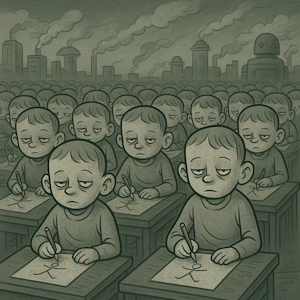
As parents, we all want our children to succeed — to be smart, confident, creative, and capable. In our quiet moments, we sometimes wish: If only my child could be good at everything... if only all kids had the same abilities, life would be so fair, so peaceful.
But would it really?
Imagine a world where every child had exactly the same talents, intelligence, emotional strength, speed, and sensitivity. Everyone could solve math problems, play instruments, build houses, cook meals, write stories, and lead teams — all with equal ease.
Sounds like utopia? Actually, it’s a recipe for disaster.
Let’s unpack why.
1. The Joy of Discovery Would Disappear
In the real world, one of the most beautiful experiences for children is discovering their unique gift — that one thing they shine in. Some love sketching. Some fix electronics. Some can sense emotions. Some can run like the wind.
If everyone had all talents in equal measure, there would be nothing left to find. Every child would be born knowing the same things, doing the same things. No wonder. No curiosity. No excitement.
The process of becoming would be gone.
2. No One Would Need Anyone — And That’s Dangerous
When we live in a world where people have different strengths, we are interdependent. We call the plumber, visit the doctor, buy from the farmer, watch the artist, trust the leader, and comfort the friend.
If everyone had the same talents and capabilities — no one would need anyone.
That may sound liberating, but it’s not. Because need is the glue of human connection. It’s what makes us cooperate, support, and build community.
Without need, society becomes a disconnected crowd of self-sufficient units — lonely, silent, unnecessary to each other.
3. The Economy Would Collapse
Now here’s the hard truth:
If every person could do everything, the economy would collapse.
- No services would be required.
- No specializations would exist.
- There would be nothing to exchange, nothing to sell, and nothing to hire.
Why would a teacher teach, if every child already knows what she knows?
Why would a business exist, if everyone could produce whatever they need themselves?
Money flows because of difference. If there's no gap, there’s no transaction.
If there’s no transaction, there’s no economy.
And without an economy, there’s no movement — only stillness. Stagnation.
4. Purpose Would Fade
Purpose often comes from being able to fill a gap — to do something someone else cannot, and to be of value.
If everyone can do everything, there’s no gap.
So there’s no unique purpose.
In such a world, your child wouldn’t wake up with the thrill of building something meaningful — they’d be stuck in a flat routine of sameness.
Nothing would stand out.
And in time, nothing would matter.
5. Action Would Lose Meaning
Most of our actions today come from responding to lack or imbalance.
- We build because someone needs shelter.
- We heal because someone is sick.
- We teach because someone doesn’t know.
- We grow food because someone is hungry.
But in a perfectly uniform world, no one would lack anything.
Which means — no one would act.
Your child wouldn’t feel the need to help, share, care, or create — because everything is already ‘handled’.
This may sound peaceful. But in truth, it’s lifeless.
6. Jealousy Would Still Exist — Just in New Forms
We might think: ‘If everyone had equal talents, there’d be no envy, no comparison.’
But humans are wired to seek uniqueness.
Even in such a world, new forms of jealousy would appear:
- Who finishes faster?
- Who gets noticed more?
- Who receives more praise?
So the solution isn’t to equalize talent — it’s to teach children to value their differences and appreciate others’ strengths without insecurity.
7. Our Children Would Miss Learning Humility
When a child sees that someone else can do something they can’t — it brings a touch of humility. Not shame — just the gentle realization that others matter too.
A world of equal talent would create ego, not humility.
Your child might never learn to say — I need help — or Thank you for doing this for me.
That’s a dangerous loss.
8. Even Nature Isn’t Equal — So Why Should We Force It?
The Vedas say something profound:
Even your two hands are not equal.
One writes, one supports. One leads, the other follows.
But both work together.
Trying to force equality of ability would go against nature itself.
What children need is not uniformity, but balance.
The strong must uplift the weak. The skilled must teach the unskilled.
That is dharma — not sameness, but shared responsibility.
So What Should Parents Do?
Instead of wishing our children had every talent, we must help them do three things:
- Discover what they’re naturally drawn to
- Accept what they struggle with, without shame
- Respect the talents of others — and learn from them
Here’s how you can support that:
- Let your child fail. It teaches effort.
- Celebrate their strengths without exaggerating.
- Normalize their weaknesses — say, It’s okay, no one’s good at everything.
- Encourage collaboration — Can your friend help you with this?
- Tell stories of people who succeeded by doing what they loved — not what others expected.
Final Thought
Difference is not a flaw. It’s the very engine of human life.
If everyone had the same talent, the world would freeze.
No giving. No helping. No learning.
No economy. No connection.
No purpose. No humility.
Just a grey, mechanical sameness.
So when your child says, Why can’t I be like them? —
Smile and say, Because you were meant to be something they’re not. And that’s beautiful.
- How does the text reframe the concept of human need from a weakness into a societal strength?
The text argues that need is the actual glue of human connection. While society often views self-sufficiency as the ultimate goal, true independence for everyone would result in a disconnected and lonely crowd. It is our lack of certain skills that forces us to cooperate, build communities, and deeply value one another. - What is the overlooked connection between individual limitations and economic survival mentioned in the essay?
The essay points out that the economy relies entirely on the gap between what people can do. If everyone had identical skills and could produce everything they needed, all transactions, services, and trade would cease. Individual limitations are therefore the invisible engine that keeps society moving and prevents economic stagnation. - Why does the author argue that equalizing talent would not actually eliminate jealousy?
Humans are naturally wired to seek uniqueness and differentiation. Even if all inherent talents were made equal, people would still find arbitrary metrics to compare, such as who completes a task faster or who receives more attention. This reveals the hidden truth that jealousy stems from human nature, not just from the unequal distribution of skills. - According to the principles of the text, how is personal purpose inherently tied to the inability of others?
Purpose often derives from filling a void or being of value to someone else. If everyone can do everything perfectly, no one lacks anything, which means no one can step in to help, heal, or build for another. Therefore, our sense of meaning is deeply dependent on the vulnerabilities and missing skills of those around us. - How does the presence of diverse talents foster humility rather than shame in children?
When a child realizes they cannot do something that another person can, it gently teaches them that others have immense value too. This natural limitation forces the ego to step back, allowing the child to ask for help and express gratitude, which are essential components of genuine humility. - What is the core flaw in the utopian wish for all children to be equally gifted?
The core flaw is equating equality of ability with fairness and peace. The text exposes this wish as a recipe for a lifeless, mechanical sameness where the joy of self-discovery, the thrill of overcoming challenges, and the beauty of human cooperation are completely erased. - How does the text use the metaphor of human hands to explain the principle of dharma?
The essay notes that even our two hands are unequal, with one naturally leading and the other supporting. This reflects a broader natural law, or dharma, which is not about forcing sameness, but achieving balance through shared responsibility. The strong uplift the weak, and the skilled guide the unskilled, mimicking the natural harmony of the universe. - In a world of absolute equality and self-sufficiency, why would human action lose its meaning?
Most human actions are responses to a lack or an imbalance, such as building shelter for the exposed or growing food for the hungry. If everyone were equally capable and lacked nothing, the motivation to help, create, or share would disappear, leaving a stagnant world devoid of meaningful action. - How does the essay suggest parents shift their perspective on their child's weaknesses?
Instead of wishing for a child to be good at everything, parents should view weaknesses as normal and necessary. By accepting what a child struggles with and encouraging them to seek help from friends, parents teach them to respect the talents of others and understand that no single person is meant to be entirely self-sufficient. - What is the profound realization a child should have when they ask why they cannot be like someone else?
The child should understand that their differences are not flaws, but their unique contribution to the world. They were meant to be something others are not, and this very difference is what makes them necessary, beautiful, and highly valuable to the human experience.






Children's Section
Parenting
Click on any topic to open
7
30
Astrology
Bhagavad Gita
Bhagavatam
Bharat Matha
Devi
Devi Mahatmyam
Ganapathy
Garuda Puranam
Glory of Venkatesha
Hanuman
Kathopanishad
Mahabharatam
Mantra Shastra
Mystique
Practical Wisdom
Purana Stories
Radhe Radhe
Ramayana
Rare Topics
Rigveda Explained
Rituals
Sages and Saints
Shiva
Spiritual books
Sri Suktam
Story of Sri Yantra
Temples
Vedas
Vishnu Sahasranama
Yoga Vasishta
26
17
10
0


