Vinobaji’s Character and His Mother’s Role
We are looking at the Indian values to be inculcated in children.
One of them is Ahimsa.
We first saw what is Himsa and how Himsa can corrupt oneself. Being violent or aggressive is more harmful to oneself than the victim of such violence or aggression.
We also saw what Yoga Shastra says about Ahimsa. If you practice Ahimsa, you can even change the environment around you.
Ahimsa is not just a reaction — how you should behave when facing a situation which brings anger or rage in you, or not even how you should react when facing violence or aggression yourself.
Ahimsa is your whole approach to life.
Acharya Vinoba Bhave narrates two incidents from his life.
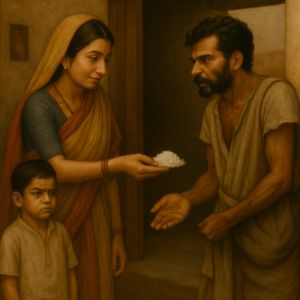
His mother was an ardent practitioner of Ahimsa. She used to give alms whenever a beggar came to their doorstep.
One day, during his youth, one such beggar came. He was looking healthy, hail, and hearty. The mother gave him bhiksha and sent him away.
After the beggar left, Vinobaji started counselling his mother.
That man looks perfectly normal. Don’t do this. This is not good. He should work and earn for himself. He must be lazy to work. Don’t encourage this. If food is available for free, people will become lazy. This is not good for the nation also.
You are a religious person. Won’t you respect what Lord Krishna has said in Geeta?
देशे काले च पात्रे च तद्दानं सात्विकं स्मृतम्
Right place, right time, and deserving person — only such dana is satwika — will yield good results.
This man doesn’t look deserving.
The mother said:
But who are we to decide who is deserving and who is not deserving?
I don’t have knowledge to decide who is deserving and who is not deserving.
For me, it is simple — if God sends someone to my doorstep, then he is deserving.
I don’t know anything beyond that.
This transformed the whole thinking of Vinobaji. He was so much influenced by this statement.
Isn’t it true — do we really have the wisdom to arrive at such conclusions, to be judgemental?
See the role of the mother in the life of such a great person.
This is the role that every mother has in a child’s life, every father has in the child’s life.
Much later, in Vinobaji’s ashrama, a boy — one of the inmates — was caught smoking beedi. He was hiding and smoking beedi. He was brought before Vinobaji.
Smoking was not permitted.
Vinobaji said:
Don’t you know that smoking is bad for your health?
More than that — why are you hiding and smoking?
This dishonesty will do more harm to you than your smoking.
Then he told the other people:
This boy has already picked up this habit.
He won’t be able to stop all of a sudden.
We will have to slowly take him out.
For the time being, provide him with a secluded place where he can smoke without harming others, and also a limited supply of beedis.
We will get him out of this slowly.
This is Ahimsa.
Compare this with some of the school teachers.
Four or five-year-old child — they will call the parents to open house and paint a picture as if the child is a criminal.
He is distracting other children.
He has no discipline.
He uses abusive words.
He doesn’t write.
He doesn’t read.
Madam, isn’t this what we have sent the child to the school for?
We are paying you the hefty fees for.
Isn’t this your job?
Moulding the child’s character — isn’t this your responsibility?
Isn’t this what you say in your advertisements and pre-admission sessions?
The child is spending most of the time with you, hardly any time with us.
Who is going to influence the child more — you or us?
This is what you as parents should be asking such teachers.
Compare these kinds of teacher’s attitude with Vinobaji here.
As parents, you should understand this.
So, not just reputation of the school, not just comforts and facilities — pay equal attention to how the child is treated in the school. What is their approach?






Children's Section
Parenting
Click on any topic to open
7
30
Astrology
Bhagavad Gita
Bhagavatam
Bharat Matha
Devi
Devi Mahatmyam
Ganapathy
Garuda Puranam
Glory of Venkatesha
Hanuman
Kathopanishad
Mahabharatam
Mantra Shastra
Mystique
Practical Wisdom
Purana Stories
Radhe Radhe
Ramayana
Rare Topics
Rigveda Explained
Rituals
Sages and Saints
Shiva
Spiritual books
Sri Suktam
Story of Sri Yantra
Temples
Vedas
Vishnu Sahasranama
Yoga Vasishta
26
17
10
0


