How Much Pleasure Can You Enjoy?
Everybody is in pursuit of pleasure.
Some are in pursuit of physical pleasure – Vishaya Sukha.
Some are in pursuit of spiritual pleasure – Brahmananda.
Veda says – the Parabrahma is nothing but Ananda – Anando Brahmeti Vyajanat.
The destination of all spiritual pursuits is this Ananda – nothing but Ananda.
So the spiritual people are also pleasure seekers.
You need not think that Brahmananda is a different kind of pleasure.
It is only a much higher kind of pleasure.
The level of pleasure a man can enjoy while being in the body is limited.
You go to a countryside wayside hotel – the menu is limited – the taste also may not be great.
It just satisfies your hunger.
Then you go to a food festival.
You get all kinds of delicacies there.
The sensation that your tongue gets and also the pleasure that your mind gets
by taking food at these two places are different in terms of grade.
The first one is ordinary taste.
The second one is a treat for your taste buds.
The first one the pleasure is small.
The second one the pleasure is much higher.
So this gradation of the pleasure that you get is based on the external object which is stimulating the sensory organ called tongue.
Now there is another thing.
Your body has a limit.
It has a maximum limit up to which it can enjoy a pleasure.
Even in pain – there is an upper limit up to which you can experience pain.
Beyond that it goes into numbness.
Beyond a certain limit, if the pain is more than that, then you will not even feel it.
Just like everything else, pain also works in a range.
There is a lower range which is called pain threshold below which you will not feel the pain.
Above the upper limit also there is no pain.
Modern medicine gives a pain rating scale 0 to 10 – the extent of pain.
10 means the worst, the highest.
This is the limitation of the human body.
Same for pleasure also.
There is a lower and upper limit.
युवा स्यात् साधु युवा अध्यायकः
आशिष्ठो दृढिष्ठो बलिष्ठः
तस्येयं पृथिवी सर्वा वित्तस्य पूर्णा स्यात्
स एको मानुष आनन्दः
A youngster, healthy, strong, educated, active, wealthy, with access to all kinds of resources –
Whatever is the highest pleasure he can get in this world – take that as one.
This is the highest.
If you stimulate him more than this, his sensory organs won’t read,
his brain won’t read, his mind won’t read.
This is the cap.
It is like an upper cap of your digital wallet or bank account –
You can’t put more money into it than the upper cap.
So take this pleasure as one.
ये ते शतं मानुषा आनन्दाः
स एको मनुष्यगन्धर्वाणामानन्दः
Gandharvas are higher beings compared to humans.
They are at a higher plane of evolution.
In Gandharvas also there are many categories.
The category called Manushya Gandharvas – they were humans earlier and attained Gandharva-hood through noble deeds.
Manushya Gandharvas can enjoy pleasure 100 times more than humans.
Their sensitivity to pleasure is 100 times that of humans.
The level of pleasure that is not available to a human being – that is available to them – 100 times more.
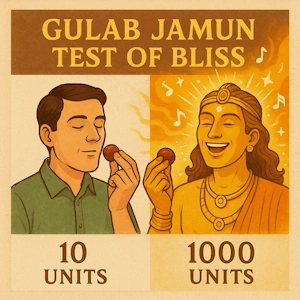
Let’s say – take two gulab jamuns – the best, you won’t be able to make it better than that – the perfect gulab jamun, identical two pieces.
One piece, a man puts in his mouth.
The other piece, a Manushya Gandharva puts in his mouth.
Let’s say the man gets a pleasure of 10 units out of it.
The same gulab jamun will generate a pleasure of 1000 units in the Manushya Gandharva.
Do you get it?
This is the sensitivity.
Some people can even tell the ingredients of a dish by tasting it.
There are tea tasters.
They are much more sensitive to taste.
Similarly, the Manushya Gandharvas can enjoy pleasure 100 times more than humans.
ये ते शतं मनुष्यगन्धर्वाणामानन्दाः
स एको देवगन्धर्वाणामानन्दः
Deva Gandharvas are born Gandharvas at the time of creation itself.
In the administrative service, there are two kinds of IAS –
Those who enter service as IAS from day one – they clear UPSC exam, get trained in the academy and from day one they join service as IAS.
Then there are promotee IAS – some due to their merit and quality get promoted as IAS after a long service.
This is the difference between Deva Gandharvas and Manushya Gandharvas.
Deva Gandharvas are Gandharvas from day one.
Manushya Gandharvas are promotee Gandharvas.
Deva Gandharvas can enjoy pleasure 100 times more than Manushya Gandharvas.
In the same way – those Pitrs who are in Chiraloka, not the ones who are your forefathers –
They are the original forefathers of Devas, Gandharvas from where they all originated.
Their level of pleasure, that they can enjoy, is 100 times that of Deva Gandharvas.
Beyond this there is a category of Devas called आजानजाः –
They are Devas right from the time of creation.
They can enjoy pleasure 100 times more than the previous category.
Be clear that this is not about availability of pleasure-giving objects.
It is about how much pleasure the same object can give to each category.
There are Karma Devas – those who have become Devas by their meritorious deeds such as performing yajna.
Karma Devas’ level of pleasure that they can enjoy is 100 times that of Ajanaja Devas.
Above Karma Devas are the Devas who are 33 in number – they are just Devas.
Their level of pleasure sensitivity is 100 times that of Karma Devas.
These are classifications – Ajanajah, Karma Devas, Regular Devas.
You should appreciate how much depth the scriptures go into.
Indra can enjoy 100 times more than Devas –
ये ते शतं देवानामानन्दाः स एक इन्द्रस्यानन्दः
Devaguru Brihaspati’s level of pleasure is 100 times that of Indra.
Prajapati’s Ananda is 100 times that of Brihaspati.
And Brahma’s Ananda is 100 times that of Prajapati.
It is Brahma – the creator Brahma –
स वै शरीरी प्रथमः स वै पुरुष उच्यते
आदिकर्ता स भूतानां ब्रह्माऽग्रे समवर्तत
Brahma is the created world.
Brahma’s pleasure is the ultimate pleasure that is available in the created world.
He enjoys the sum total of all pleasures in the world.
But even Brahma is not pleasure itself.
He is an enjoyer of pleasure.
Creator Brahma and Ananda are two different things.
Ananda is something that Brahma enjoys.
It is like a stimulus for him.
But Parabrahma is Ananda itself.
Paramatma is Ananda itself.
A part of which only even creator Brahma enjoys.
The destination of the spiritual seeker is to become this Ananda itself.
But very interestingly, at every stage of these mantras, Taittiriya Upanishad also says –
श्रोत्रियस्य चाकामहतस्य
All these levels of pleasure are available to the Shrotriya, the one who has Shruti with him – Vedic knowledge with him – and also has no desires.
When you have desires, you are limiting yourself.
You see – 'I want this' also means 'I want only this much, not more.'
This is the advantage of relinquishing desires.
At the end of every mantra this is repeated – श्रोत्रियस्य चाकामहतस्य
Means it is a progressive path.
Not one static state.
Not that 'I have learned the Veda, and I have reached the highest state.'
The Shrotriya, as he realizes more and more and relinquishes desires more and more –
Progressively, the higher levels of Ananda are made available to him.





English
Vedas
Click on any topic to open
7
30
Astrology
Bhagavad Gita
Bhagavatam
Bharat Matha
Devi
Devi Mahatmyam
Ganapathy
Garuda Puranam
Glory of Venkatesha
Hanuman
Kathopanishad
Mahabharatam
Mantra Shastra
Mystique
Practical Wisdom
Purana Stories
Radhe Radhe
Ramayana
Rare Topics
Rigveda Explained
Rituals
Sages and Saints
Shiva
Spiritual books
Sri Suktam
Story of Sri Yantra
Temples
Vedas
Vishnu Sahasranama
Yoga Vasishta
26
17
10
0


