How Lineages Started
There are millions of beings—plants, trees, animals, insects, birds, and humans. Describing the process of creation for all these is very difficult.
At the beginning of the Mahabharata, a small part of this is described to show how lineages started. Surya’s son was Devabhrat. Devabhrat’s son was Subhrat. Subhrat had three sons—Dashajyoti, Shatajyoti, and Sahasrajyoti. Dashajyoti had 10,000 sons, Shatajyoti had 1 lakh sons, and Sahasrajyoti had one million sons. All the vamshas, like Kuru vamsha, Yadu vamsha, and Ikshvaku vamsha, started from these lineages.
One natural question that comes up is: where are all the women? How can there be a lineage without women? Today, we look at a human being as half father, half mother. In the earlier stages of creation, this was not the case. The male was considered the primary procreator, with the beejas or seeds in his possession. These seeds could germinate in any field, one of them being the female womb. Seeds could germinate in any appropriate field, not necessarily a female womb.
Asexual reproduction is known in biology, where reproduction happens without the need for a male-female union. We also know about cloning. So, when we say that Sahasrajyoti had one million sons, it is obvious that we are not talking about reproduction through male-female union.
A similar question arises about whether Saraswathy is the daughter or patni of Brahma. One must think out of the box and not interpret these concepts strictly by today’s understanding. There are many other possibilities. That is what we should understand.
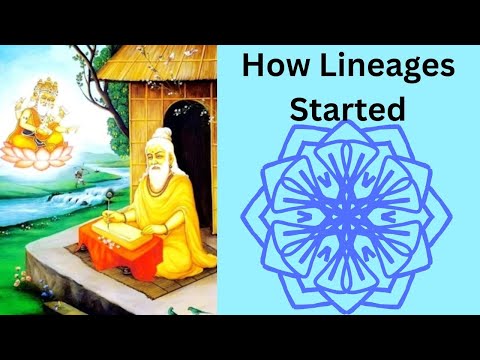
As Vyasa Maharshi was meditating, all these revelations flashed through his mind—how it all came into existence, how all the vamshas came into being, all the beings, movable and immovable; the Vedas; secrets of the purusharthas; all the shastras; all the advice; even Yoga-shastra, Ayurveda, Dhanurveda, and all kinds of knowledge. He saw all this within himself while meditating and put it all down in the Mahabharata. That is why the Mahabharata is considered a complete scripture. It is not about one thing; it is about everything.
There are several traditions connected to the Mahabharata. Some say it starts with 'नारायणं नमस्कृत्य,' while others say it starts from Astika Parva. Whatever it is, the Mahabharata is the result of Vyasa Maharshi's tapas and brahmacharya.
After he conceived the Mahabharata, Vyasa began wondering, 'How am I going to propagate this among people?' At that time, Brahmadeva came to Vyasashrama. Vyasa Maharshi told Brahmadeva:
'I have seen the principles of the Vedas and all shastras, principles of all Vedangas, Upanishads; they have all been understood by me. Historic incidents, Puranas—I have understood everything from a refined and pure perspective. I have understood what time is. I have understood whether old age, diseases, death, and fear are real or not. All dharmas, including varnashrama dharma, are clear to me. Astronomy, cosmic chronology, everything I have seen and known. Justice, education, medicine, vratas, the reasons for taking birth as a human, an animal, or a bird, the reasons for becoming a Deva—everything I know now. I know all about holy tirthas, mountains, rivers, seas, and forests. Battle science, architecture—everything I have seen and conceived within myself. But who can ever write all this down? Unless these are written down and propagated, they will only remain within me. They cannot be used for the welfare of the world.'
Vyasa Maharshi shared this with Brahmadeva.





English
Mahabharatam
Click on any topic to open
7
30
Astrology
Bhagavad Gita
Bhagavatam
Bharat Matha
Devi
Devi Mahatmyam
Ganapathy
Garuda Puranam
Glory of Venkatesha
Hanuman
Kathopanishad
Mahabharatam
Mantra Shastra
Mystique
Practical Wisdom
Purana Stories
Radhe Radhe
Ramayana
Rare Topics
Rigveda Explained
Rituals
Sages and Saints
Shiva
Spiritual books
Sri Suktam
Story of Sri Yantra
Temples
Vedas
Vishnu Sahasranama
Yoga Vasishta
26
17
10
0


