How Lakshmi Devi Occupied the Chest of Sri Hari
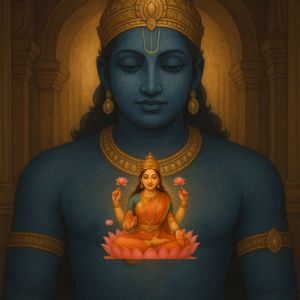
When the churning started, all the lotuses that were in the milky ocean had disappeared. Now, all the devas are lined up on the banks of the milky ocean, the 33 crore devas. They are standing there with folded hands in anjali mudra, yearning for a kataksha from you. It looks as if those lotuses that disappeared from the milky ocean are ready to blossom again on its banks. The devas were all standing there with their palms in anjali mudra like lotus buds about to blossom.
Just imagine the grand scene.
Sri Hari was right in front of her, about to accept her as his prana vallabha. They were facing each other. There was no limit to the joy of Ksheera Sagara, Mata’s father, seeing his daughter and the prospective bridegroom, the lord of the universe. Ksheera Sagara himself got immersed in ananda sagara seeing this divine scene.
And she playfully went and occupied the vakshasthala of Sri Hari.
There were devas and rishis and crores and crores all around. There was no shyness on her face, there was no blush on her face. Why should she be shy, they were all her children, they were all babies for her. But the blush was on the waves of Ksheera Sagara – a reddish hue of shyness, like Ganga. And the shyama varna of Sri Hari – the bluish hue of Yamuna. And mother’s own golden brilliance – like Saraswathy. It looked as if the Triveni Sangam of Ganga, Yamuna and Saraswathy was happening then and there.
निकषे हेमरेखेव श्रीरासीदनपायिनी says Raghuvamsha.
And on Sri Hari’s vakshasthala, here she looks like a golden line on blue granite stone. And she does not move from there. That is her permanent position.
Her kataksha gives more than what you ask for. You ask for ten, she gives hundred. You ask for hundred, she gives thousand. That is her nature.
Not only Goddess Lakshmi, her father Ksheera Sagara is Sri Hari’s resting place. Her brother Chandra is one of his eyes – Surya and Chandra are his two eyes. Another brother, Kaustubha, adorns his chest. She occupies his chest. The whole family is his favorite it seems.
Why does Lakshmi occupy his chest? So that Sri Hari does not develop any anger towards us offenders, sinners, humans. She is there to soften him where the anger is likely to arise itself.
Among the five pranas – prana, apana, vyana, udana and samana, the position of prana is the heart, the chest. Being the prana vallabha, as dear as prana to Sri Hari, Mata also occupies his heart.
Her original seat is the tender lotus, quite befitting her tender beauty. She has left that seat and has occupied the hard vakshasthala of Sri Hari. Why hard? Because you see that Sri Hari is constantly engaged in battle with the evil for protecting dharma, and being in the battleground his stature is that of a strong powerful commander. His chest is hard, moreover the hard Kaustubha mani is also there. Mata occupies the hard chest for the welfare of her devotees, for their protection.
Sri Hari’s greatness is incomparable. He encompasses the entire universe, and she is seated on top of him. He is there inside every being, and she is there in his heart. What should be her greatness?
Lakshmi Devi is apparently a little jealous of anyone else getting close to Sri Hari and a little suspectful of Sri Hari’s popularity among women. Once she even cursed him.
Sri Hari was just looking at her and smiling at her, for no reason. She thought, oh he must have got somebody else, he is making fun of me. And she cursed him, that let his laughing head fall off. Exactly that happened. Sri Hari’s head was once cut off and was replaced by a horse’s head, and he became Hayagriva.
This was a leela played by the divine couple, to kill a demon who also had the name Hayagriva – Hayagrivasura. Hayagrivasura had got the boon that only another Hayagriva can kill him. And Sri Hari became another Hayagriva for this. Haya means horse. Hayagriva means one who has horse’s head.
But however, Sri Hari is always very careful after this cursing incident. So out of all the gems, he wears only Kaustubha on his chest. If it is some other gem and the goddess sees her own reflection on it and takes it for another woman, not to take risk. Kaustubha is her own brother, she will be relaxed.
-
Why is the chest the chosen place for Lakshmi?
Because the chest is the seat of prana. Placing compassion at the source of life ensures mercy governs power before anger even arises. -
What does leaving the lotus for a hard chest signal?
Duty over comfort. She chooses strength and protection for devotees over personal ease, proving love acts where it matters most. -
How do tenderness and absolute power work together?
They are complementary. Power sets order; tenderness directs it toward care. Without compassion, power harms; with compassion, it heals. -
Why link ocean, moon, and gem to one form?
To show a complete system: rest (ocean), clarity (moon), and unshakable value (gem). Harmony comes when these align around the divine center. -
What is the point of portraying divine jealousy?
It humanizes the relationship and teaches vigilance: guard love, remove causes of misunderstanding, and convert emotion into protection. -
How can a curse become a solution?
Through leela. A constraint forces a new form precisely fitted to defeat evil. What looks like a setback becomes the instrument of victory. -
Why say her glance gives more than asked?
Grace is surplus by nature. Effort matters, but results overflow when aligned with grace. Ask with trust; accept with humility. -
Why does one gem stay on the chest?
To prevent confusion and preserve peace. Symbols can set boundaries that protect relationships. Choose reminders that keep hearts calm. -
What leadership lesson sits here?
Wear compassion on your chest. Keep a visible check on anger at its source. Let every decision pass through mercy before action. -
Why evoke a confluence of three rivers?
It teaches balance: purity, calm strength, and luminous wisdom flowing together. A life thrives when these three meet within. -
What does ‘prana vallabha’ teach about love?
True love equals life itself. It is not an accessory; it regulates breath, motive, and action. Keep love at the core, not the edge. -
How should a devotee respond to this vision?
Place remembrance at heart level, serve with steadiness, and let compassion be your first impulse. Protection follows alignment. -
What is the larger philosophical message?
The universe stands when strength submits to compassion. Order is sustainable only when mercy sits at its center.





English
Vishnu Sahasranama
Click on any topic to open
7
30
Astrology
Bhagavad Gita
Bhagavatam
Bharat Matha
Devi
Devi Mahatmyam
Ganapathy
Garuda Puranam
Glory of Venkatesha
Hanuman
Kathopanishad
Mahabharatam
Mantra Shastra
Mystique
Practical Wisdom
Purana Stories
Radhe Radhe
Ramayana
Rare Topics
Rigveda Explained
Rituals
Sages and Saints
Shiva
Spiritual books
Sri Suktam
Story of Sri Yantra
Temples
Vedas
Vishnu Sahasranama
Yoga Vasishta
26
17
10
0


