How Gau Seva Guided Her Final Journey
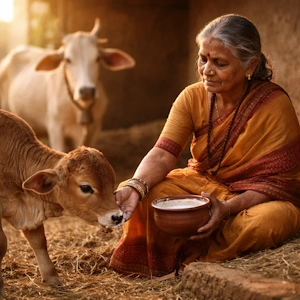
In a quiet town lived a devoted couple, both deeply rooted in dharma and service. The husband, a learned vaidya, spent his life healing others. His wife, Gangabai, was known for her unwavering dedication to gau seva — serving and protecting cows with love and reverence.
One day, something unusual happened.
Gangabai calmly told her husband, ‘My time in this body is coming to an end.’
The vaidya was startled. He examined her carefully and said, ‘You are perfectly healthy. There is no sign of illness. Do not think like this.’
But Gangabai did not argue. She simply smiled.
Days passed. Then weeks. Again she repeated, ‘My departure is near.’
This time, her husband grew concerned. He trusted his knowledge, yet something in her voice carried quiet certainty. Still, he dismissed it, thinking it was only her imagination.
Two months later, Gangabai spoke again. This time, her words were firm.
‘On this day, at this time, I will leave.’
Now even the husband fell silent.
The day arrived.
There was no sickness. No weakness. No pain.
Yet, as the hour approached, Gangabai sat peacefully, her mind steady, her face glowing with calmness.
Curious and anxious, the husband asked, ‘How can this happen? You are healthy. How do you know all this?’
Gangabai gently replied,
‘This is the fruit of serving cows with a pure heart. I feel something calling me. I see beings coming. I see a path opening. And I feel protected… as if the very cows I served are now guiding me.’
She paused, then continued,
‘They are surrounding me, protecting me, leading me. There is no fear. Only peace.’
Then she gave her final instructions.
She said, ‘Bring curd in a clay pot. Feed it to the calf.’
Her husband followed her words.
Then she said, ‘When my mother comes and cries, do not let her lose herself in grief. Tell her to chant Ram or Om. Let her mind stay steady.’
Everything was done exactly as she wished.
She then sat quietly, remembering Bhagavan, her breath slow and gentle.
And just like that… she left.
No struggle. No fear. No confusion.
Only stillness.
The house was silent.
The husband stood there, humbled. All his knowledge could not explain what he had just witnessed.
But one truth became clear.
A life lived in simple, sincere seva carries a power beyond logic.
It purifies the mind, steadies the heart, and prepares the soul.
Gangabai did not just serve cows.
She served with faith. With love. Without expectation.
And in return, at the final moment, she did not walk alone.
She was guided.
She was protected.
She was received.
Simple lesson.
What you serve with sincerity… will stand by you when nothing else can.
Question 1: What is the central spiritual principle demonstrated through the life and departure of Gangabai?
Answer: The central principle is the transformative power of selfless service. By serving living beings without expectation, she purified her consciousness. This immense purity granted her absolute clarity, detachment from the physical body, and a peaceful transition, showing that true, selfless service acts as the ultimate spiritual anchor.
Question 2: How was it possible for Gangabai to predict the exact time of her passing despite being physically healthy?
Answer: In deep spiritual traditions, when a person's mind becomes entirely free from material attachments, their intuitive perception awakens. Gangabai was attuned to the subtle life force within her. She did not rely on physical symptoms but on an inner spiritual clock, sensing the completion of her earthly duties and the natural withdrawal of her vital energy.
Question 3: What does the husband's reaction signify regarding the contrast between spiritual reality and material knowledge?
Answer: The husband represents empirical science and logic. As a healer, he looked exclusively for physical signs of decay or disease. His inability to diagnose or understand her departure highlights the limitation of purely material knowledge. It reveals the secret that spiritual milestones and the journey of the soul operate on laws that entirely transcend physical medical science.
Question 4: What is the deeper mystery behind Gangabai feeling protected and guided by the cows during her final moments?
Answer: On a mystical level, the entities we serve with pure love become our spiritual allies. The collective consciousness and gratitude of the beings she nurtured formed a subtle, protective shield around her. The mystery is that energy given in pure service takes a conscious form in the unseen realms, guiding the soul through unknown dimensions and eliminating the fear of the unknown.
Question 5: Why did Gangabai experience no fear, struggle, or confusion at the time of death?
Answer: Fear of death usually arises from profound attachment to the body, unfulfilled material desires, and ignorance of what lies ahead. Gangabai had dedicated her entire life to dharma, leaving no unfulfilled selfish desires. Her constant focus on the divine and her selfless actions anchored her identity in the eternal soul rather than the temporary physical body.
Question 6: What is the hidden significance of her instruction to feed curd to a calf right before her passing?
Answer: Feeding the calf represents the continuation of dharma and compassion even as one leaves the physical world. Curd represents auspiciousness, nourishment, and the culmination of the milk cycle, symbolizing the perfect completion of her life's work. It was her final act of connection to the divine, ensuring her transition was sealed with an act of pure giving.
Question 7: What is the spiritual secret behind her instruction regarding her mother's grief?
Answer: Grief and intense lamentation create heavy, dense emotional vibrations that can tether or disturb a departing soul. By asking her mother to chant divine names, Gangabai ensured that the environment remained spiritually elevated and calm. Chanting shifts the focus from the loss of the physical body to the eternal nature of the divine, aiding a smooth and upward transition for the soul.
Question 8: How does a pure heart act as a bridge to the unseen realms, as experienced by Gangabai?
Answer: A pure heart is entirely free from the noise of ego, selfish desires, and material anxieties. This inner emptiness creates a receptive vessel for divine grace and higher perception. The secret revealed here is that intuitive vision is not achieved through rigorous mental effort, but by clearing the heart through selfless action, which naturally dissolves the veil between the physical world and the spiritual dimension.
Question 9: What does Gangabai's peaceful passing reveal about the ultimate concept of death in spiritual philosophy?
Answer: It reveals that death does not have to be an involuntary, painful event inflicted upon a person by disease or old age. For a spiritually awakened individual, it can be a conscious, voluntary shedding of the physical body. It is a graceful and deliberate transition, simply moving from one state of existence to another without breaking the continuity of consciousness.
Question 10: How does the story explain the ultimate reward of absolute sincerity?
Answer: The story reveals that the ultimate reward of devotion is not material wealth or worldly recognition, but spiritual companionship and absolute protection at the most crucial moment of existence. The profound secret is that whatever you serve with absolute sincerity merges with your consciousness, taking form to stand by you when all physical relationships and material possessions fade away.
Objection 1: Human beings cannot predict their own death without an underlying physical disease. It is medically impossible.
Reply: While medical science relies entirely on observable physical decline, spiritual traditions recognize the subtle body and life force. A person deeply attuned to their inner self can intuitively sense the withdrawal of this life force long before physical symptoms manifest. It is not a medical diagnosis, but an intuitive recognition of the completion of one's natural life span.
Objection 2: Feeling guided by animals or unseen beings is just a hallucination caused by a dying brain.
Reply: Hallucinations caused by a dying brain are typically accompanied by confusion, distress, agitation, or physical trauma. Gangabai was completely lucid, calm, and physically healthy. Her experience of guidance was highly orderly and brought profound peace, which aligns with spiritual visions of higher consciousness rather than chaotic neurological misfiring.
Objection 3: The husband failed as a doctor by not seeking further medical intervention when she talked about dying.
Reply: The husband did examine her carefully and found absolutely no illness to treat. True healing involves understanding the patient as a whole. When he recognized her profound lucidity, physical health, and unwavering spiritual resolve, he respected her autonomy. Intervening medically in the total absence of disease would have been illogical and deeply disruptive to her peace.
Objection 4: Serving animals does not magically grant someone a peaceful death. Death is purely a biological process.
Reply: While death is a biological event, the experience of dying is deeply psychological and spiritual. Serving others with absolute selflessness rewires the mind, reducing ego, greed, and attachment. This psychological purity naturally leads to a peaceful state of mind, which directly impacts how peacefully one experiences the final biological transition.
Objection 5: Asking a mother not to cry is cruel and suppresses natural human emotions.
Reply: She did not ask her mother to suppress emotion, but to channel it into a higher spiritual practice. In moments of profound transition, uncontrolled grief can cause immense distress to both the living and the departing. Redirecting the mind to divine names provides profound comfort, inner strength, and a constructive, uplifting way to process sudden loss.
Objection 6: The idea that feeding curd to a calf affects a dying person is mere superstition and holds no logical value.
Reply: Sacred rituals are symbolic actions that focus the mind and intent. Feeding the calf was not a magical spell, but a final, deliberate act of compassion and grounding in her life's purpose. It represented the unbroken chain of harmony with nature, bringing a profound sense of ultimate closure and spiritual fulfillment to her mind before departing.
Objection 7: This is just a story designed to promote a specific religious agenda regarding the worship of cows.
Reply: While the narrative features the service of cows, the underlying psychological and spiritual principle is universal. Whether one serves humanity, nature, or animals, the mechanics remain exactly the same. Selfless service cultivates inner peace, detachment, and fearlessness, which are universally recognized virtues across all major philosophical traditions.
Objection 8: If a person can just decide to die while healthy, it is essentially giving up on life, which is unnatural and defeatist.
Reply: Giving up implies despair, depression, or an attempt to escape suffering. Gangabai did not escape suffering, as she had none. A conscious departure is about recognizing the natural end of one's earthly journey with immense gratitude and readiness. It is an embrace of the natural cycle of existence, not a rejection or defeat of life.
Objection 9: The husband was simply romanticizing her sudden, unexplained medical failure after the fact to cope with his sudden loss.
Reply: The husband was a trained healer equipped to recognize sudden medical failures like heart attacks or strokes, which involve pain or struggle. Her passing was preceded by months of calm forewarning, specific timing, and final instructions, followed by a completely conscious exit. Such an exact sequence of events defies random medical failure, pointing instead to a deliberate process.
Objection 10: Believing that good deeds will stand by you at death is just a psychological coping mechanism to deal with the terrifying reality of mortality.
Reply: Even if viewed strictly from a psychological perspective, living a life of sincere service leaves a person with absolutely no regrets and a deep sense of completed purpose. This fulfillment naturally removes the fear of mortality. Therefore, whether viewed as a psychological coping mechanism or a profound spiritual truth, the end result is exactly the same: a fearless, dignified, and perfectly peaceful end.





English
Rare Topics
Click on any topic to open
7
30
Astrology
Bhagavad Gita
Bhagavatam
Bharat Matha
Devi
Devi Mahatmyam
Ganapathy
Garuda Puranam
Glory of Venkatesha
Hanuman
Kathopanishad
Mahabharatam
Mantra Shastra
Mystique
Practical Wisdom
Purana Stories
Radhe Radhe
Ramayana
Rare Topics
Rigveda Explained
Rituals
Sages and Saints
Shiva
Spiritual books
Sri Suktam
Story of Sri Yantra
Temples
Vedas
Vishnu Sahasranama
Yoga Vasishta
26
17
10
0


