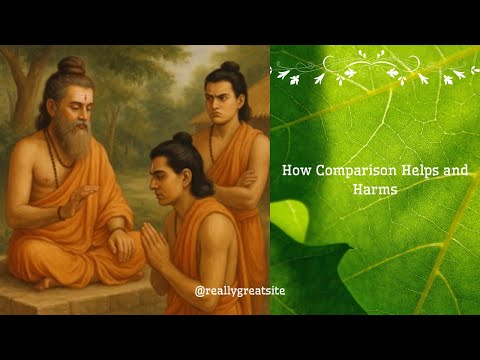
How Comparison Helps and Harms
1. The Nature of Comparison
Comparison is built into the human mind. The moment you perceive something, your intellect starts measuring — bigger than, smaller than, better, worse. This constant evaluation once had a purpose: it helped our species survive. Over time, it turned into a double-edged sword — sharpening intellect but wounding contentment.
2. Evolutionary Roots of Comparison
In early human history, comparison wasn’t emotional — it was practical. Our ancestors survived by comparing signs and outcomes:
-
Which fruit looked ripe?
-
Which path was safer?
-
Which hunter was stronger to follow?
This pattern-recognition through contrast built learning, imitation, and cooperation — the very foundations of civilization. Without it, no tool, no tribe, no progress.
Even in social structures, comparison helped establish order — leaders and learners, teachers and disciples. The problem began when factual observation turned emotional. Why does he have more than me? Why not me? That shift created matsara — envy, the corrosion of clarity.
3. How Comparison Helps
-
Discernment (Viveka):
The mind’s power to compare lets us separate truth from falsehood, dharma from adharma. Healthy comparison sharpens judgment.
Example: Arjuna’s questioning on the battlefield wasn’t jealousy — it was moral comparison leading to wisdom. -
Aspiration (Utsaha):
Seeing excellence can inspire you to rise. This is sad-matsara — noble envy — when you admire someone’s virtue and want to embody it. -
Self-Correction (Atma-pariksha):
Comparison with your past self keeps the ego in check. It helps measure spiritual growth without creating rivalry.
4. How Comparison Harms
-
Birth of Matsara:
When comparison turns personal — he is better, I am lesser — it becomes poison. Matsara consumes peace and blocks progress. -
Loss of Santosha (Contentment):
The Bhagavad Gita calls contentment an inner wealth. Constant comparison drains it, feeding greed and restlessness. -
Ego Trap:
Comparison feeds superiority and inferiority, both equally binding. Pride inflates; self-pity paralyzes. -
Deviation from Swadharma:
Each person has a unique dharma. Comparing your path with another’s is like comparing the moon’s light to the sun’s — pointless and distracting.
5. Matsara in Sanatana Dharma
Among the six inner impurities (shadripus) — kama, krodha, lobha, moha, mada, matsara — envy is the most subtle. It is sorrow at another’s joy, joy at another’s sorrow. Bhagavata Purana opens by declaring that Bhakti is only for the nirmatsara — those free from envy.
A jealous heart cannot hold devotion; love and rivalry cannot breathe the same air.
6. From Survival of the Body to Survival of the Spirit
In the animal stage, comparison ensured outer survival. It taught adaptation.
In the human stage, it must now ensure inner survival. It must evolve into discernment, self-awareness, and humility.
What was once a weapon for hunting must now become a mirror for truth.
A mind enslaved to comparison lives in fear.
A mind purified of matsara lives in freedom.
7. The Dharmic Transformation
Sanatana Dharma never asks you to suppress comparison; it asks you to sanctify it.
-
Instead of Am I better than him? — ask Am I truer to my dharma than I was yesterday?
-
Instead of He has more than me — ask What karma and guna led to this, and what can I learn?
When comparison fuels learning, it uplifts; when it fuels jealousy, it corrupts.
8. The Inner Practice
-
Cultivate Santosha — joy in your dharma.
-
Practice Maitri — delight in others’ success.
-
Engage in Atma-pariksha — compare only with your own past.
-
Deepen Bhakti — when you see all as Bhagavan’s expressions, rivalry dissolves.
In Essence
Comparison once kept humans alive; now it must keep them awakened.
Matsara is the leftover shadow of evolution — useful once, dangerous now.
When guided by dharma, comparison becomes discernment; when ruled by ego, it becomes decay.





English
Practical Wisdom
Click on any topic to open
7
30
Astrology
Bhagavad Gita
Bhagavatam
Bharat Matha
Devi
Devi Mahatmyam
Ganapathy
Garuda Puranam
Glory of Venkatesha
Hanuman
Kathopanishad
Mahabharatam
Mantra Shastra
Mystique
Practical Wisdom
Purana Stories
Radhe Radhe
Ramayana
Rare Topics
Rigveda Explained
Rituals
Sages and Saints
Shiva
Spiritual books
Sri Suktam
Story of Sri Yantra
Temples
Vedas
Vishnu Sahasranama
Yoga Vasishta
26
17
10
0


