He Thought Death Was The End… But Yama Had Other Plans
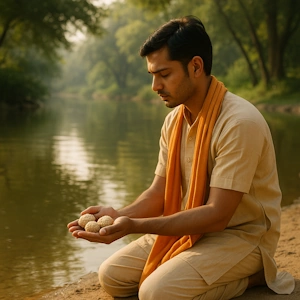
Dragged from the body, the sinner’s soul is beaten and taken to Yamaloka — shown every naraka built by his karma. Yama sends him back to Earth — to complete the death rites that still awaited.
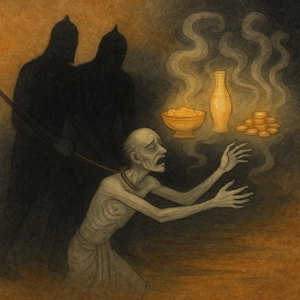
Dragged from Yama’s court, still bound in noose and sorrow, the preta finds himself hovering — unseen, unheard — near his own home.
His stomach burns with an unnatural fire. His throat is parched as though all the rivers of the world had dried up within him.
But no food, no water can satisfy him now. This is not hunger of the flesh — it is the craving born of karma.
He weeps — not just from pain, but from longing.
And he watches.
If his sons offer pindas and water with faith, he tastes relief.
But even when he eats, he remains unsatisfied.
He had mocked dharma, laughed at rituals, denied the devatas.
And now? Even food feels like ash.
If no one offers shraddha, no one gives water,
the preta does not fade into silence.
He becomes a starving ghost.
He roams the homes of his lineage,
not resting, not released, but circling like a moth around a flame.
No mantra reaches him. No prayer soothes him.
He collapses again and again from a thirst that will never end.
These are the ones the world forgets — but dharma remembers.
Karma never dies.
Not even after a hundred thousand kalpas.
It waits — like a shadow. Like fire under ash.
No one earns a human body again
without exhausting the karmas that cling to their soul.
Suffering must be lived.
Without that, rebirth is denied.
Therefore, the son should offer pinda each of the ten days.
Every day serves a sacred purpose.
Two parts of the pinda are offered to the five elements.
One part goes to the Yamadootas, who must carry him.
And one part — the preta himself receives,
just enough to continue the journey.
On the first day, the head forms.
Second day — neck and shoulders.
Third — the heart.
Fourth — the back.
Fifth — the navel.
Sixth — hips and lower spine.
Seventh — thighs.
Eighth and ninth — knees and feet.
By the tenth day, the preta is fully formed.
But he is still weak.
So he eats on the eleventh and twelfth days —
not out of choice, but to survive the coming torment.
On the thirteenth day — the Yamadootas return.
Ropes in hand. Eyes glowing.
No delay.
They seize the preta and drag him again.
Not as a man. Not as a soul.
But like a monkey caught in chains.
He is pulled through darkness, through flame,
through screams, winds, blood, and sorrow.
This is not poetry.
This is Yama’s road.
The road is long — 86,000 yojanas.
The preta walks 247 yojanas each day.
He must pass through sixteen ancient cities of pain:
Somya — beautiful from outside, deceiving within.
Sauripura — where illusions burn.
Nagendra Bhavana — mountains of serpents.
Gandharva Shaila — musicless hills of silence.
Krauncha, Kroora, Vichitra — twisted realms of fear.
Duhkhada — where pain is the air.
Nanakrandapura — where every soul cries.
Sutapta — walls that bleed fire.
Raudra — fierce and merciless.
Payovarsana — where boiling liquid rains.
Shitaadhya — ice that cuts.
Bhayada — a kingdom of terror.
Dharma Bhavana — vast, silent, all-seeing.
Yamya Pura — the final gate.
Each name is a mirror of karmic truth.
No sinner walks it without trembling.
All this while, the preta cries —
My body! My family! My home!
But the Yamadootas do not pause.
Their ropes tighten. Their pace quickens.
Yamya Pura looms ahead.
Behind him — his home.
Before him — Yama’s throne.
And in his ears, only the thunder of his own karma.
- The sinner’s soul is violently pulled from the body and taken before Yama, where every hell his karma has built is shown.
- Yama sends the soul back to Earth, for its death rites must still be completed before the journey can continue.
- The preta hovers near his home, unseen and unheard, consumed by burning hunger and thirst that no physical food or water can quench.
- His suffering is karmic — a craving of the soul born from his own disbelief, mockery of dharma, and neglect of rituals.
- Only when his family performs the ten days of rites with faith does he receive partial relief, though never full satisfaction.
- Without offerings of food and water, the preta becomes a restless, starving ghost wandering among his descendants.
- Karma ensures no sinner escapes consequence; even after countless ages, no rebirth is possible without living through one’s suffering.
- Each of the ten days of pinda-dana helps rebuild the preta’s subtle body step by step until it becomes complete by the tenth day.
- The eleventh and twelfth days sustain him briefly, preparing him for the final departure when the Yamadootas return.
- On the thirteenth day, the preta is seized again and dragged on the terrible road to Yama’s realm, bound and helpless.
- The road stretches eighty-six thousand yojanas and passes through sixteen cities, each revealing different dimensions of torment.
- Every city mirrors a truth of karma — illusions, fire, ice, serpents, cries, silence, and judgment — until he reaches Yama’s throne.
- Through it all, his cries for family and body go unheard; the only sound that follows him is the echo of his own karma.
What happens to a sinner’s soul after death?
It is seized by Yamadootas and taken before Yama, who reveals all the hells shaped by the soul’s actions. Only after this reckoning is the soul sent back to Earth for its rites to be completed. This phase ensures the soul experiences both judgment and purification.
Why must the soul return after seeing Yama?
Because the karmic process is incomplete without the rituals performed by the living. The son’s offerings bridge the soul’s disconnection, allowing it to continue toward eventual release. Yama’s justice includes giving the family a final chance to assist the departed.
Isn’t this cruel — to show punishment first and then send the soul back?
It isn’t cruelty but cosmic order. The soul must recognize the consequences of its deeds and then be given a brief pause for correction through ritual. This dual process ensures awareness, repentance, and continuity of dharma.
Why does the preta suffer hunger and thirst after death?
Because his desires remain, but his physical body is gone. The karmic craving lingers, turning into unbearable hunger and thirst that no material food can soothe. It is the residue of attachment expressing itself as torment.
How do the family’s offerings help the preta?
Each offering carries both symbolic and energetic value — the faith, intention, and mantra nourish the subtle being. The preta receives partial comfort, enough to endure the stages of transition. Without faith, even the act loses its potency.
If rituals don’t change karma, what’s their use?
They don’t erase karma; they support the soul through it. Like a bridge across fire, rituals don’t stop the flames but give a way to pass through them without total destruction. They express compassion that balances suffering.
What happens when no one performs shraddha or offers food?
The soul becomes a wandering ghost — hungry, invisible, and bound to its lineage. It circles familiar places, tormented by memories and cravings that never fade. Such souls remain trapped until someone later restores the missing rites.
Can forgotten ancestors really affect the living?
Yes. Unfulfilled energies of the departed influence the emotional and spiritual atmosphere of families. Just as neglected roots weaken a tree, neglected ancestors disturb the balance of descendants. Ancestral rites maintain continuity between worlds.
Why doesn’t the preta dissolve naturally over time?
Because time alone doesn’t cleanse karma. Only fulfillment of obligations and sincere offering can release it. The universe keeps unfinished energies bound until they are consciously addressed — that is dharma’s precision.
Why does karma never die even after countless ages?
Because karma is energy imprinted on consciousness, not matter. Until experienced or transcended, it stays attached to the soul like shadow to form. Even if eons pass, it waits for the right body and moment to unfold.
Can one escape karma through prayer or repentance?
Repentance changes the future, not the past. Karma already earned must be lived through — though sincere prayer can lighten its expression. Just as a seed can’t be unplanted, but its fruit can be softened by care, so is karma tempered by bhakti.
Isn’t this fatalistic?
Not at all. Karma is not punishment but education. Each experience teaches the soul what ignorance once ignored. Acceptance and correction are liberation, not helplessness. That’s why even suffering becomes sacred when understood.
What is the purpose of ten days of rites?
They rebuild the preta’s subtle form from fragments — from head to feet — preparing it for the next phase of existence. Each day refines one aspect of its being and transfers merit through sacred intention. The process is both metaphysical and psychological.
Why does the preta need a body again?
The subtle body is required to travel to the afterworld and experience karmic outcomes. Without form, perception and movement are impossible. The rites give it structure so justice can operate with precision.
Can modern people skip these rites since they don’t understand them?
Ignorance doesn’t cancel law. Whether known or not, these processes function. Understanding enhances faith, but performance sustains cosmic balance. Rituals were designed to protect the soul, not to satisfy curiosity.
Why do Yamadootas return on the thirteenth day?
Because the allotted period for Earth-bound presence ends. The preta has completed formation and temporary feeding, so it must now face judgment. The thirteenth day marks the close of earthly ties and the start of karmic reckoning.
Is there symbolic meaning behind being dragged like a chained animal?
Yes — it shows how the ego that lived as master becomes slave to its own actions. The rope is not Yama’s cruelty but karma’s bond, pulling the soul to its rightful destination. Pride collapses into accountability.
Can anyone avoid this terrifying path?
Yes — those who live righteously, honor dharma, and perform sacred duties cross peacefully under divine guidance. The Yamadootas’ road exists only for those who mocked the law of cause and effect. Dharma is the difference between fear and freedom.
What are the sixteen cities on the way to Yama’s realm?
They are stations of suffering, each mirroring a specific aspect of one’s past deeds — illusion, pain, pride, cruelty, or greed. Every city purges a layer of karmic impurity, preparing the soul for final judgment.
Why are these cities described with both beauty and horror?
Because karma often hides poison under pleasure. What once looked attractive now reveals its consequence. The journey strips away illusion until the soul sees truth nakedly — what it loved wrongly becomes what burns it.
Isn’t this just ancient metaphor, not literal geography?
Even if symbolic, the experience is real in consciousness. These realms represent inner states a soul must traverse after death. Whether one calls them cities or psychological zones, the pain remains authentic to the sufferer.
Why do the preta’s cries go unheard?
Because attachment blinds him even after death — his senses no longer connect to the material world. He shouts into the void, but the living can’t hear him; the bridge is broken. Only prayer and offering can carry sound across.
What does it mean that only his karma thunders in his ears?
It signifies self-confrontation. In death, all distractions vanish, leaving the soul alone with its own deeds. The noise is the echo of everything it ignored — now amplified as truth. There is no external judge, only reflection.
So is Yama truly a being or just this inner judgment?
He is both. Cosmic law personified and inner conscience awakened. Whether seen as deity or principle, Yama represents dharma’s impartial justice — the moment when truth is no longer optional.
धृतः पाशेन रुदति क्षुत्तृड्भ्यां परिपीडितः ॥ ४२ ॥ भुंक्ते पिण्डं सुतैर्दत्तं दानं चातुरकालिकम् ॥ तथापि नास्तिकस्तार्क्ष्य तृप्तिं याति न पातकी ॥ ४३ ॥ पापिनां नोपतिष्ठन्ति दानं श्राद्धं जलांजलिः | अतः क्षुद्व्या कुलाच यान्ति पिण्डदानभुजोपिते ॥ ४४ ॥ भवन्ति प्रेतरूपास्ते पिण्डदान विवर्जिताः ॥ आकल्प निजनारण्ये भ्रमन्ति बहुदुःखिता ॥ ४५ ॥ नाभुक्तं क्षीयते कर्म कल्पकोटि शतैरपि ॥ अभुक्त्वा यातनां जन्तुमानुष्यलभते नहि ॥४६॥ अतोदद्यात्सुतः पिण्डान्दिनेषु दशसुद्दिज || प्रत्यहन्तेविभज्यन्ते चतुर्भागैः खगोत्तम ॥ ४७ ॥
भागद्वयं तु देहस्य पुष्टिदं भूतपञ्चके ॥ तृतीयं यमदूतानां चतुर्थे सोपजीवति ॥ ४८ ॥ अहोरात्रैश्च नवभिः प्रेतः पिण्डमवाप्नुयात् ॥ जन्तुर्निष्पन्नदेहश्च दशमे बलमाप्नुयात् ॥ ४९ ॥ दग्धे देहे पुनर्देहः पिण्डैरुत्पद्यते ॥ हस्तमात्रः पुमान्येन पथि भुंक्ते शुभाशुभम् ॥५०॥ प्रथमेऽहनि यः पिण्डस्तेन मूर्धा प्रजायते ॥ ग्रीवास्कन्धौ द्वितीयेन तृतीयात् हृदयं भवेत् ॥५१॥ चतुर्थेन भवेत्पृष्टपञ्चमान्नाभिरेव च ॥ षष्ठेन च कटीगुहयं सप्तमात् सक्थिनी भवेत् ॥ ५२ ॥ जानुपादौ तथा द्वाभ्यां दशमेह्नि क्षुधातृषा ॥ ५३ ॥ पिण्डजं देहमाश्रित्य क्षुधाविष्टस्तृषार्दितः ॥ एकादशं द्वादशं च प्रेतोभुंक्त दिनद्वयम् ॥ ५४ ॥ त्रयोदशेहनि प्रेतो यन्त्रितो यमकिङ्करैः ॥ तस्मिन्मार्गे व्रजत्येक गृहीत इव मर्कटः ॥ ५५ ॥ षडशीति सहस्राणि योजनानां प्रमाणतः ॥ यममार्गस्य विस्तारो विना वैतरणीं खग ॥ ५६ ॥ अहन्यहनि वै प्रेतो योजनानां शतद्वयम् ॥ चत्वारिंशत्तथा सप्त दिवारात्रेण गच्छति ॥ ५७ ॥ अतीत्य क्रमशो मार्गे पुराणीमानि षोडश ॥ प्रयाति धर्मराजस्य भवनं पातकीजनः ॥ ५८ ॥ सौम्य सौरिपुरं नगेन्द्र भवनं गन्धर्वशैलागमौ क्रौञ्च क्रूरपुरं विचित्रभवनं बह्वापदं दुःखदम् ॥ नानाक्रन्दपुरं सुतप्तभवनं रौद्रं पयोवर्षणं शीताढ्यं बहुभीति धर्मभवनं याम्यं पुरं चाग्रतः ॥ ५९ ॥याम्यपाशैर्धृतः पापीहाहेतिप्ररुदन्पथि ॥ स्वगृहं तु परित्यज्य पुरं याम्यमनुव्रजेत् ॥ ६० ॥





English
Garuda Puranam
Click on any topic to open
7
30
Astrology
Bhagavad Gita
Bhagavatam
Bharat Matha
Devi
Devi Mahatmyam
Ganapathy
Garuda Puranam
Glory of Venkatesha
Hanuman
Kathopanishad
Mahabharatam
Mantra Shastra
Mystique
Practical Wisdom
Purana Stories
Radhe Radhe
Ramayana
Rare Topics
Rigveda Explained
Rituals
Sages and Saints
Shiva
Spiritual books
Sri Suktam
Story of Sri Yantra
Temples
Vedas
Vishnu Sahasranama
Yoga Vasishta
26
17
10
0


