Harikesanallur Muthaiah Bhagavathar: The Titan of Carnatic Music
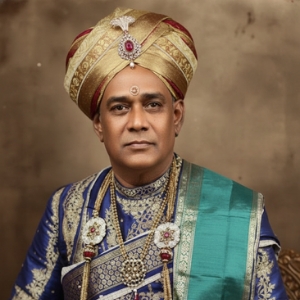
In the early 20th-century landscape of Indian classical music, few names command as much reverence as Harikesanallur Muthaiah Bhagavathar. He was a phenomenon—a master vocalist, a prolific composer (Vaggeyakara), a captivating Harikatha exponent, and a dedicated musicologist. His life’s work acted as a bridge, bringing the complex technicalities of Carnatic music to the common man without diluting its spiritual essence.
Early Life and Musical Roots:
Born on November 15, 1877, in the small village of Harikesanallur in the Tirunelveli district of Tamil Nadu, Muthaiah was the son of Lingam Iyer, a renowned Vedic scholar. Having lost his father at the tender age of nine, he was raised under the guardianship of his maternal uncle, Perianna Iyer.
While his early education was rooted in the Vedas, his soul resonated with music. Driven by this passion, he traveled to Thiruvaiyaru, the cradle of Carnatic music, to apprentice under Sambasiva Iyer (son of the legendary Sabhapati Iyer). His rigorous discipline and naturally resonant voice quickly established him as a premier concert vocalist.
The Harikatha Exponent:
Beyond the concert stage, Muthaiah Bhagavathar’s fame reached every corner of South India through the art of Harikatha (spiritual storytelling). His majestic physical presence, booming voice, and ability to weave intricate ragas into mythological narratives made him a superstar of his era. It was his mastery of this art form that earned him the permanent title of 'Bhagavathar'.
Through his Harikatha performances, he simplified the most complex aspects of music theory for the layperson, making classical music accessible and culturally relevant.
A Prolific Composer (Vaggeyakara):
While he was a celebrated performer, Muthaiah Bhagavathar’s legacy is most profoundly felt through his compositions. He composed over 400 pieces in Tamil, Telugu, Sanskrit, and Kannada.
- Architect of New Ragas: He is credited with creating and popularizing over 20 new ragas. Ragas that are staples in concerts today—such as Vijayasaraswathi, Hamsanandi, Nivedita, and Budhamanohari—were either discovered or given a definitive structure by him.
- The Chamundeshwari Keerthanas: At the request of the Mysore royalty, he composed 108 Kritis (Ashtottara Shatanamavali) in praise of Goddess Chamundeshwari. Each song was set in a different raga, showcasing his unparalleled creative genius.
- Reviving Swathi Thirunal: One of his greatest historical contributions was reviving the compositions of Maharaja Swathi Thirunal. He painstakingly researched lost manuscripts and set them to music, ensuring the Maharaja’s musical legacy was preserved for future generations.
Honors and Royal Patronage:
His virtuosity earned him the patronage of the greatest royal houses of the time:
- Kingdom of Mysore: Maharaja Krishnaraja Wadiyar IV conferred upon him the title 'Gayaka Shikhamani' (The Crest-Jewel of Singers). To this day, his portrait is honored in the Mysore Palace.
- Kingdom of Travancore: He served as the first Principal of the Swathi Thirunal College of Music in Thiruvananthapuram.
- Music Academy, Madras: In 1930, the Madras Music Academy bestowed upon him its highest honor, the 'Sangita Kalanidhi' award. He was one of the earliest recipients of this prestigious title.
Contribution to the Tamil Isai Movement:
Muthaiah Bhagavathar was a vocal supporter of the Tamil Isai (Tamil Music) movement. He believed that music reaches the heart most effectively when the listener understands the language of the lyrics. His Tamil compositions, such as "Nijamanadha Ni Nambu" and "Valli Nayagane," remain beloved by audiences today. He also served as the Head of the Music Department at Annamalai University, where he mentored a generation of musicians.
Legacy and Final Days:
Muthaiah Bhagavathar passed away on June 30, 1945. His legacy lived on through his illustrious disciples, most notably the legendary Madurai Mani Iyer. The “Harikesanallur style” is characterized by a perfect blend of melodic richness and rhythmic precision.
For the Bhagavathar, music was never a mere profession; it was a form of penance (Tapas) and a path to the divine. His ability to breathe life into ragas while maintaining the sanctity of the lyrics remains a gold standard in Carnatic music.
Conclusion:
Harikesanallur Muthaiah Bhagavathar was a true 'Sangita Samrat' (Emperor of Music). From the banks of the Thamirabarani in the south to the royal courts of Mysore and Travancore, his musical footprint is indelible. As long as his keerthanas are sung and his ragas are played, his spirit will continue to resonate in the world of Indian classical music.





English
Rare Topics
Click on any topic to open
7
30
Astrology
Bhagavad Gita
Bhagavatam
Bharat Matha
Devi
Devi Mahatmyam
Ganapathy
Garuda Puranam
Glory of Venkatesha
Hanuman
Kathopanishad
Mahabharatam
Mantra Shastra
Mystique
Practical Wisdom
Purana Stories
Radhe Radhe
Ramayana
Rare Topics
Rigveda Explained
Rituals
Sages and Saints
Shiva
Spiritual books
Sri Suktam
Story of Sri Yantra
Temples
Vedas
Vishnu Sahasranama
Yoga Vasishta
26
17
10
0


