Grace for Few, Karma for Others
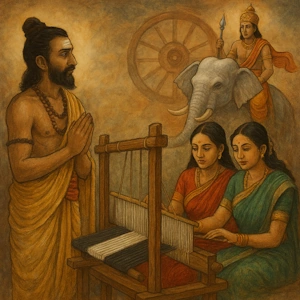
We will finish Uttanka’s story by explaining the mysteries that Uttanka saw on the way.
He came back and told his guruji about the experiences, and his guruji explained to him their meaning and significance.
When he set out for Paushya’s palace, first he saw a man seated on top of a huge bull.
That man had told Uttanka to eat the dung of the bull and drink its urine.
Guruji said it was my friend Indra — 'Indro mama sakha'.
See the words used — Indra, my friend.
This is the kind of proximity our forefathers, the sages, had with the gods.
The bull was Airavata, Indra’s vehicle.
And its dung and urine was amruta.
If Uttanka had not consumed this amruta, he would have died in Nagaloka.
Indra knew what was ahead for him.
When he returns with the ear ornaments, Takshaka would snatch them away and he will have to go to Nagaloka after him.
Indra was protecting him, being the disciple of his friend.
This has another beautiful explanation also.
See, divine providence is available to you depending on your eligibility — what you have done to get divine providence.
God does not protect everyone.
Scriptures are clear about this — God protects His devotees, those who are aligned with Him.
'Aligned with Him' means those who conduct themselves as He wants, those who conduct themselves virtuously.
Others just follow the path of karma — do good, get good; do bad, get bad.
If you are with God, if God is with you, if you handed over your reins into God’s hands — not merely in words, sincerely, seriously — then He would absolve you from the ill effects, even the bad you have done, provided you repent for them, and your repentance is sincere.
This is a privilege available only to people who are aligned with the divine power, who recognize the divine power.
You can say God is there only for people who recognize Him.
That means what?
You do virtuous things when you recognize God.
Those virtuous things themselves come to you to protect you, save you, help you — then you say God helped me.
God doesn’t help you if you don’t deserve it.
God is like a teller in a bank — He will take money from your account and give it to you.
So here the bull is Uttanka’s own virtuous past, virtuous acts.
The person riding it, controlling it, is Parameswara — here, Indra.
He shows Uttanka the path also — 'eat this dung'.
Asking someone to eat the dung of a bull — very weird, isn’t it?
It was not so obnoxious.
We consume gomutra, gomaya.
They are used in medicines such as Panchagavya Ghrita.
Panchagavya Ghrita is used in the treatment of psychiatric disorders.
The man on the horse in Nagaloka that we have already seen — it was again Indra.
What is this dung and urine?
What comes out of virtuous acts.
Dung is the net result.
Food goes in — what remains is dung.
Karma may have a lot of impurities also associated with it.
All that is burned away, and what comes out as the net result is the dung — which Uttanka ate — which is compared to amruta.
This may not be the case with every animal, but as per Vedic principles, it is applicable in the case of bull (anadvāhana) and cow.
That’s why Indra came riding a bull here and riding a horse in Nagaloka.
The nature of support that Uttanka needed at both these places were different.
Here, Indra came riding Uttanka’s own virtuous past karma and gave the net result of that to him — to empower him, to protect him from untimely death in Nagaloka.
Indra had to force him to eat the dung and drink the urine.
Because Uttanka did not realize what was happening.
The virtues that you do, the results of them — God will force you to enjoy the benefits of them.
You can’t miss them.
Even if you don’t understand, you can’t miss them.
God will come to you with them and force you to get their protection and benefit.
Uttanka ate and drank half-heartedly.
He thought it was dung and urine.
That’s why he did achamana.
He didn’t realize that it was amruta.
If he had realized that it was amruta, then he would not have done achamana for purification.
So, it is his own ignorance that made him impure — not what he ate.
Then he didn’t do the achamana properly, so he remained impure.
Impurity was in his mind, not in what he ate.
See what all it is revealing.
There at Paushya’s palace, he could not see Paushya’s wife initially.
She was a pativrata, and Uttanka was impure on account of his own mental impurity.
See one more thing — Uttanka has spent his whole life in the ashrama without much interaction with the outside world.
That’s why all these issues are coming up.
He has to learn to apply whatever he has learned in the practical world.
That will come up only when you interact with others.
This is also a learning process for Uttanka.
He could not see the pativrata, because a pativrata is equal to God.
You will not be able to see God if you have the slightest of impurity in your mind.
When your mind becomes 100% pure, then you can see God — just like how you see a human being or a tree or a mountain.
At that time there was impurity in Uttanka’s mind — of his own creation.
Impurity which made him not recognize that amruta was being given to him.
When the impurity went away after proper achamana, Paushya’s queen became visible to him.
See how much importance is given to Indra as the protector in Mahabharata.
The western Indologists did a propaganda that Indra was downgraded into a reckless, lustful, drunkard in the Puranas and Itihasas.
Nothing can be so absolutely untruthful.
Indra is still a very virtuous and powerful god — who comes to the help of the virtuous — on His own.
Indra is at the very foundation of the Vedic principles.
They wanted to break the Vedas, so they hit at Indra.
By taking the story of Govardhana, we also started believing in all this.
The incident of Govardhana, in which Krishna stopped yajna meant for Indra —
this is grossly misinterpreted by the western Indologists to confuse us.
We will take it up in Bhagavatam.
In Nagaloka, he saw two girls weaving a cloth.
The cloth had two kinds of threads — black and white.
What they are weaving perpetually are the world experiences.
Why two girls? Why not one?
Because to experience the world, you need two things — knowledge and ignorance.
If you are sitting in a dark room, you will not be able to see the objects.
So that much of light should be there — worldly knowledge.
But not so much knowledge that you can understand their real nature also.
Some knowledge and some ignorance.
The mix of these two are responsible for all world experiences.
The duality of everything — the cloth made of black and white.
Every act has some punya and some papa in it.
Only the proportion varies.
Everything that is in the world is a mix of good and bad — this cannot be avoided.
Then the wheel with the twelve spokes — that is the Samvatsara Chakra with the twelve months.
And the six boys turning it — the six seasons.
The time that never stops.
These are the two components at the very base of the world experiences — duality and time.
Is this how you have heard Mahabharata so far?
This is how you should understand Mahabharata —
otherwise, it is just time pass.





English
Mahabharatam
Click on any topic to open
7
30
Astrology
Bhagavad Gita
Bhagavatam
Bharat Matha
Devi
Devi Mahatmyam
Ganapathy
Garuda Puranam
Glory of Venkatesha
Hanuman
Kathopanishad
Mahabharatam
Mantra Shastra
Mystique
Practical Wisdom
Purana Stories
Radhe Radhe
Ramayana
Rare Topics
Rigveda Explained
Rituals
Sages and Saints
Shiva
Spiritual books
Sri Suktam
Story of Sri Yantra
Temples
Vedas
Vishnu Sahasranama
Yoga Vasishta
26
17
10
0


