Beyond the Mahabharata: Understanding the Ashwins
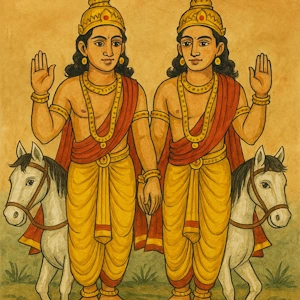
Mahabharata is not just about Pandavas and Kauravas and the battle of Kurukshetra. In every single verse, so much of tattwas, principles, are hidden.
We are making use of this opportunity to understand more about the Ashwini Devas. Upamanyu, a disciple of Dhaumya, lost his eyesight and fell into a well in the forest. Dhaumya told him to pray to Ashwini Devas — the divine doctors. We are making use of the verses that Upamanyu chanted to understand more about Ashwini Devas.
What is the primary source of knowledge about the Ashwins? Rigveda. That’s why Dhaumya told Upamanyu — praise them with Rigveda mantras. And what Mahabharata has is the meaning of the Rigveda mantras in verse form as shlokas. They are mantras and these are shlokas. Upamanyu must have chanted Rigveda mantras. Here in Mahabharata, instead of reproducing those mantras as they are, Sage Vyasa is conveying their meaning through these shlokas.
We will be going a little beyond these shlokas to understand about Ashwins. Ashwins are a pair. They always move about together. Ashwins are devatas of the heaven. In the Vedas, there are devatas on earth, atmosphere and heaven. They are classified like this.
Example of devata on earth is Agni. Example of devata in the atmosphere or Antariksha is Vayu. Example of devata in the heaven is Surya. Like Surya, Ashwins are also dyustthaneeya devata.
They are called Ashwins because they always have horses with them — ashwa means horse. Another Acharya says, they are called Ashwins because their mother is Ashwini, the female horse, and father is Surya.
This Ashwini is the wife of Surya Deva — Samjna — who had left him because of his extreme heat after leaving behind her replica, Chhaya. Chhaya’s son is Shani Deva. Samjna had assumed the form of a female horse. But when Surya found out what happened, then he also assumed the form of a horse and united with her. Ashwins were born out of this union.
But another mantra says that one of them is the son of Ratri and the other son of Usha. Don’t get confused — why two different versions? Different versions are different perspectives, of different Acharyas. The same mantra can be interpreted in many different ways — that is the depth and beauty of Vedas.
Take any object. You can see it with your eyes. Then you look at the same object after keeping it under a lens — that too concave and convex lens — you see it totally differently. Keep it under a microscope, you will see it differently. They are not contradictions, they are different perspectives.
Their timing is just before sunrise — when it is a mix of darkness and light. One of them stands for darkness, one of them stands for light. When they are together, you get that state just before sunrise. Usha Devi is the goddess of dawn, but the timing of Ashwins is dawn.
Some Acharyas say that they stand for heaven and earth. Some say that they stand for Surya and Chandra. Some say that they stand for knowledge and food, light and food. These are all different perspectives.
Just as they always come together, their actions are also together and similar, and they are always praised together. Offerings are always given to them together. One of the Ashwins is known for his great strength, immense strength. The other is known for his light, brilliance. In the pre-sunrise also, the one aligned with darkness is known for his strength, the other one is aligned with light.
Their offerings are also made in the morning only. Originally, they did not have their share of offering made in the yajna. It was Chyavana Maharishi, whom they cured of blindness, who made Ashwins eligible for their share of offerings in yagas.
Even though they are together, they have individual names also — Naasatya and Dasra. Nakula and Sahadeva — they are sons of Ashwins.
Ashwins are very important devatas of the Vedas. After Indra, Agni and Soma is their position. There are entire 50 Suktas in Rigveda attributed to them and many more references elsewhere. Anything that is in pairs — eyes, ears, hands, legs, even two birds together, two bulls drawing a cart together — all these places, Ashwins have their influence.
The 39th Sukta of the second Mandala of Rigveda starting with 'ग्रावाणेव' is about this concept only. Rigveda calls them as ever young — they never get aged. They are always youngsters.
'अश्विनौ वै देवानां आनुजावरौ' — says Yajurveda. They are the youngest among Devas.
'धियंजिन्वा मधुवर्णा शभस्पती' — what is their colour? That of honey. And they are also very fond of honey. They only give honey to honey bees. Not only their color — the color of their chariot is also that of honey.
They both are very intelligent — 'कवी गम्भीरचेतसा'. These are all Vedic references — you will not find them in Mahabharata.
Even though they are a pair, many of the things connected to them are in three numbers. They are the only devatas whose chariot has got three wheels. And their chariot can move with the speed of the mind.
They don’t ride horses, but their chariot is drawn by horses. But their chariot is also drawn by birds, buffaloes, donkeys. They are very smart.
Agni Deva is very smart, very intelligent — he has every kind of knowledge with him. Even Agni, Ashwins have defeated with their kushala.
There was a Rajarshi called ऋजाश्व. Once he gathered 100 goats from the citizens for a donkey that used to draw the chariot of Ashwins. This donkey had assumed the form of a female wolf. But when Rijashwa’s father came to know about this, he cursed Rijashwa for having taken the wealth of the people. Rijashwa became blind. Ashwins restored his eyesight.
Ashwins are famous for their power to restore eyesight. Chyavana also — they gave back eyesight. Here, Rijashwa. That should be the reason Dhaumya asked Upamanyu to pray to Ashwins to get back his eyesight.





English
Mahabharatam
Click on any topic to open
7
30
Astrology
Bhagavad Gita
Bhagavatam
Bharat Matha
Devi
Devi Mahatmyam
Ganapathy
Garuda Puranam
Glory of Venkatesha
Hanuman
Kathopanishad
Mahabharatam
Mantra Shastra
Mystique
Practical Wisdom
Purana Stories
Radhe Radhe
Ramayana
Rare Topics
Rigveda Explained
Rituals
Sages and Saints
Shiva
Spiritual books
Sri Suktam
Story of Sri Yantra
Temples
Vedas
Vishnu Sahasranama
Yoga Vasishta
26
17
10
0


