God as a Variable
Brahma Vaivarta Purana has a different way of explaining srishti.
In Brahma Vaivarta Purana, utmost importance is given to Lord Krishna.
After pralaya, light is all that remains. It is not darkness, it is light. But within this light, still, three worlds exist — Goloka of Sri Krishna, Vaikuntha of Narayana, and Shiva Loka of Mahadeva. At the topmost is Goloka, below Goloka to the right is Vaikuntha, and to the left of Vaikuntha is Shivaloka.
After pralaya, nothing except Bhagawan Sri Krishna is there. Then everything — every devata — they all come from him. Even Maha Vishnu Narayana comes out of him.
This sounds strange.
It is deep-rooted in our mind that Sri Krishna is an avatara of Maha Vishnu Narayana — an avatara that comes and goes. Here the Purana says, Narayana himself has come out of Sri Krishna.
So, is this correct? Or is this wrong?
The problem is with how we look at it.
We want everything in a simple, linear manner. We are used to this only.
People with exposure to mathematics and some tech would understand this better.
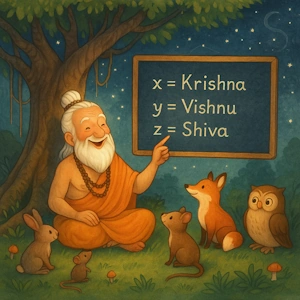
Take a variable x.
Now let’s say:
y = x multiplied by two
z = x divided by three
k = 4x + 3y + 7z
Now you can assign whatever value you want to x — 2 or 3 or 10000 — and values of y, z, k, they all change accordingly.
These legends and stories are all like that.
In the place of the variable, you can put Krishna, Vishnu, Shiva, Shakti — whatever you want — and the rest of the things change accordingly.
Names are not so important. Concepts are more important.
So when you put Krishna at the top, then Brahma, Vishnu, and Shiva — they all originate from him.
When you put Shiva on top, then Krishna, Brahma, Vishnu — they all come out of him.
It is so simple.
Those with exposure to technology know how feedbacks work. Output goes back into the system and influences the input, which again affects the output. This goes on and on and on.
This is how systems work. And the universe is a system.
When we say Krishna or Shiva and Durga, they are not stand-alone entities who sit above and control everything.
They are what the universe itself is. They are not separate from it.
So our sages have kept this nomenclature flexible.
What they want to convey is the concept. They don’t hold on to the names.
If you see the attributes of all the deities, they are more or less the same.
Once, a Ganapathy puja was going on. Towards the end, when everyone was offering flowers and namaskara, one person said, 'Krishna, Narayana.'
This offended some people. 'Why is he saying this? This is a Ganapathy puja!'
But, does it really matter? Does the name really matter?
There are identified defects in rituals such as anya mantrairyajanam. It is a defect if you worship with a mantra that doesn’t address the deity or mantra of another deity.
That is for rituals.
At a level of better understanding, these names are interchangeable.
This is as your level of awareness grows. Not initially.
If you see sahasranamas of different deities — Shiva, Vishnu, Ganesha — you will find that many names are common.
Because that is how it is. They are all describing the same entity.
My point here is, don’t get fanatic about these names — who is bigger, who is greater.
You will have to discard these concepts at some point of time — that is, if you are growing, evolving.





English
Rare Topics
Click on any topic to open
7
30
Astrology
Bhagavad Gita
Bhagavatam
Bharat Matha
Devi
Devi Mahatmyam
Ganapathy
Garuda Puranam
Glory of Venkatesha
Hanuman
Kathopanishad
Mahabharatam
Mantra Shastra
Mystique
Practical Wisdom
Purana Stories
Radhe Radhe
Ramayana
Rare Topics
Rigveda Explained
Rituals
Sages and Saints
Shiva
Spiritual books
Sri Suktam
Story of Sri Yantra
Temples
Vedas
Vishnu Sahasranama
Yoga Vasishta
26
17
10
0


