Give Yourself a Rating for Your Bhakti
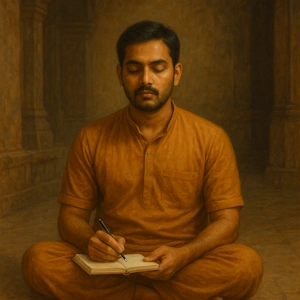
Today, we will look at the meaning of the divya nama sarveshwaraha and also explore a method to measure your bhakti, to measure how far you have progressed in bhakti, where you stand in bhakti.
सर्वेश्वरः – सर्वेषामीश्वराणामीश्वरः – we called him ishwara earlier, now this is sarveshwara – ishwara of ishwaras. Who is an ishwara – someone who is a ruler, who rules over. There are many ishwaras, Indra is the ishwara of swarga. Adishesha is the ishwara of patala. Even on earth, all rulers are ishwaras. Now, Sri Hari is the ishwara of all these ishwaras, that’s why he is sarveshwara. He is like an emperor of all the universes. There is no one above him. All these ishwaras, they report to him. They are answerable to him. They are all under his command. So, his status is not as an equal, as one among them. He is above all of them.
अशक्तानां च शक्तानां वैरूप्यं शरणागतानाम् विलंबनं वैक्लब्यं च परिहर्तुं आशु तान् अश्नुते इति सर्वॆश्वर
Those who take refuge in him, he attends to them instantly, whether they are capable, qualified does not matter. Even when the devotee has hundred shortcomings, hundred incapacities, the devotee may not have devotion to start with. He may have come to him just to get something, like how we go to shop, pay money and buy something. This devotee’s attitude is that: I will give 20 mins of my time to you every day. I will say your thousand names. In return for that I am expecting you to give me 5 lacs every month. Good. Even this attitude, he only has to change.
This man is not going to realize, never going to realize, that Sri Hari is not a super market where you pay money and get value for money. He will never realize on his own. Even this Sri Hari only has to make him understand. He may not do this on day one, but over a period of time, he will. That is why he is sarveshwara. He has to take care of everything. Even though he has delegated so many things to so many iswaras, the ultimate responsibility is on his shoulders. He is not answerable to anyone. That makes it even more difficult. He will not be able to put the blame on anybody else. Because he is sarveshwara, ishwara of all ishwara. This explanation is based on the meaning that he reaches out immediately, instantly.
विभीषणेन आशु जगाम संगमम्
Like how spontaneously he reached out to Vibhishana in Lanka, the noble soul of Lanka. That connect was instantaneous. He reached out to Ravana also and gave him mukti. He doesn’t discriminate.
Now how to giving a rating to yourself for your bhakti.
In bhakti we will give a maximum score of 90. Instead of the usual 100, it will be 90. Your score is going to be out of 90, instead of 100.
Take a paper.
Write ten points one by one. Against each of these points you have to give a score of yourself out of 10. 10 x 10 – 100. For each of these points the maximum score is 10, and you have to rate yourself 0 to 10.
The points are, write one below another:
-
If I lose something, money, job, status, property, how much can I remain undisturbed mentally. 0 to 10, rate yourself. Imagine the extreme and rate yourself. Zero if you get agitated, 10 if you can be absolutely calm. All these 10 points are being treated as positive qualities. If you have it 100% give yourself 10, at the other end give yourself 0.
-
If I lose a close relative, how much can I remain undisturbed.
-
How much time do I devote to God, divine thoughts. Do I connect God to everything that I do, even the most silly and mundane things.
-
How much do I stay away from looking for comforts and pleasures. 0 if you want your food to taste perfect, your bed to be soft and without a wrinkle. 10 if you are not bothered.
-
Your craving for name, fame, reputation. Give yourself a 10 if you are just not bothered. 0 if you are concerned about these. Or anything in between depending on where you stand.
-
How much do you have longing to be with the Lord, see his images, hear about him.
-
You know teenagers in their first love. When they hear the voice of the lover, or an image of him or her, there is something that happens inside, a flash as if hit by something, the heartbeat increases, the energy level increases. How much of this happens with you when you hear Bhagawan’s name, see his image, say his name.
-
How much pleasure do you get when taking his holy names. The level of ananda that you get when you take his holy names. Each one. Each name gives a different kind of pleasure. Do you realize this. How much do you realize this internal feeling.
-
How much do you talk about his greatness to others. Whenever you are in conversation with someone, even a stranger, how often and how fast do you take the conversation towards Bhagawan, around Bhagawan.
-
How elated, how elevated do you feel when you are in his temple or any divine place associated with him.
Against each of these ten points rate yourself. Add them together. Let’s say you have scored 3, 7.5, 2.5. 6, 1, 5, 7, 4. Your score will be 45 out of 100.
This is where you stand now. 100 is where you have to go.
-
Why is Sri Hari called the ruler above all rulers?
Because every power you see — from nature’s forces to cosmic deities — functions under his command. Remembering this cuts fear and ego. It puts your mind in order. -
How does this help my day-to-day anxiety?
Chanting the Vishnu Sahasranama tells your nervous system there is a higher order. Breath settles. Pulse steadies. Decisions get cleaner because you stop fighting imagined chaos. -
What if my bhakti is mixed with bargaining and expectations?
Start anyway. Nama japa reshapes motive over time. Aim for sincerity, not perfection. Track progress weekly: fewer complaints, more gratitude. -
How do I measure where I stand without fooling myself?
Use a 0–10 self-rating for calm in loss, time given to nama, craving for praise, joy in darshan, urge to share Hari’s glories. Add them. Repeat monthly. Trend matters more than the score. -
I have little time. What is the minimum effective routine?
Morning: 9 names from the Sahasranama, 9 breaths, 3 minutes. Night: Govinda nama for 108 counts. Keep a small tally bead or app. Non-negotiable. -
Will chanting actually change my habits?
Yes, through repetition. The name interrupts impulse loops. You notice the urge, name Hari, and the urge loses grip. That gap is your freedom. -
How does this touch physical health without overpromising?
Slow, rhythmic chanting with nasal resonance lengthens exhale, improves vagal tone, and helps sleep quality. You feel steadier energy across the day. -
Where do family relationships come in?
Keep household friction outside the puja boundary. Do a shared nama round before difficult talks. Afterward, decide only in calm. Families that chant together argue less and repair faster. -
What about grief and shock — does nama help there too?
It gives a stable rail to hold. You will still feel pain, but panic drops. Repeat a short line — ‘Narayana’ — in sets of 12 breaths. Stay with it till the storm passes. -
How do I keep desire for status from hijacking my practice?
Tie recognition to effort, not applause: ‘Did I chant today as promised?’ If yes, you win. If no, fix it now, not tomorrow. Praise and blame become background noise. -
How can I deepen beyond mechanical repetition?
Each day, pick one name — say ‘Madhusudana’ — and connect it to one action — ‘cut this one inner demon today: envy’. Journal one line at night on how you did.





English
Vishnu Sahasranama
Click on any topic to open
7
30
Astrology
Bhagavad Gita
Bhagavatam
Bharat Matha
Devi
Devi Mahatmyam
Ganapathy
Garuda Puranam
Glory of Venkatesha
Hanuman
Kathopanishad
Mahabharatam
Mantra Shastra
Mystique
Practical Wisdom
Purana Stories
Radhe Radhe
Ramayana
Rare Topics
Rigveda Explained
Rituals
Sages and Saints
Shiva
Spiritual books
Sri Suktam
Story of Sri Yantra
Temples
Vedas
Vishnu Sahasranama
Yoga Vasishta
26
17
10
0


