From Suffering to Surrender
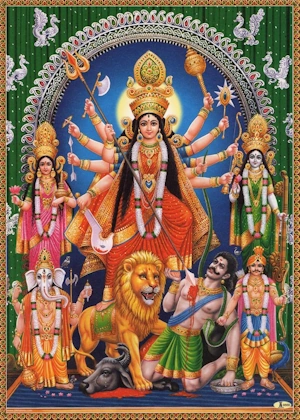
The 13th chapter of the Devi Mahatmya, known as Suratha–Vaishyayor Vara-Pradaanam, marks a turning point where the story shifts from cosmic battles to personal seeking. Having heard the Goddess’s glory, King Suratha and the merchant Samadhi are stirred deeply. Questions burn in their hearts — about loss, delusion, and the nature of true refuge. What follows is not a debate or a lesson, but a quiet, determined journey into devotion. This chapter becomes a window into the soul’s longing — showing how ordinary lives, when touched by the Devi’s story, are drawn to something far beyond their original path.
ॐ ऋषिरुवाच ॥ १३.१॥
एतत्ते कथितं भूप देवीमाहात्म्यमुत्तमम् ।
एवं प्रभावा सा देवी ययेदं धार्यते जगत् ॥ १३.२॥
‘O King, thus I have narrated to you the supreme glory of the Goddess — the Devi Mahatmya.’
The sage speaks gently now, like a father who has shared a secret long guarded. He has finished telling the tale — not just of battles and boons, but of the Devi who births and burns the worlds, who veils and reveals reality itself.
This is not a mere story — it is uttamam, the highest. Because what it reveals is not about the Goddess. It is the Goddess.
‘Such is the power of the Devi — she by whom this entire universe is upheld.’
This verse is like a bell that echoes after the chant is over.
She fought Shumbha and Nishumbha? Yes.
But more than that — she is the reason gravity holds, breath moves, thoughts stir, fire burns, and rivers flow. She upholds the cosmos — not with hands, but with will.
This isn’t just about victory.
It’s about why anything exists at all.
विद्या तथैव क्रियते भगवद्विष्णुमायया ।
तया त्वमेष वैश्यश्च तथैवान्ये विवेकिनः ॥१३.३॥
‘All this — knowledge, confusion, activity — arises through the divine Maya of Bhagavan Vishnu.
It is by that very power that you, this merchant, and even the wise become deluded.’
Now the sage turns inward — explaining that even the wisest are not immune to her spell.
King Suratha and the merchant Samadhi — they both had worldly pain. But that pain itself was her invitation. A whisper from Maya — saying, ‘Come closer. Seek deeper.’
Delusion is not punishment. It’s the starting point of the soul’s return.
मोह्यन्ते मोहिताश्चैव मोहमेष्यन्ति चापरे ।
तामुपैहि महाराज शरणं परमेश्वरीम् ॥१३.४॥
Deluded are some, others are already under her spell, and many more shall fall into delusion yet.
O great king, therefore take refuge in her — the Supreme Goddess.
Here, the sage reveals a universal secret — no one is immune to her Maya.
- Some are already confused.
- Some are being confused now.
- And some are walking straight into the fog without even knowing it.
But the solution is not to escape delusion by force —
It is to surrender to the one who wields the veil.
She is not merely the source of illusion.
She is the only shelter beyond it.
The sage pleads:
‘O king, stop trying to control the storm.
Bow to the sky that holds it.’
आराधिता सैव नृणां भोगस्वर्गापवर्गदा ॥१३.५॥
Worshipped with devotion, she alone bestows upon human beings pleasure, heavenly enjoyment, and liberation.
This line is the heart of spiritual assurance. The sage gives it to Suratha like a final instruction and hidden key:
- Want worldly joys? She gives them.
- Craving the pleasures of heaven? She opens that gate.
- Longing for moksha — complete release? She is the giver of that too.
She doesn’t demand perfection.
She asks for ārādhana — true-hearted worship. A turning of the whole being toward her — whether through mantra, service, silence, or tears.
She meets the devotee at the level of their longing,
and lifts them toward what they never knew they needed.
मार्कण्डेय उवाच ॥१३.६॥
इति तस्य वचः श्रुत्वा सुरथः स नराधिपः ॥१३.७॥
Markandeya said:
Thus, hearing those words, King Suratha — that noble ruler among men — was stirred deeply.
Up till now, Suratha was a fallen king.
A man wronged, wandering, confused.
But now?
The seed of bhakti has cracked open in him.
He’s no longer thinking like a king — he’s yearning like a child.
The sage’s words have landed, not on his ears, but on his inner flame.
That’s how transformation begins —
Not when answers come, but when ego bends.
This moment is not loud.
It is sacred, still, and alive.
प्रणिपत्य महाभागं तमृषिं संशितव्रतम् ।
निर्विण्णोऽतिममत्वेन राज्यापहरणेन च ॥१३.८॥
He bowed to the blessed sage, firm in his vows.
He was full of sorrow — from the pain of ego, and the loss of his kingdom.
The loss of power wasn't just political — it shook him awake.
Now, before the sage, he bows — not out of custom, but out of a thirst to be lifted out of his smallness.
जगाम सद्यस्तपसे स च वैश्यो महामुने ।
सन्दर्शनार्थमम्बाया नदीपुलिनमास्थितः ॥१३.९॥
That very moment, the king and the merchant both departed for tapas.
They settled on the riverbank, to seek the vision of the Divine Mother.
They didn't argue with destiny.
They went into silence, into yearning, into the wilderness — not to run from the world,
but to meet the one who holds the world.
स च वैश्यस्तपस्तेपे देवीसूक्तं परं जपन् ।
तौ तस्मिन् पुलिने देव्याः कृत्वा मूर्तिं महीमयीम् ॥१३.१०॥
There, the merchant performed intense tapas, chanting the supreme Devi Suktam.
Together, they crafted a clay image of the Goddess on the riverbank.
Their hands shaped earth into divinity.
Not out of ritual… but devotion made visible.
Every grain of that mud was soaked with love.
They didn’t just remember the Devi —
They built a place for her to arrive.
अर्हणां चक्रतुस्तस्याः पुष्पधूपाग्नितर्पणैः ।
निराहारौ यतात्मानौ तन्मनस्कौ समाहितौ ॥१३.११॥
They worshipped her with flowers, incense, fire, and offerings.
Fasting, self-controlled, and focused in mind — they remained completely absorbed in her.
This is not asceticism for show.
This is bhakti boiled down to its purest flame.
Hunger didn’t distract them.
The world faded. Only she remained.
ददतुस्तौ बलिं चैव निजगात्रासृगुक्षितम् ।
एवं समाराधयतोस्त्रिभिर्वर्षैर्यतात्मनोः ॥१३.१२॥
They even offered their own blood as bali — a sacrifice soaked from their own bodies.
And so, for three full years, these self-controlled men worshipped her in earnest.
This is where the body becomes an altar.
They had nothing left to offer — so they gave themselves.
Blood — not as violence, but as devotion turned into red drops.
That’s how far bhakti can go —
When the soul is on fire, even pain becomes an offering.
परितुष्टा जगद्धात्री प्रत्यक्षं प्राह चण्डिका ॥१३.१३॥
The World-Mother, pleased with their worship, appeared directly before them and spoke as Chandika.
Not in dream.
Not in symbol.
She came.
She — Chandika — whose eyes had once burned armies, now stood in compassion before two simple seekers.
The clay murti became radiant form.
This is the fruit of real surrender —
Darshan.
Not imagined. Real.
देव्युवाच ॥१३.१४॥
यत्प्रार्थ्यते त्वया भूप त्वया च कुलनन्दन ।
मत्तस्तत्प्राप्यतां सर्वं परितुष्टा ददामि ते ॥१३.१५॥
The Goddess said:
‘O king, O noble merchant — whatever you desire,
may you receive it from me.
I am pleased. I grant you both your wishes.
No condition. No test.
She didn’t ask what tapasya have you done?
She said: You called. I heard. Ask — and you shall have.
That is the kindness of the Mother.
ततो वव्रे नृपो राज्यमविभ्रंश्यन्यजन्मनि ।
अत्रैव च निजं राज्यं हतशत्रुबलं बलात् ॥१३.१६॥
The king asked for his lost kingdom now, and for undisturbed sovereignty in another life.
He wanted both: redemption now, and a destiny anchored in strength later.
He had fallen once — now he wanted to rise rooted in Devi’s grace.
सोऽपि वैश्यस्ततो ज्ञानं वव्रे निर्विण्णमानसः ।
ममेत्यहमिति प्राज्ञः सङ्गविच्युतिकारकम् ॥१३.१७॥
The merchant, weary of worldly ties, asked for knowledge —
true wisdom that dissolves the ego’s illusion of ‘I’ and ‘mine’.
This is rare.
He had tasted the world — wealth, family, loss.
And now he sought the source of it all. Not gold, not heaven —
freedom from the very grip of identity.
A seeker’s heart.
A sage in the making.
देव्युवाच ॥१३.१९॥
स्वल्पैरहोभिर्नृपते स्वं राज्यं प्राप्स्यते भवान् ॥१३.२०॥
हत्वा रिपूनस्खलितं तव तत्र भविष्यति ॥१३.२१॥
The Goddess said:
‘O king, in just a few days, you will reclaim your kingdom.
Your enemies will fall, and your reign shall be firm and unshaken.’
No delays. No uncertainty.
Her words are not prediction — they are command.
She wills reality into shape.
मृतश्च भूयः सम्प्राप्य जन्म देवाद्विवस्वतः ।
सावर्णिको मनुर्नाम भवान्भुवि भविष्यति ॥१३.२२–२३॥
‘And after death, you shall be reborn as the son of the Sun God,
and shall become the Manu known as Savarni.’
Not just a king — a cosmic legislator.
A Manu — the father of mankind for an entire epoch.
This is what happens when you surrender fully:
She doesn’t just fix your life.
She rewrites your destiny.
वैश्यवर्य त्वया यश्च वरोऽस्मत्तोऽभिवाञ्छितः ।
तं प्रयच्छामि संसिद्ध्यै तव ज्ञानं भविष्यति ॥१३.२४–२५॥
‘O noble merchant, you shall attain the boon you asked for —
complete spiritual knowledge shall dawn within you.’
No more doubt.
No more confusion.
Wisdom will rise from within — like the sun breaking the night.
She gives him not lectures — but awakening.
मार्कण्डेय उवाच ॥
इति दत्त्वा तयोर्देवी यथाभिलषितं वरम् ।
बभूवान्तर्हिता सद्यो भक्त्या ताभ्यामभिष्टुता ॥१३.२६–२७॥
Markandeya said:
Having granted the boons they desired, the Goddess vanished on the spot —
praised deeply by both for her boundless grace.
She doesn’t linger.
She gives, she blesses — and she vanishes like dawn after sunrise.
But her presence now lives in their breath, in their destiny.
They don’t need her form anymore —
they have her within.
एवं देव्या वरं लब्ध्वा सुरथः क्षत्रियर्षभः ।
सूर्याज्जन्म समासाद्य सावर्णिर्भविता मनुः ॥१३.२८–२९॥
Thus, Suratha, the noble warrior, by Devi’s blessing,
was later born as the son of the Sun — the future Manu named Savarni.
And so the Mahatmya closes — not with war,
but with transformation.
One man regains a kingdom.
Another regains his Self.
Both — by surrendering to Her.
॥ स्वस्ति श्रीमार्कण्डेयपुराणे सावर्णिके मन्वन्तरे देवीमाहात्म्ये
सुरथवैश्ययोर्वरप्रदानं नाम त्रयोदशोऽध्यायः ॥ १३॥
Thus ends the thirteenth chapter of the Devi Mahatmya,
from the Markandeya Purana — titled
‘The Boon Given to Suratha and the Merchant.’
The 13th chapter closes not with spectacle, but with fulfillment. Two seekers, broken by life yet awakened by Devi’s tale, walk the path of surrender — and their devotion does not go unanswered. What they receive is shaped by their innermost longing: one seeks restoration, the other seeks release. The Devi responds to both — with grace, with power, and with precision. This final chapter reveals a deeper truth: the Devi Mahatmya is not just for listening — it is for living. And when remembered with faith, her story doesn’t end on the page… it begins in the heart of the devotee.
- Why does the Sage Medhas emphasize that even the wise are deluded by the Goddess’s Maya after narrating her immense victories?
The Sage reminds us that the Devi is not just a warrior queen who defeats external demons; she is the sovereign power of the universe. By stating that even the wise (vivekinah) are deluded, he humbles the ego of the seeker. He reveals that delusion is not a personal failure but a cosmic function of Bhagavan Vishnu’s Maya. This understanding shifts the seeker’s goal from "trying to be smart enough to escape" to "surrendering to the source of the illusion." - What is the symbolic significance of the King and the Merchant performing their tapas on a riverbank and crafting a clay image of the Devi?
The riverbank represents the boundary between the worldly life and the spiritual depths. By shaping a "murti mahimayim" (clay image) with their own hands, they demonstrate that devotion begins with what is tangible and humble. It signifies the principle that when one has lost everything (like the king’s kingdom or the merchant’s family ties), the earth itself provides the medium to reconnect with the Divine. It shows that God can be invoked through simple, sincere effort. - The text mentions that King Suratha and Samadhi chanted the Devi Suktam during their penance. Why is this specific hymn significant?
The Devi Suktam is a Vedic hymn (from the Rig Veda) where the Goddess speaks in the first person, declaring herself as the power behind all gods and actions. By chanting this, the seekers were not just reciting a story about her; they were aligning their breath with her own self-declaration. It represents the transition from listening to the Mahatmya (the story) to vibrating with the Suktam (the essence). - How does the offering of their own blood (bali) as a sacrifice redefine the concept of "sacrifice" in spiritual practice?
The offering of blood is the ultimate symbol of "Atma-Nivedana" or self-offering. When Suratha and Samadhi realized that flowers and incense were external, they offered the very essence of their life force. In a mystical sense, this signifies that the seeker must eventually offer their own identity and biological ego to the Goddess. It is not an act of violence, but an act of total, unreserved intensity where the seeker says, "I have nothing left to give but my very existence." - Why did the Goddess grant two completely different boons to the King and the Merchant despite their performing the same penance?
This highlights the Devi as "Yathabhilashitam Vara-Pradam"—the giver of boons according to one’s own longing. She does not impose a "one-size-fits-all" spirituality. The King still had a duty to rule and a desire for justice, so she granted him his kingdom. The Merchant had seen the futility of worldly ties and sought liberation, so she granted him wisdom. This teaches that the Divine meets us exactly where we are and fulfills our "Svadharma" (personal nature). - What is the hidden meaning behind Suratha being promised the status of a "Manu" (Savarni Manu) in his next life?
Becoming a Manu is a position of immense cosmic responsibility, far greater than being a local king. This reveals a hidden spiritual law: when you surrender your lost earthly position to the Divine, she doesn't just return it; she magnifies it into a divine office. His personal loss was transformed into a cosmic gain. It suggests that her grace prepares us for roles we cannot even conceive of in our current state of "delusion." - Samadhi the merchant asked for knowledge that dissolves the ego of "I" and "Mine." Why is this considered the "highest" boon?
While the King sought the "seen" (the kingdom), the Merchant sought the "Seer" (the Self). The sense of "Mama" (mine) and "Aham" (I) is the root of all suffering. By asking for the dissolution of these, Samadhi sought the end of the cycle of birth and death. His boon represents "Apavarga" (liberation), proving that even a person involved in trade and commerce can reach the highest peaks of Advaitic realization through the Devi’s grace. - The Goddess vanishes immediately after granting the boons. What does this "vanishing" teach the devotee?
The vanishing (antardhita) signifies that the Goddess is not an object to be possessed or a form to be stared at indefinitely. Once she grants the boon, she becomes the very "wisdom" in the Merchant and the "power" in the King. She moves from being "outside" as a vision to "inside" as their very nature. It teaches the seeker that the goal of Darshan is to be transformed by the presence, not just to witness a spectacle. - How does this chapter address the concept of "misery" as a spiritual catalyst?
Both Suratha and Samadhi began their journey because of "Nirveda"—disgust or weariness caused by betrayal and loss. The 13th chapter shows that their misery was actually a "masked grace." Had the King not lost his kingdom and the Merchant not been cast out by his family, they would never have sought the Sage Medhas or the Devi. It teaches us that our greatest worldly failures are often the doors the Devi opens to lead us to her. - What is the significance of the title "Suratha–Vaishyayor Vara-Pradaanam" (The Granting of Boons to the King and the Merchant) ending the entire text?
By ending the Devi Mahatmya with the success of two human beings, the scripture moves from the mythological realm to the human realm. It serves as a "Phalashruti" (statement of fruits)—a promise to the reader that if these two men could receive her grace, so can anyone. It transforms the text from a legend into a practical guide, closing with a message of hope: Her grace is available, her power is real, and she is ready to grant whatever the heart truly seeks.





English
Devi Mahatmyam
Click on any topic to open
7
30
Astrology
Bhagavad Gita
Bhagavatam
Bharat Matha
Devi
Devi Mahatmyam
Ganapathy
Garuda Puranam
Glory of Venkatesha
Hanuman
Kathopanishad
Mahabharatam
Mantra Shastra
Mystique
Practical Wisdom
Purana Stories
Radhe Radhe
Ramayana
Rare Topics
Rigveda Explained
Rituals
Sages and Saints
Shiva
Spiritual books
Sri Suktam
Story of Sri Yantra
Temples
Vedas
Vishnu Sahasranama
Yoga Vasishta
26
17
10
0


