Five Kinds of Sound
Since mantra shastra is all about sound / vibrations, it is imperative that we gain as much knowledge about sound and vibrations as possible.
We have already seen the importance of correct pronunciation. In the case of veda mantras, the correct intonations — swaras. Also, how the pranava or omakkara which we say is the source of everything is different from the omkara that we chant, that we are able to chant. Also how this created world is always in motion — there is nothing that is at rest in the jagat.
Now we will look at the five states with respect to sound or the five kinds of sound.
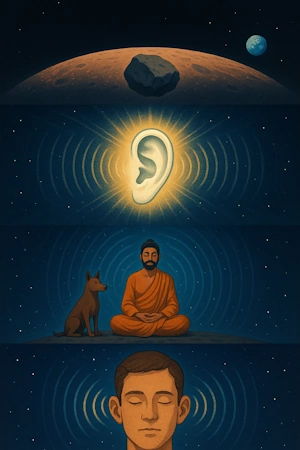
One — the regular sound that we hear, we as human beings hear. It has an upper frequency limit and a lower frequency limit. This is the regular sound — even when you chant a mantra aloud, only if it is within this audible range that the ears of another person will be able to catch the vibrations and process it.
The next level is sound that is beyond this range — both above and below. We won’t be able to hear this sound with ears. But powerful microphones can catch this sound — they can be amplified and then we can hear it. Animals — some animals like dogs — can hear these vibrations even without the help of machines. Yogis, real yogis, can hear some of these vibrations. Some of them — the really accomplished ones — can hear what you say within your mind. This is mind reading. But here also there is an upper limit and a lower limit. Yogi A is more accomplished than yogi B. Yogi A can hear even what yogi B cannot hear. This is like the sensitivity of a device. But even if you have a very very high sensitivity microphone, it cannot hear everything. But this higher kind of hearing, which is far more than the regular human hearing, is the second kind.
The third kind of hearing is absolute hearing, infinite hearing — which is, even the tiniest among tiniest of vibrations or sound, this state of hearing will catch. There is no upper or lower limit. If there is a vibration, it will be received by this kind of hearing — the absolute hearing. These three are called apara.
Then the fourth state — para. There is a vibration, but due to lack of complimentary factors between the source of the vibration and the listener, it is not heard. For example, a rock falls down a hillside in a distant planet. Since there is physical movement, there is a vibration. If this happened on Earth, we could have heard the sound. Since there is no air or medium between the source and us for vibrations to travel, they don’t reach us. This is the fourth state called para. Vibration is there. It cannot be heard. If a medium is introduced, it can be heard — at least by the absolute ear or the yogic ear. Even a subatomic movement in the distant planet can be heard either by the absolute ear or yogic ear if a medium is present.
The fifth state is absolute stillness. There is no vibration at all — not even subatomic. Atoms come into existence only after creation. That planet is there as part of the created world. We are talking about a state in which there is no vibration at all. Even para shabda we can hear if supporting factors are available. But the fifth state — there is no vibration only. There is nothing to produce a vibration.






English
Mantra Shastra
Click on any topic to open
7
30
Astrology
Bhagavad Gita
Bhagavatam
Bharat Matha
Devi
Devi Mahatmyam
Ganapathy
Garuda Puranam
Glory of Venkatesha
Hanuman
Kathopanishad
Mahabharatam
Mantra Shastra
Mystique
Practical Wisdom
Purana Stories
Radhe Radhe
Ramayana
Rare Topics
Rigveda Explained
Rituals
Sages and Saints
Shiva
Spiritual books
Sri Suktam
Story of Sri Yantra
Temples
Vedas
Vishnu Sahasranama
Yoga Vasishta
26
17
10
0


