Faith in Ganesha: Wealth Restored, Lives Transformed, Justice Served
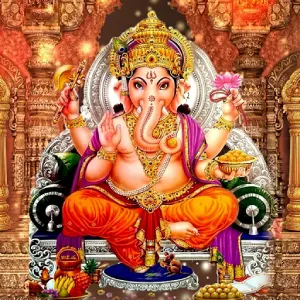
Mani, a wealthy merchant, was on a trade journey. One night, he decided to rest at a roadside inn. He was carrying a box filled with gems and treasures. While he slept deeply, thieves broke into the inn and stole his box. When Mani woke up and saw the theft, he was devastated. Mani, a devotee of Lord Ganesha, quickly vowed, 'If I recover my wealth, I will fast for Lord Ganesha.'
Just after making this vow, Mani noticed something gleaming nearby. He rushed over and found a box on the ground. When he opened it, he saw it was not his own. This box had even more gems and treasures than he had lost. Relieved and grateful, Mani continued his journey and returned to his hometown, Kachhabhuj. Feeling blessed and joyful, he kept his vow to fast for Lord Ganesha. Mani then decided to hold a grand ceremony in honor of Lord Ganesha. He invited prominent merchants, officials, and his relatives. Many learned scholars were called to perform rituals. Mani generously offered donations and fed everyone with respect and gratitude.
Among the guests was Chitrabahu, the chief minister and Mani's close friend. After the feast, Chitrabahu asked Mani about his journey and the recovery of his wealth. Mani shared the story of the theft and the miracle, thanking Lord Ganesha for his grace. Chitrabahu, deeply moved, praised Lord Ganesha and admired Mani's faith and devotion.
A few days later, some men arrived at Chitrabahu's court with gems to sell. To check if they were genuine, Chitrabahu asked Mani to examine them. Seeing the gems, Mani recognized them as the ones stolen from him. Shocked, he declared, 'These are the same gems stolen from me!'
Chitrabahu, understanding the seriousness, demanded the men explain where they got the gems. They tried to lie, but surrounded by the king’s guards, they confessed. They said, 'We stole these from this merchant. Please forgive us!'
Chitrabahu spoke to them sternly yet fairly, 'Lord Ganesha's power brought you here with the stolen goods. If you want a peaceful life, stop stealing. Do honest work and worship Lord Ganesha. You will find wealth and happiness naturally.'
Moved by his words, the thieves vowed never to steal again. They pledged to live righteously and began worshiping Lord Ganesha. Over time, they found happiness and prosperity, proving the power of faith and devotion.
Meanwhile, Mani continued to honor his vow. He worshiped Lord Ganesha regularly, grateful for the divine intervention. His story spread, inspiring others to have faith and devotion.
Chitrabahu also made a vow to fast for Lord Ganesha if he was blessed with a son. When his prayer was answered, he forgot his vow in his joy. Soon, misfortunes followed. The king stripped him of his title and wealth and exiled him. With no support, he wandered aimlessly, begging by the Narmada River.
One day, while begging, he came to a Sage's ashram. Bowing deeply, he sought the sage's guidance. The sage asked, 'Who are you, and why are you in this state?'
Chitrabahu explained his rise and fall, seeking redemption. The Sage meditated and said, 'You vowed to fast for Lord Ganesha if blessed with a son but forgot your vow. This is why you suffer. To regain your honor and wealth, observe the Ganesha Chaturthi fast with true devotion. Worship Lord Ganesha sincerely.'
Realizing his mistake, Chitrabahu vowed to fast and worship Lord Ganesha. On Ganesha Chaturthi, he performed the rituals sincerely. Soon after, the king recalled him and restored his position and wealth. His life was filled with prosperity again, showing the power of devotion and Lord Ganesha's blessings.
Key Takeaways:
- Lord Ganesha is a protector and restorer of wealth. Mani's stolen wealth was returned with added riches, showing Ganesha's power to restore and provide abundance.
- Lord Ganesha transforms wrongdoers. The thieves were guided back to the rightful owner and chose a better path, showing Ganesha's role in promoting moral living.
- Ganesha enforces vows and justice. When Chitrabahu neglected his vow, he faced misfortunes. His life improved only after fulfilling his vow, highlighting the importance of keeping commitments.
- Belief and faith can lead to positive outcomes. Mani's faith led him to act, attracting a miraculous recovery. Faith can bring comfort in tough times.
- Redemption can change behavior. The thieves, when given guidance, chose righteousness, showing potential for personal growth.
- Neglecting responsibilities leads to negative outcomes. Chitrabahu's downfall after forgetting his vow shows the importance of fulfilling commitments for a stable life.
- Why did the recovery of a box that was not his own serve as a spiritual test for Mani?
While a person of lesser character might have felt guilt or confusion over taking a box that didn't belong to them, the story frames this as a divine exchange. Mani’s immediate reaction was gratitude rather than greed. By accepting the more valuable box as a gift from Lord Ganesha, he demonstrated a state of total surrender, acknowledging that the divine can replace loss with even greater abundance if the devotee’s heart remains steadfast. - What does the transformation of the thieves reveal about the nature of Ganesha's justice?
In many traditions, justice is purely punitive, but here it is restorative. Lord Ganesha did not simply arrange for the thieves to be jailed; he orchestrated a series of events that led them to the Chief Minister’s court. The ultimate goal was not their suffering, but their reformation. This highlights the principle that true divine intervention aims to correct the soul, turning a life of crime into a life of righteous labor and devotion. - Is there a hidden meaning behind Chitrabahu forgetting his vow once his desire for a son was fulfilled?
This represents a common human psychological trap: using spirituality as a transaction. When we are in pain, we make promises, but when we are comfortable, we become complacent. Chitrabahu’s downfall signifies that a vow is not just a deal made with the divine, but a tether to one's own integrity. Breaking the vow caused a collapse of his internal discipline, which eventually manifested as the loss of his external social standing. - How does the story illustrate the concept of Prarabdha Karma or the ripening of actions?
The appearance of the thieves at court days after Mani's celebration is not a coincidence; it is the physical manifestation of karma coming full circle. Mani’s devotion acted as a catalyst that accelerated the truth coming to light. The story suggests that when one aligns with divine principles, the universe conspires to bring hidden truths to the surface, ensuring that what was lost is recognized and what was stolen is accounted for. - Why was the Sage's role necessary for Chitrabahu's redemption?
The Sage acts as the Mirror of Truth. Chitrabahu was wandering in a state of confusion, unable to connect his current misery to his past negligence. The Sage’s meditation allowed him to see the spiritual cause behind the material effect. This emphasizes that while we may forget our commitments, the spiritual laws of the universe do not, and often a guide or mentor is needed to help us identify our own blind spots. - What is the significance of the Narmada River in Chitrabahu’s period of exile?
Rivers in these traditions often symbolize purification and transition. By begging on the banks of the Narmada, Chitrabahu was being stripped of his ego and his attachment to his title. This period of wandering was a "dark night of the soul" that prepared him to receive the Sage’s wisdom with a humble heart. It suggests that sometimes, losing everything is a prerequisite for finding true spiritual clarity. - How does Mani’s reaction to the stolen gems at court reflect his spiritual maturity?
Instead of reacting with rage or a demand for immediate execution of the thieves, Mani simply identified the gems. He remained a witness to the truth. His calm allowed Chitrabahu to handle the situation with fairness. This shows that a true devotee remains balanced even when confronted with the perpetrators of their past trauma, trusting that the law of the land and the law of the divine will work in tandem. - What is the symbolic difference between Mani’s loss and Chitrabahu’s loss?
Mani’s loss was an external misfortune caused by others (the thieves), which he met with a vow of faith. Chitrabahu’s loss was an internal failure of character (forgetting his vow), which led to his exile. The story subtly teaches that we cannot always control external thefts, but we are entirely responsible for the losses that occur due to our own broken promises and lack of gratitude. - Why does the story emphasize the specific ritual of the Ganesha Chaturthi fast?
In the context of the story, the fast is more than just abstaining from food; it is a ritual of refocusing the mind. For Chitrabahu, the fast was a way to "re-pay" the spiritual debt he owed. It serves as a tool for discipline, helping the devotee to prioritize the divine over physical urges and worldly distractions, thereby restoring the balance that was broken by his initial forgetfulness. - What is the hidden lesson regarding the "added riches" Mani found in the second box?
The fact that the second box contained more wealth than the first suggests that divine restoration is not merely about returning to the status quo. It implies that the "interest" on Mani’s faith was paid in abundance. It teaches the believer that the trials they endure are often placeholders for a much larger blessing, provided they do not lose their way during the period of "deep sleep" or loss.





English
Ganapathy
Click on any topic to open
7
30
Astrology
Bhagavad Gita
Bhagavatam
Bharat Matha
Devi
Devi Mahatmyam
Ganapathy
Garuda Puranam
Glory of Venkatesha
Hanuman
Kathopanishad
Mahabharatam
Mantra Shastra
Mystique
Practical Wisdom
Purana Stories
Radhe Radhe
Ramayana
Rare Topics
Rigveda Explained
Rituals
Sages and Saints
Shiva
Spiritual books
Sri Suktam
Story of Sri Yantra
Temples
Vedas
Vishnu Sahasranama
Yoga Vasishta
26
17
10
0


