Elders are not Outdated
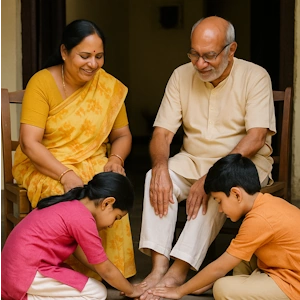
Today we are diving into a topic every Indian parent thinks about but rarely discusses openly: how do we teach our children to respect elders without turning it into fear, guilt, or blind obedience? In the Hindu worldview, a family is not just a house where people live together. It is a sacred unit, a space of learning, healing, and guidance. But somewhere along the way, respect became mixed up with silence, suppression, and anxiety. Let us untangle this with clarity and compassion.
In Hindu thought, the idea of honoring elders comes from a simple truth: someone who has lived longer has seen life from more angles. Respect was never about bowing down. It was about listening, learning, and acknowledging the continuity of generations. Our scriptures always paired respect with tenderness, not fear. Look at Rama touching the feet of his parents. Look at Nachiketa speaking firmly yet politely to his father. Look at Krishna advising elders when needed. Respect and voice went together.
So how do we bring this alive for our children today? The first step is removing fear from the equation. If a child behaves respectfully only because they fear punishment, what we create is compliance, not character. Fear teaches kids to hide mistakes, to lie, to perform. Respect built through warmth teaches honesty and courage. When children know they are safe even when they falter, they naturally speak gently and listen sincerely.
The second step is modelling. Parents are the first gurukula. If children see a father yelling at his own parents but lecturing the child about respect, nothing will change. Kids copy vibration, not instruction. When parents speak kindly to elders and handle disagreements with dignity, children absorb that tone without effort. In Hindu culture, samskara is built not by speeches but by exposure.
The third step is giving children boundaries. This is where many families struggle. Respect does not mean allowing discomfort. A child must know they can say 'I dont like this', or 'I need space', even to an elder. That is not adharmic; that is emotional hygiene. When we teach children to express themselves calmly, we are strengthening both respect and self-respect. The Bhagavad Gita constantly speaks of clarity in speech. That clarity must begin at home.
The fourth step is conversations. Short, real, daily conversations. Tell your children why elders matter. Tell them about the sacrifices a grandmother made, the hardships a grandfather faced. Stories build empathy. Empathy builds respect. When children see elders as humans with journeys, not just authority figures, their tone softens naturally.
Next, gently teach them the Hindu idea of seva. Not as forced service, but as an expression of gratitude. Helping an elder walk, offering water, listening to their stories, these small acts connect generations. The more connection, the less rebellion. The more understanding, the less friction.
Finally, let children question. A culture becomes alive when questions are welcomed. In every Hindu text, from Upanishads to epics, the student is encouraged to ask, to challenge, to understand. When children question respectfully, they grow into adults who can think without losing their roots.
So what does real respect look like in a modern Hindu home? It looks like children who speak with softness, but not fear. It looks like elders who guide without dominating. It looks like parents who create a space where voice and humility coexist. It looks like a family where warmth is the default language.
Remember, fear may produce obedience today, but warmth produces respect that lasts a lifetime. And in a dharmic family, respect is not demanded. It is cultivated. Step by step, moment by moment, through presence, patience, and love.






Children's Section
Parenting
Click on any topic to open
7
30
Astrology
Bhagavad Gita
Bhagavatam
Bharat Matha
Devi
Devi Mahatmyam
Ganapathy
Garuda Puranam
Glory of Venkatesha
Hanuman
Kathopanishad
Mahabharatam
Mantra Shastra
Mystique
Practical Wisdom
Purana Stories
Radhe Radhe
Ramayana
Rare Topics
Rigveda Explained
Rituals
Sages and Saints
Shiva
Spiritual books
Sri Suktam
Story of Sri Yantra
Temples
Vedas
Vishnu Sahasranama
Yoga Vasishta
26
17
10
0


