Easy Power is the Real Danger
Most people struggle to gain power.
They work.
They compete.
They wait.
But sometimes, power comes without effort.
No struggle.
No earning.
Just placed in your hands.
This is where the real test begins.
Because when something comes easily,
the mind stops questioning it.
It starts justifying it.
‘I deserve this.’
‘This is my chance.’
This is how adharma enters quietly.
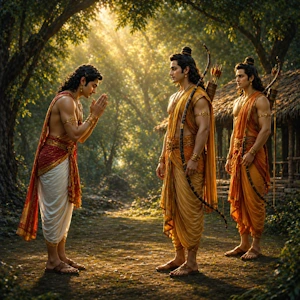
Now look at Bharata.
He returns expecting nothing.
But finds the throne ready for him.
No opposition.
No effort.
No qualification.
Everything arranged.
But he does not feel joy.
He pauses.
He looks deeper.
He asks,
‘How did this come to me?’
And the truth is revealed.
His father is gone.
Rama has been sent to the forest.
All this…
to make him king.
This is the moment that defines him.
He could have accepted it.
No one would have stopped him.
People would have obeyed him.
History would have still called him king.
But Bharata refuses internally.
He does not celebrate.
He does not justify.
He does not adjust to the situation.
He rejects the very foundation of that power.
Because he sees clearly:
Power built on adharma is not strength.
It is corruption in disguise.
He chooses dharma over throne.
He chooses truth over advantage.
He goes to Rama.
He returns the kingdom.
And when Rama does not come back,
he does something even more powerful.
He does not take the throne for himself.
He places Rama’s sandals on it.
And rules only as a caretaker.
No ego.
No ownership.
No claim.
This is rare.
Most people want position.
Bharata wanted alignment with dharma.
This is the real test of character.
Not when you struggle to gain something.
But when you are given everything…
And still choose what is right.
Q&A
Q. Why did Bharata reject the throne even when it was legally his?
Because legality is not the same as dharma. He saw that the throne came through injustice, so he refused to accept it as his own.
Q. What does placing Rama’s sandals on the throne mean?
It shows complete surrender. Bharata made it clear that the kingdom belongs to Rama, and he is only serving as a caretaker, not the true ruler.
Q. How can this apply in modern life?
Whenever success comes through unfair means, manipulation, or harm to others, we must pause like Bharata and question whether it is worth accepting.
Objection & Reply
Objection. In real life, no one behaves like Bharata. You have to be practical.
Reply. Practical does not mean compromising dharma. Bharata’s example shows that long-term respect, inner stability, and true strength come only when decisions align with what is right, not just what is available.
At Vedadhara, this is the focus.
To show that these are not just stories.
They are mirrors.
Share this with someone who thinks success should be accepted at any cost.





English
Ramayana
Click on any topic to open
7
30
Astrology
Bhagavad Gita
Bhagavatam
Bharat Matha
Devi
Devi Mahatmyam
Ganapathy
Garuda Puranam
Glory of Venkatesha
Hanuman
Kathopanishad
Mahabharatam
Mantra Shastra
Mystique
Practical Wisdom
Purana Stories
Radhe Radhe
Ramayana
Rare Topics
Rigveda Explained
Rituals
Sages and Saints
Shiva
Spiritual books
Sri Suktam
Story of Sri Yantra
Temples
Vedas
Vishnu Sahasranama
Yoga Vasishta
26
17
10
0


