Why Mahabharata Is Considered So Important
Nathva Ganesham Gajavaktra Yuktam Gurum Smaran Veda Vidam Varenyam Vishnum Vibhum Vaidika Tattvarupam Vaikuntha Samstham Satatam Namami
What is the importance and authority of Mahabharata? The principles of Vedas are very difficult to understand
They should be expounded and understood with the help of Itihasas and Puranas
Itihasa puranabhyam vedam samupabhrumayet
Nirnaya Sarva Shastranam Bharatam Parikeertitam
The final answer to Shastras is Bharata
Shastra mentioned in Bharata is final
Principles of Dharma mentioned in Bharata are final
And the author of Bharata is none other than Srihari himself
Yathasa Bhagavan Vyasa Sakshan Narayanah Prabhuhu
Vishnu Purana says, Krishnadvaipayanam Vyasam Vidhi Narayanam Prabhum Kohyanyo Bhuvimaitreya Mahabharata Krutbhavet
No Vyasa to be Narayana himself
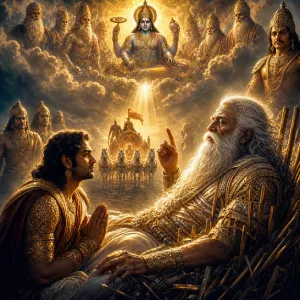
Who else can create something as astounding as Mahabharata? Once, as desired by Vyasa, all the Devas starting from Brahma and all the Rishis assemble together
And weight the Shastras
They put Mahabharata on one side of the balance and all the other Shastras, scriptures of knowledge on the other side
Mahabharata site stood heavier
Bharatam sarva vedascha tulam aropitah pura devair brahmadhibis sarvair rishibishcha samanvitaihi vyasasyaiva tatra tvatyarichyata Bharatam
It is because Mahabharata stood heavier than all the other scriptures because of its weight, Bhara, it is called Bharata and because of its greatness, Mahabharata
Mahatvat Bharatvatcha Mahabharatamuchyate
The importance of Bharata is that the principles of Dharma and Adharma, righteousness and unrighteousness are not only declared as in Smritis and Dharma Sutras, They are also established with real life examples in Mahabharata
Nirnaya Sarva Shastranam sa drushtanto hi Bharate
Matim manthanamavidya yenaasau shruti saagaraat prakasham janito loke mahabharata chandramaaha
While the Devas and Asuras were churning the milky ocean, the moon came out of it
Likewise, when the shruti saagara, the ocean of Vedas, the ocean of knowledge was churned by Vyasa, What came out was Mahabharata, like a moon spreading its light all over the world
Yo vidya chaturo vedan sangopanishadan dwijaha, nachakhyanamidam vidya naiva sasyad vijakshanah
The scholar who knows all the four Vedas along with their six Angas such as Shiksha, Niruktam, he cannot be called an acclaimed scholar if he doesn't know Mahabharata
Yadihaasti tadanyatra
Ye nehaasti na tatkvachit
Whatever is there in Mahabharata, you can find them elsewhere also
But if there is something that is not there in Mahabharata, you will never be able to find it elsewhere
Sahasranama has another speciality
These 1000 names are not ordinary names
Each and every one of them is carefully chosen by Vyasa
They have all been sung by the great Rishis
What Vyasa did was to compile them into a stotra
Rishibhih parigeetani tani vakshyami bhutaye
Vyasa only sent Yudhishthira to Bhishma saying, if you want to hear all the dharmas, go to Bhishma Pitamaha
He will give answer to all your doubts regarding dharma
There is nothing that he doesn't know
He is the one who knows the intricacies of dharma
Dharma is not simple
Observance of Dharma is not simple
There is always a dilemma
What is right and what is wrong? A pigeon has laid eggs on your terrace
You see a crow coming to take away the egg
Should you stop it or not? If you don't, you are party to destruction of life even before it has come on earth
If you stop the crow, you are interfering with its natural right to food
Dharma is not easy to understand and interpret
Dharma in Hinduism, Sanatana Dharma is not a set of rules
They are complex and intricate
Dealing with every aspect of personal and social life and your relation with the nature, gods, and everything else
Smritis and Dharma Sutras, the primary texts dealing with Dharma, often contradict each other, apparently
Their interpretations do so more
There is always confusion
Dharma could get someone as learned and as intelligent as Yudhishthira confused
So Vyasa tells him to go to Bhishma Pitamaha who has all the answers
Yudhishthira himself is Dharmaputra, son of Yama, the Lord of judgment, whose judgment is final, whose judgment about Dharma is final, whose judgment about what is right and what is wrong is final
When he himself is confused about Dharma, he is being asked to go to Bhishma Pitamah
Hari Om
- Why is it said that the principles of the Vedas must be understood through the lens of the Itihasas and Puranas?
The Vedas contain the ultimate truth but are often cryptic and difficult for the common mind to grasp. The verse Itihasa puranabhyam vedam samupabhrumayet teaches that the Itihasas, like the Mahabharata, expand and support the Veda. They take abstract Vedic principles and demonstrate them through the lives of real people, making the subtle nuances of Dharma visible and relatable. - What is the literal and spiritual significance of the name Mahabharata?
The name is derived from two qualities: Mahatvat, meaning greatness in scope and wisdom, and Bharavatcha, meaning weightiness. When the Devas weighed the Mahabharata against all other Shastras and Vedas on a celestial balance, the Mahabharata was heavier. Thus, it is the Great Weight of knowledge that outweighs all other scriptures combined. - How does the Vishnu Purana establish the divine authority of the author of the Mahabharata?
The Vishnu Purana explicitly identifies the author, Sri Krishna Dvaipayana Vyasa, as an incarnation of Lord Narayana himself. The text asks, who else but Narayana could possess the capacity to create such an astounding and all-encompassing work? To read the Mahabharata is to receive knowledge directly from the Supreme Lord. - Why is the Mahabharata compared to the moon emerging from the milky ocean?
Just as the moon was a precious jewel that emerged during the churning of the ocean (Samudra Manthan) to provide light to the world, the Mahabharata emerged when Vyasa churned the vast ocean of the Vedas. It serves as the Chandra (moon) that illuminates the darkness of ignorance and provides the cooling light of wisdom to all of humanity. - What is the hidden meaning behind the statement that a scholar of the four Vedas is not truly acclaimed without knowing the Mahabharata?
A scholar may master the sounds and rules of the Vedas (Angas and Upangas), but without the Mahabharata, their knowledge remains theoretical. The Mahabharata provides the Sahitya (application) of the Veda. Without understanding how Dharma functions in the face of conflict, a scholar lacks the practical vision required for true wisdom. - How does the Mahabharata address the contradictions found in various Smritis and Dharma Sutras?
Smritis often provide conflicting rules for different contexts, leading to confusion. The Mahabharata acts as the Nirnaya, or the final decision. By presenting Sa Drushtanto, or real-life examples and outcomes, it resolves theoretical contradictions and shows which path of Dharma is superior in complex, situational realities. - Why did Vyasa send Yudhishthira, the son of Dharma himself, to Bhishma Pitamaha to learn about righteousness?
This highlights that Dharma is so intricate (Sukshma) that even its personification can face dilemmas. Bhishma Pitamaha represented the pinnacle of lived experience and sacrifice. By sending Yudhishthira to Bhishma, Vyasa shows that the highest Dharma is often found in the words of those who have maintained their vows and wisdom through the greatest trials of life. - What is the significance of the phrase Yadihaasti tadanyatra, ye nehaasti na tatkvachit?
This serves as an ultimate seal of the text's completeness. It translates to: Whatever is found here may be found elsewhere, but what is not found here cannot be found anywhere else. It means the Mahabharata is an exhaustive map of the human condition, spirituality, politics, and ethics; no new human experience exists outside its framework. - What is the special nature of the Vishnu Sahasranama as found within the Mahabharata?
The 1000 names are not mere linguistic descriptions but are Rishibhih parigeetani, meaning they were sung by ancient seers through divine realization. Vyasa’s genius lay in compiling these spiritually charged vibrations into a single Stotra. It acts as the essence of the entire Mahabharata, offering a direct path to the Divine through the power of the Name. - How does the example of the pigeon and the crow illustrate the complexity of Sanatana Dharma?
It demonstrates that Dharma is not a binary set of rules. Protecting the pigeon's egg seems right, but starving the crow seems wrong. This "Dharma Sankat" (dilemma) shows that righteousness involves weighing the preservation of life, the natural order, and the specific duties of the individual. The Mahabharata teaches us how to navigate these "gray areas" where simple rules of thumb fail.





English
Vishnu Sahasranama
Click on any topic to open
7
30
Astrology
Bhagavad Gita
Bhagavatam
Bharat Matha
Devi
Devi Mahatmyam
Ganapathy
Garuda Puranam
Glory of Venkatesha
Hanuman
Kathopanishad
Mahabharatam
Mantra Shastra
Mystique
Practical Wisdom
Purana Stories
Radhe Radhe
Ramayana
Rare Topics
Rigveda Explained
Rituals
Sages and Saints
Shiva
Spiritual books
Sri Suktam
Story of Sri Yantra
Temples
Vedas
Vishnu Sahasranama
Yoga Vasishta
26
17
10
0


