Durva Grass Protects From Curses and Evil Eye
We already saw why Durva is a favourite of Lord Ganesha.
Apart from this, the Vedas have described the importance of Durva.
The outlook of the Vedas is that everything is divine.
There is something called Durveshtaka — a yaga in which the deity is Durva grass.
Veda considers that Paramatma has taken the form of Durva grass for the sake of cattle, as their food, annam.
So, divinity in the grass should be worshipped.
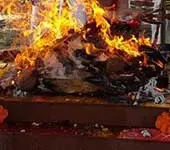
Ahutis are offered to Durva — mind you, not with Durva, to Durva. These ahutis are meant for Durva — the divinity that has appeared in the form of Durva.
काण्डात् काण्डात् प्ररोहन्ती परुषः परुषः परि
एवा नो दूर्वे प्र तनु सहस्रेण शतेन च
The mantra is addressing Durva — you grow out of every stem, even in a stem, you grow out of every joint.
Now it is prayed that you grow and multiply in this manner so that our cattle have adequate grass, adequate food.
This is a culture that would never exploit nature — because it considers even grass as divinity. Worship grass. Offer ahutis in Agni meant for grass — Durva grass.
या शतेन प्रतनोषि सहस्रेण विरोहसि
तस्यास्ते देवीष्टके विधेम हविषा वयम्
This is how you spread yourself — and we are offering ahutis to you in this ishtaka, this yaga.
There is another property of Durva.
Durva can remove curses — neutralize curses.
This is mentioned in Atharva Veda.
These mantras are part of the second kanda, second anuvaka.
अघद्विष्टा देवजाता वीरुच्छपथयोपनी
आपो मलमिव प्राणैक्षीत् सर्वान् मच्छपथाँ अधि
Durva is devajata, created by gods for the purpose of shapathayopanee — removal of curses.
It washes away curses like how water washes away dirt.
यश्च सापत्नः शपथो जाम्याः शपथश्च यः
ब्रह्मा यन्मन्युतः शपात् सर्वं तन्नो अधस्पदम्
Be it a curse from a rival, a curse from one’s own sister, a Brahmana shapa — may they all be under our feet, meaning may they not be able to rise and harm us.
दिवो मूलमवततं पृथिव्या अध्युत्ततम्
तेन सहस्रकाण्डेन परि णः पाहि विश्वतः
How do we know that this sukta is addressed to Durva? Because of the term sahasra kanda.
The same reference is there in the earlier Yajurveda mantra — kandat kandat — also.
This earth is like a tree which is upside down with its roots in heaven.
This concept is found in several places in the Vedic corpus.
And you, oh Durva, you grow in the upward direction with a thousand stems.
Protect us from curses all around — परि णः पाहि विश्वतः
परि मां परि मे प्रजां परि णः पाहि यद्धनम्
अरातिर्नो मा तारीन्मा नस्तारिषुरभिमातयः
Curses can destroy oneself, children, grandchildren, and wealth.
You protect all of them.
शप्तारमेतु शपथो यः सुहार्त् तेन नः सह
चक्षुर्मन्त्रस्य दुहार्दः पृष्टीरपि शृणीमसि
May the curses go back to those who made them — may they be withdrawn.
May there be only well-wishers around us.
May we also be protected from evil eye — drishti dosha.
See how powerful Durva is.
Next time you see Durva, take Durva in your hand to offer worship — all this should come to your mind.
There is an important point to understand here.
Rituals are not mechanical procedures as they are made out to be by some people.
Rituals make us understand a lot of principles.
If Durva is not used in pujas, will we ever get an opportunity to come face to face with it? Recognize it?
We will think that it is just another grass. But Durva, as per Veda, is so powerful — it can even remove and send back curses.
So, when our sages devised these systems, they had all this in mind.
We will incorporate Durva into puja.
People will start wondering why. They will become inquisitive. Then they will find the answer.
Everything that is used in a ritual has a lot of significance.
It will make you understand the world better — and how everything is connected to everything else.
Your thought process changes. Your vision changes. Your perspective changes — when you do it the right way.
Take for instance Durva itself — where does Durva derive its power from?
We say yajno vai Vishnu — the process of yajna, the procedure itself is Sri Hari Vishnu Paramatma.
This is what Veda says.
Without milk, curd, ghee — there is no yajna. So yajna is dependent on cows. That makes cows also divine.
Where do cows get milk from? From grass — that makes grass also divine.
Veda worships all these — yajna, cow, grass.
Without rain, no grass — so rain clouds are divine for us — God Parjanya.
All these thoughts would come to your mind — should come to your mind — when you are doing a ritual.
Someone who has not used Durva grass in this special context of doing a ritual with it, doing a puja with it, will never get the opportunity to think in this direction.
Understand all these.
This is one of the purposes of rituals.
When you do these rituals again and again — this perspective, this understanding, this knowledge would strengthen in your mind.
We all express gratitude to the priest who conducts a puja for us.
We should also be thankful to everything — the flowers, the cows, the rain clouds — without whose involvement the puja would not have happened.
This is the attitude we should develop.





English
Rituals
Click on any topic to open
7
30
Astrology
Bhagavad Gita
Bhagavatam
Bharat Matha
Devi
Devi Mahatmyam
Ganapathy
Garuda Puranam
Glory of Venkatesha
Hanuman
Kathopanishad
Mahabharatam
Mantra Shastra
Mystique
Practical Wisdom
Purana Stories
Radhe Radhe
Ramayana
Rare Topics
Rigveda Explained
Rituals
Sages and Saints
Shiva
Spiritual books
Sri Suktam
Story of Sri Yantra
Temples
Vedas
Vishnu Sahasranama
Yoga Vasishta
26
17
10
0


