Do Ancestors Become Gods After Death?
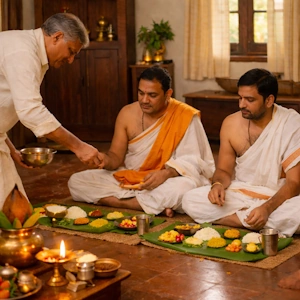
After death, does a person become all powerful as a pitru?
No.
After death, a person does not suddenly become powerful like a deva or Bhagavan.
What continues is not power, but identity in a subtler form.
What actually happens after death
When death happens, the gross physical body is dropped.
But the individual does not end.
The subtle body continues.
This includes impressions, tendencies, and identity.
Through proper rites like Shraddha and Tarpana, this being is gradually established in a stable state known as pitru.
This is not an upgrade.
It is a transition into a different mode of existence.
What exactly is a pitru
A pitru is:
-
Not Bhagavan
-
Not a deva
-
Not an all-powerful being
A pitru is a dependent subtle existence.
It exists in Pitru Loka.
It remains connected to its lineage.
It continues within the boundaries of its karma.
There is no sudden expansion into universal control or knowledge.
The biggest misunderstanding
Many people assume:
After death → ancestor → powerful being
This is incorrect.
Becoming a pitru does not mean:
-
gaining divine authority
-
controlling events freely
-
knowing everything
Instead, it means:
-
existing without a physical body
-
being sustained through a subtle system
-
remaining connected to descendants
Then why are pitrus called Vasu–Rudra–Aditya swaroopah?
This is where confusion happens.
In Shraddha, ancestors are referred to as:
-
Vasu swaroopa
-
Rudra swaroopa
-
Aditya swaroopa
This does not mean they become devas.
It means they are placed within a structured cosmic framework.
Their existence and nourishment are linked through these devata channels.
Offerings do not reach them randomly.
They move through an ordered system.
So ‘swaroopa’ here means:
-
aligned to a level
-
connected to a channel
-
eligible to receive in a structured way
Not independent divine power.
What actually changes
The change is not in power.
The change is in state.
From:
-
physical, visible, independent
To:
-
subtle, unseen, dependent
The pitru exists in a system where:
-
rituals maintain connection
-
offerings sustain the link
-
lineage defines the scope
The real nature of this system
This is not emotional storytelling.
It is a functional framework in dharma.
The living and the departed remain connected through:
-
remembrance
-
ritual
-
continuity of family dharma
The pitru does not operate freely.
It functions within rules.
Straight understanding
A person does not become powerful after death.
They become subtle.
They become dependent.
They become part of a lineage-based system.
Not powerless.
Not divine.
But structured and limited.
1
Question: Does a person gain divine power after becoming a Pitru
Answer: No. Power does not suddenly expand after death. What continues is identity in a subtler form. The being functions within limits, not as a cosmic controller.
2
Question: What actually changes at death if not power
Answer: The state changes. The physical body drops. The subtle identity continues. The being moves from visible, independent functioning to a subtle, dependent mode within a structured system.
3
Question: Why is a Pitru called a dependent existence
Answer: Because it relies on connection. It is sustained through karma, lineage continuity, and offerings from descendants. It does not act freely outside this framework.
4
Question: What is meant by Vasu, Rudra, Aditya association in Shraddha
Answer: It indicates placement within a structured channel. The Pitru is aligned to specific levels through which offerings are routed. It does not mean the Pitru becomes those deities.
5
Question: What is the real scope of a Pitru’s influence
Answer: Limited and lineage-bound. It can support or affect conditions within its family line. It cannot act universally or override the broader laws of karma.
1
Objection: If there is no increase in power, why perform rituals at all
Reply: Rituals maintain connection and support. They do not grant power. They ensure stability and continuity within the system.
2
Objection: This makes the Pitru state seem weak
Reply: It is not weakness. It is defined function. The role has influence within its domain, but not beyond it.
3
Objection: Why assume dependency continues after death
Reply: Because the system describes continuity of karma and connection. The form changes, but the relational structure remains.
4
Objection: Calling it a system removes emotional meaning
Reply: It clarifies function. Emotion and respect still exist, but understanding the structure prevents confusion.
5
Objection: This feels too limited compared to spiritual ideas of liberation
Reply: Liberation is a different state altogether. Pitru state is part of the cycle, not the final goal.





English
Garuda Puranam
Click on any topic to open


