The Divine Smile That Refused to Leave My Restless Mind
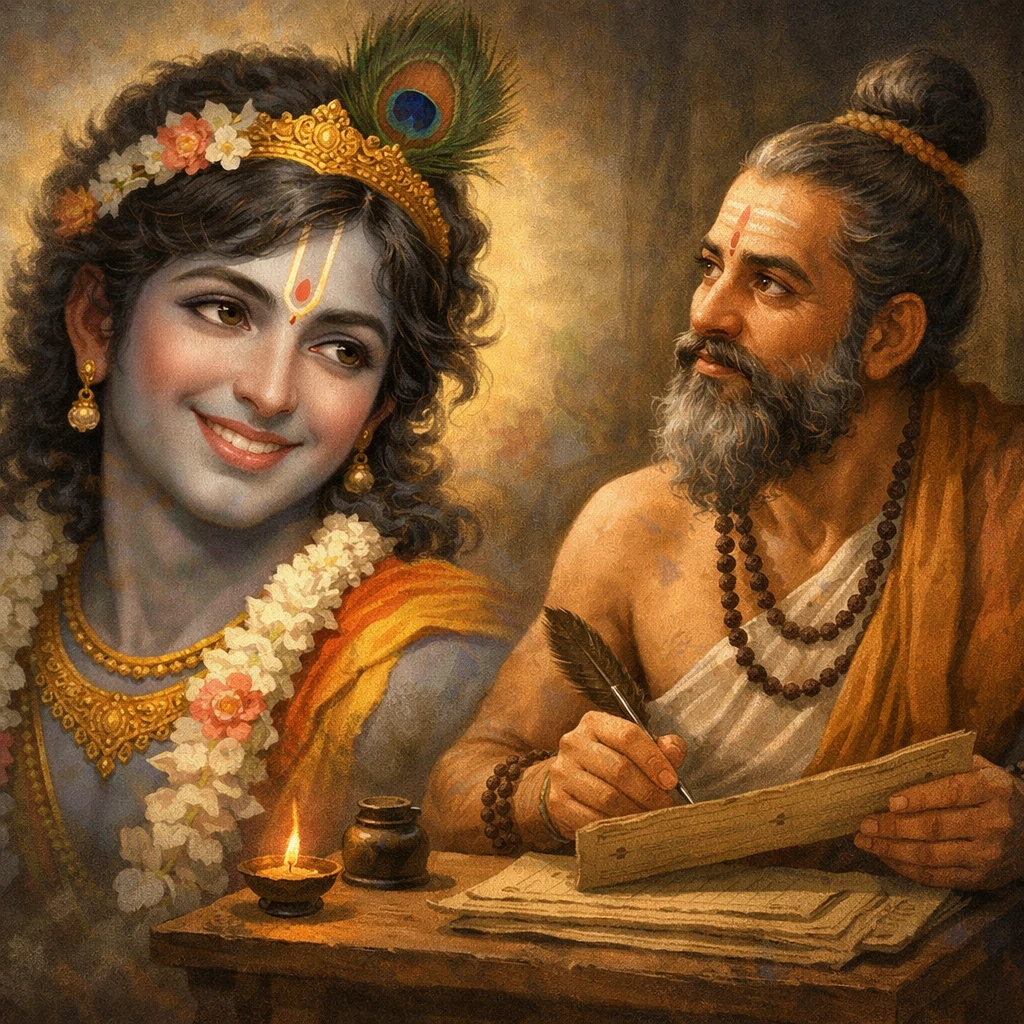
मधुरतरस्मिताऽमृतविमुग्धमुखाम्बुरुहम्
मदशिखिपिञ्छिलाङ्छितमनोज्ञकचप्रचयम्।
विषयविषामिषग्रसनगृध्नुनि चेतसि मे
विपुलविलोचनं किमपि धाम चकास्ति चिरम्॥
There are verses that describe Bhagavan.
And then there are verses that reveal what happens when Bhagavan enters the heart.
This is the second kind.
The poet is not calmly observing Krishna from a distance.
He is overwhelmed. Disturbed. Pulled apart within.
Look at how he begins.
मधुरतरस्मित — a smile sweeter than anything known.
Not just sweetness of taste. Not just beauty of form.
This sweetness dissolves resistance. It melts the mind.
अमृतविमुग्ध — like nectar that leaves one spellbound.
It does not just please. It intoxicates. It captivates completely.
मुखाम्बुरुहम् — a lotus-like face.
The lotus here is not just softness or symmetry.
It is freshness. It is untouched purity.
A presence that does not decay, does not tire, does not fade.
Then the image deepens.
मदशिखिपिञ्छिलाङ्छित — adorned with peacock feathers.
There is something playful here.
Not a distant, rigid divinity.
A living, charming, irresistible presence.
मनोज्ञकचप्रचयम् — locks of hair arranged in captivating beauty.
Every detail draws the mind inward.
Up to this point, it feels like a standard description of Krishna.
But suddenly, the verse turns inward.
विषयविषामिषग्रसनगृध्नुनि चेतसि मे —
my mind is greedy.
Greedy for sense objects.
Running behind them like an animal chasing bait.
And what is that bait?
विषयविष — worldly pleasures are poison.
But they are coated as आमिष — bait, something tempting.
This is a brutally honest admission.
The poet is not pretending to be pure.
He is not claiming detachment.
He sees his own condition clearly:
My mind runs after things that attract, but ultimately bind.
It knows the harm. Still, it runs.
And yet — something astonishing happens.
विपुलविलोचनं किमपि धाम —
that vast-eyed divine form… that mysterious radiance…
चकास्ति चिरम् —
it keeps shining in my mind for a long time.
Now pause here.
This is the heart of the verse.
The poet is shocked.
In a mind that is restless, distracted, impure —
how is this divine form shining so steadily?
This is not imagination.
This is not effort.
This is entry of Bhagavan into the inner space.
Spiritual life is often presented as a sequence:
First purify the mind.
Then attain Bhagavan.
This verse reverses that expectation.
Here, Bhagavan appears first.
And His presence begins the purification.
Even in a mind addicted to distractions,
the moment Krishna’s form takes root —
a new force begins working from within.
This creates tension.
On one side, there is attraction towards the world.
On the other side, there is attraction towards Bhagavan.
The devotee lives in this pull.
He watches his own mind with honesty.
He does not hide its weaknesses.
But he also cannot deny what he has seen.
That vision refuses to leave.
This is why the word किमपि is used — something indescribable.
Because what shines within cannot be reduced to form alone.
It is not just Krishna’s face.
It is not just His smile.
It is a presence. A living experience.
And once experienced, it does not fade like ordinary impressions.
Now look at its significance for daily life.
Most people think:
My mind is too distracted.
I am not ready for devotion.
I will first fix myself, then turn to Bhagavan.
This verse cuts through that idea.
The mind does not become pure by waiting.
It becomes pure by exposure.
Even a single genuine glimpse of Bhagavan —
through a name, a form, a katha, a moment of bhava —
plants something irreversible.
You may still run after distractions.
You may still struggle.
But now, there is a second current inside you.
And that current is stronger than it appears.
It quietly works.
It keeps bringing the mind back.
It creates dissatisfaction with lower pleasures.
It makes worldly attractions feel incomplete.
This is the beginning of transformation.
Not forced.
Not artificial.
But organic, arising from contact with the divine.
That is why the poet does not say
‘I am purified’.
He says —
‘In this mind of mine, still greedy, still restless —
that divine radiance continues to shine.’
That is bhakti in its raw, honest form.
Not perfection.
Not performance.
But a living relationship.
And once that relationship begins,
everything else slowly rearranges itself around it.
So the real message of this verse is not just about Krishna’s beauty.
It is about His persistence.
If He has once entered your inner space,
He does not leave easily.
Even if you forget Him —
He keeps appearing.
Even if you turn away —
He keeps shining.
And slowly, gently, firmly —
He begins to claim the mind as His own.
- How does the poet describe the nature of Bhagavan Krishna's smile in this verse?
The poet uses the term Madhuratarasmita to describe a smile that is sweeter than anything known to the world. This sweetness is not a mere physical attribute but a spiritual force that dissolves internal resistance and melts the mind. It is an intoxicating nectar that leaves the devotee spellbound, moving beyond simple beauty into a realm of total captivation. - What is the deeper significance of comparing Krishna's face to a lotus or Mukham buruham?
The lotus represents a state of untouched purity and freshness. By calling Krishna's face a lotus, the poet suggests a presence that never decays, fades, or grows tired. It is a divine quality that remains eternally new and vibrant, regardless of the chaos or impurities of the world surrounding it. - Why does the poet include the detail of peacock feathers and arranged hair?
The mention of Madashikhipinchila indicates a playful and charming divinity rather than a distant or rigid one. These details serve to draw the mind inward by highlighting the irresistible and personal nature of Krishna. It suggests that God is accessible through beauty and joy, making the divine presence feel living and intimate. - How does the poet honestly describe the current state of his own mind?
The poet is brutally honest, describing his mind as Vishaya vishamisha grasana gridhnuni. He admits his mind is greedy and behaves like an animal chasing bait. He recognizes that worldly pleasures are actually poison or Visha, yet they are coated as tempting meat or Amisha, making them hard for the restless mind to resist. - What is the revolutionary spiritual sequence presented in this verse?
Common spiritual advice suggests that one must first purify the mind to attain God. However, this verse reverses that logic. It shows that Bhagavan enters the heart even while it is still restless and distracted. His presence is the cause of purification, not the result of it. The divine light begins to shine first, and the cleaning of the vessel follows. - What is the meaning of the word Kimapi in the context of this divine vision?
Kimapi translates to something indescribable or mysterious. The poet uses this word because the experience of the divine cannot be reduced to mere form or language. It indicates that what is shining within the heart is a living experience and a mysterious radiance that defies logical explanation or material comparison. - How does the divine presence behave once it enters a distracted mind?
The verse uses the phrase Chakasti chiram, meaning it shines for a long time or persists. Unlike ordinary thoughts or worldly impressions that flicker and fade, once a glimpse of Krishna takes root, it becomes a steady current. It refuses to leave, creating a persistent internal light that remains even when the individual tries to turn away. - What tension does a devotee face after experiencing this divine radiance?
The devotee lives in a state of pull between two worlds. On one side is the habitual attraction toward worldly objects, and on the other is the magnetic pull of Bhagavan. This creates an honest tension where the seeker does not pretend to be perfect but cannot deny the reality of the divine light they have witnessed. - What is the hidden message for those who feel they are not ready for devotion?
The hidden message is that the mind does not become pure by waiting or by self-effort alone; it becomes pure through exposure to the divine. One does not need to be fixed before turning to Bhagavan. A single moment of genuine connection through a name or form plants an irreversible seed that begins to rearrange the seeker's life from the inside out. - In what way does this verse highlight the persistence of Bhagavan?
The verse emphasizes that Bhagavan is the ultimate pursuer. Once He enters the inner space of a person, He stays. Even if the person is greedy or forgets Him, His radiance continues to shine quietly. He is not a passive observer but an active force that gently and firmly begins to claim the mind as His own territory.





English
Radhe Radhe
Click on any topic to open
7
30
Astrology
Bhagavad Gita
Bhagavatam
Bharat Matha
Devi
Devi Mahatmyam
Ganapathy
Garuda Puranam
Glory of Venkatesha
Hanuman
Kathopanishad
Mahabharatam
Mantra Shastra
Mystique
Practical Wisdom
Purana Stories
Radhe Radhe
Ramayana
Rare Topics
Rigveda Explained
Rituals
Sages and Saints
Shiva
Spiritual books
Sri Suktam
Story of Sri Yantra
Temples
Vedas
Vishnu Sahasranama
Yoga Vasishta
26
17
10
0


