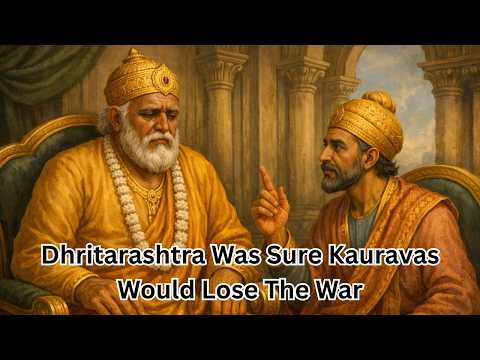
Dhritarashtra Was Sure Kauravas Would Lose The War
Arjuna through his mastery of martial art won Draupadi in her swayamvara.
Since then he is respected by all the archers of the world.
Arjuna had such an aura around him, he was like Sun, nobody could even look at him straight.
In Yudhishthira's Rajasuya, he defeated many kings who came to fight alone and in groups.
Arjuna was behind the success of Rajasuya.
This Rajasuya became famous for its grandeur.
A lot of charity was done during the yajna.
Scholars were given dakshina in abundance.
Whatever gifts came during this yajna, very valuable gifts that came from all over the world, they were being handed over to Duryodhana for safekeeping.
Duryodhana started getting jealous.
So much for Pandavas!
They are getting so much!
They have become so rich!
The sculptor of Danavas, Maya presented the Pandavas with a sabha griha, a grand court.
This sabha looked like a vimana.
It was made in such a way that dry places would look wet and wherever water was there, it would appear as if it is dry.
Duryodhana slipped.
He didn’t realize there was water.
Bhima made fun of him, in the presence of Krishnaa.
This made Duryodhana look like a dumb fool, who has never seen anything like this before.
Duryodhana went into depression.
He became pale and frail.
Dhritarashtra was informed about Duryodhana's state.
Dhritarashtra was very fond of Duryodhana.
He asked Duryodhana to gamble with the Pandavas.
Krishna knew what was going to happen was not good.
But he kept silent.
Why?
Because he knew that this gambling is going to end in a big dispute and fight, and in the ensuing war, many many evil rulers can be eliminated and the load on earth reduced.
Nobody paid heed to the advices of Bhishmacharya, Dronacharya, Kripacharya, or Vidura.
As he kept on hearing the news about the defeat of his own sons in the war,
Dhritarashtra told Sanjaya:
I am not the one who started this war.
I am not to be blamed for this war.
I didn’t even give permission for this war.
My clan has been destroyed.
Do you think I am happy?
For me, my sons and Pandu's sons were the same, I never saw any difference between them.
But my sons were overpowered by wrath, by anger.
They started accusing me.
They started finding fault with me that I was not supporting them.
They never used to listen to me.
I am a blind man.
I am helpless.
OK, I agree that I had some bias in favour of my sons.
A little bit.
But after all, they are my own sons.
It is natural.
I tolerated a lot of things.
That foolish son of mine, that dumb son of mine, Duryodhana, whenever he used to get carried away and become depressed, I also used to become depressed.
Duryodhana developed jealousy towards Pandavas when he saw all that wealth coming to them during Rajasuya.
Moreover the insult in that new sabha griha, that was the ultimate provocation.
Everyone knew that he was not strong enough to defeat Pandavas in war.
He never had interest also in warfare.
He never had the capability either.
But then, there was Shakuni, with him he entered into the conspiracy.
To amass everything that Pandavas had through cheating.
When Arjuna accomplished that task during swayamvara which nobody else would have and boldly faced all the kings who had assembled there and brought Draupadi home, that time itself I had smelled defeat for my sons.
When I saw Krishna and Balarama supporting Arjuna when he abducted their own sister Subhadra, I became all the more sure that my sons are going to lose.
I became all the more certain about our defeat when while Khandava was being set on fire, Indra started rains to extinguish the fire and Arjuna stopped Indra's rains with his arrows.
When I realized that Pandavas and their mother had escaped from the laksha griha and Vidura was also siding with them, I became certain about our defeat.
When I heard that after winning Panchali in the swayamvara, Pandavas and Panchalas have become bandhus, chances of our defeat became all the more stronger.
When I heard that the most valorous Jarasandha was killed with bare hands by Bhimasena, that too at his own capital, chances of our defeat became all the more stronger.
During Rajasuya itself when I saw big big kings under their control, I knew what was going to happen.
When I saw that Draupadi was dragged by her hair and brought to the raja sabha and she stood there helpless like an orphan, I became all the more sure what was going to happen.
When I saw what happened when dumb pest Dusshasana started pulling at Draupadi's clothes, I knew what was going to happen.
When I saw that Yudhishthira's kingdom, wealth, and everything was snatched through cheating and even then when he was forced into vanavasa his brothers didn't speak a word.
They all followed him, then I knew what was going to happen.
Seeing their unity I was sure about our defeat.
Even in the forest, when I heard that so many dharmtmas had assembled around them, I knew who was going to win this war.
When I heard that Devadhi Deva Mahadeva has given Pashupatastra to Arjuna, I became all the more sure about our defeat.
Dhritarashtra is telling all this to Sanjaya.
- Why did Dhritarashtra feel the weight of defeat long before the physical war had even ended?
The secret is that the conscience recognizes the weight of sin before the physical consequence manifests. Dhritarashtra realized that because the Pandavas possessed both divine support and moral integrity, the outcome was spiritually sealed the moment the first injustice was committed. He understood that physical armies cannot overcome the power of Dharma.
- What deep principle is revealed by Duryodhana slipping in the Maya Sabha?
The Maya Sabha represents the illusory nature of the material world. The principle is that a mind filled with jealousy and ego becomes blind to reality. When one is mentally unstable due to envy, they lose the ability to navigate even the physical world clearly. His fall was a physical manifestation of his internal spiritual disorientation.
- Why did Krishna remain silent during the dishonest gambling match?
The principle is that the Divine sometimes allows evil to reach its peak so that it can be uprooted entirely. Krishna’s silence was not indifference; it was the cosmic law allowing the negative karma of the rulers to ripen. He knew this dispute would lead to a war that would cleanse the earth of its burden of tyrannical leaders.
- What does Dhritarashtra’s admission of helplessness teach us about leadership?
It reveals that power without the courage to act on truth is a form of spiritual blindness. Even though he was the King, his attachment to his sons made him a slave to their whims. The principle is that when a leader prioritizes personal affection over universal justice, they lose their authority and invite the destruction of their legacy.
- Why did the unity of the Pandavas during their exile frighten Dhritarashtra so much?
The principle is that unity born of shared suffering and adherence to truth is unbreakable. Dhritarashtra realized that while his own sons were driven by individual greed, the Pandavas acted as a single soul. A united front of righteous people creates an invincible energy that no amount of wealth or cheating can conquer.
- What is the hidden significance of Arjuna stopping Indra's rain at the Khandava forest?
This reveals the secret that human effort, when perfected through mastery and focus, can transcend even celestial or natural obstacles. It signaled that Arjuna had reached a level of skill where he was no longer bound by ordinary human limitations. To Dhritarashtra, this was proof that no earthly warrior could ever hope to stand against him.
- Why is Duryodhana’s jealousy at the Rajasuya considered the root of the war?
The principle is that pathological envy does not merely want what another has; it wants the other person to suffer. This type of jealousy is a terminal disease of the soul. It turned a celebration of prosperity into a catalyst for war, proving that an ungrateful heart will find reasons for misery even in the midst of grand success.
- What does the killing of Jarasandha by Bhima reveal about the nature of justice?
It shows that even the most valorous and protected tyrants are vulnerable when they abandon righteousness. Jarasandha was considered invincible in his own capital, yet he was defeated by the raw strength of one who fought for a higher cause. It proved that brute force is no match for a focused instrument of justice.
- Why did the silence of the elders during Draupadi’s humiliation lead to the fall of the kingdom?
The deep principle is that a society begins its collapse the moment its leaders stop protecting the vulnerable. When Bhishma, Drona, and Kripa chose their technical duty to the throne over the universal duty of protecting a woman's dignity, they drained the Kuru house of its spiritual protection.
- What secret is revealed in Dhritarashtra’s final confession to Sanjaya?
It reveals the tragedy of post-facto wisdom. The principle is that knowledge without the courage to act is useless. Realizing the truth after the destruction is complete is merely a form of self-pity. True wisdom requires the courage to stop the momentum of evil while there is still time to change the outcome.





English
Mahabharatam
Click on any topic to open
7
30
Astrology
Bhagavad Gita
Bhagavatam
Bharat Matha
Devi
Devi Mahatmyam
Ganapathy
Garuda Puranam
Glory of Venkatesha
Hanuman
Kathopanishad
Mahabharatam
Mantra Shastra
Mystique
Practical Wisdom
Purana Stories
Radhe Radhe
Ramayana
Rare Topics
Rigveda Explained
Rituals
Sages and Saints
Shiva
Spiritual books
Sri Suktam
Story of Sri Yantra
Temples
Vedas
Vishnu Sahasranama
Yoga Vasishta
26
17
10
0


