Devotion Without Maryada Becomes Noise
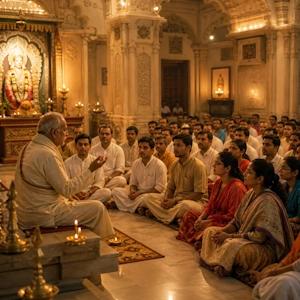
Not all devotees stand at the same level.
This is a very important point.
Modern thinking often says,
'Everyone is equal.'
Yes.
At the level of the Atma,
everyone is spiritual.
Everyone has the right to approach Bhagavan.
Everyone can chant.
Everyone can pray.
Everyone can receive grace.
But in practice,
all devotees are not at the same stage.
Some are beginners.
Some are steady practitioners.
Some have knowledge.
Some have service experience.
Some have inner purity.
Some carry responsibility.
Some guide others.
Some protect the tradition.
So Dharma does not create disorder
in the name of equality.
It creates harmony
through respect.
Devotion Does Not Mean Carelessness
A temple is not a casual gathering.
A satsang is not a social club.
A spiritual organization is not a place
where everyone behaves as they like.
There is maryada.
There is discipline.
There is order.
Without order,
even good devotion becomes noisy.
Without humility,
even service becomes ego.
Without respect,
even bhakti becomes argument.
That is why spiritual life needs structure.
Why Hierarchy Exists
Hierarchy in devotion is not meant for domination.
It is meant for protection.
A senior devotee has walked longer.
A teacher has studied deeper.
A pujari carries ritual responsibility.
A sevaka may handle practical arrangements.
A temple head may protect the system.
A beginner may simply come,
listen,
learn,
and slowly grow.
Each person has a place.
Each role has value.
But value does not mean same responsibility.
A child and a doctor are both human beings.
But in a hospital,
the doctor gives the instruction.
A passenger and a pilot are both human beings.
But in a flight,
the pilot controls the aircraft.
In the same way,
in spiritual life,
respecting roles protects everyone.
The Danger Of Ignoring Order
When hierarchy is ignored,
confusion begins.
People start correcting others
without knowledge.
They interfere in rituals
without training.
They argue with elders
without humility.
They judge teachers
without understanding.
They demand rights
without accepting discipline.
Then the atmosphere becomes heavy.
Devotion reduces.
Politics begins.
The sacred space becomes polluted
by ego.
This is why proper conduct matters.
Respect Does Not Mean Blindness
Respecting hierarchy does not mean
silently accepting everything.
If someone misuses authority,
that must be handled wisely.
If there is genuine adharma,
it should not be hidden.
But even correction has a method.
There is a way to speak.
There is a proper channel.
There is timing.
There is restraint.
Dharma never says,
'Support wrongdoing.'
Dharma says,
'Do not destroy order
while correcting disorder.'
That balance is very important.
Discipline Protects Bhakti
Many people think discipline is against devotion.
Actually,
discipline protects devotion.
When people arrive on time,
the puja flows properly.
When people speak softly,
others can pray.
When volunteers follow instructions,
service becomes smooth.
When junior devotees listen,
they learn faster.
When senior devotees remain humble,
others feel safe.
When everyone respects boundaries,
the whole environment becomes sattvic.
This is how harmony is maintained.
Seniority Comes With Responsibility
A senior devotee should not demand respect
only because of age,
position,
or years of association.
Seniority must show itself
through maturity.
A senior devotee should be more patient.
More forgiving.
More careful with words.
More protective of juniors.
More committed to the tradition.
More alert against ego.
Real seniority is not loud.
It is steady.
It does not crush others.
It guides them.
Junior Devotees Need Humility
A new devotee should not rush
to advise everyone.
First observe.
Listen.
Serve.
Ask.
Learn the tradition.
Understand the mood of the place.
Know why things are done.
Many mistakes happen because people enter
with enthusiasm,
but without training.
Enthusiasm is good.
But enthusiasm without humility
creates disturbance.
Bhakti grows beautifully
when eagerness is joined with discipline.
Roles Are Sacred
Every role in devotional life has dignity.
The person offering archana.
The person cleaning the floor.
The person cooking prasada.
The person managing accounts.
The person teaching children.
The person arranging footwear.
The person sitting silently and chanting.
All are serving Bhagavan.
But each role must stay within its maryada.
The cook should not disturb the mantra.
The singer should not override the pujari.
The manager should not insult the devotee.
The speaker should not turn knowledge into pride.
The devotee should not turn emotion into disorder.
When every role stays pure,
the whole system shines.
Straight Understanding
Spiritual hierarchy is not about superiority.
It is about order.
Discipline is not about control.
It is about protection.
Respect is not slavery.
It is maturity.
Freedom is not doing whatever one wants.
Freedom is moving in a way
that does not disturb dharma.
A devotee should know
when to speak,
when to listen,
when to serve,
and when to step back.
That itself is spiritual refinement.
Three Questions
1. Does Bhagavan love senior devotees more than beginners?
No. Bhagavan is open to all sincere hearts.
But spiritual responsibility differs from person to person.
Love is one thing.
Role is another.
A beginner can have deep sincerity.
But guidance still requires maturity, knowledge, and discipline.
2. Why should I respect someone just because they are senior?
Respect is not given because someone wants importance.
It is given because spiritual learning needs humility.
When you respect those who have walked before you,
your own mind becomes ready to receive.
Without humility, knowledge does not enter deeply.
3. Can discipline kill natural devotion?
Wrong discipline can.
But true discipline strengthens devotion.
It gives shape to bhakti.
Like a river needs banks,
devotion needs maryada.
Without banks, water becomes flood.
With banks, it reaches the ocean.
Objection And Reply
Objection:
'Hierarchy creates ego. So all devotees should be treated exactly the same.'
Reply:
Ego can misuse hierarchy.
That is true.
But lack of hierarchy creates another ego.
The ego of refusing guidance.
The ego of disrespect.
The ego of thinking,
'I know enough.'
Dharma does not support either extreme.
It gives respect to all,
but responsibility according to maturity.
That is how harmony is protected.
That is how devotion becomes stable.
At Vedadhara, we try to present these subtle principles clearly.
Because bhakti is not only emotion.
It is conduct.
It is discipline.
It is respect.
It is the art of moving together
without disturbing the sacred atmosphere.
Share this with someone who serves in a temple,
satsang,
or spiritual group.






English
Rare Topics
Click on any topic to open
7
30
Astrology
Bhagavad Gita
Bhagavatam
Bharat Matha
Devi
Devi Mahatmyam
Ganapathy
Garuda Puranam
Glory of Venkatesha
Hanuman
Kathopanishad
Mahabharatam
Mantra Shastra
Mystique
Practical Wisdom
Purana Stories
Radhe Radhe
Ramayana
Rare Topics
Rigveda Explained
Rituals
Sages and Saints
Shiva
Spiritual books
Sri Suktam
Story of Sri Yantra
Temples
Vedas
Vishnu Sahasranama
Yoga Vasishta
26
17
10
0


