Vedic Origins of Taxation
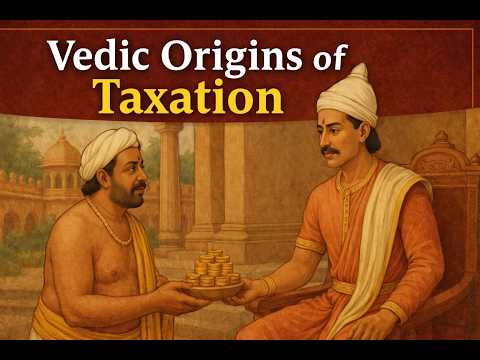
When we say that everything has developed out of the Vedas, that means everything, literally everything.
Even administrative concepts.
Let us look at one of them.
In yajnas, the ladles are of four types- Sruva, Juhu Dhruva, and Upabhrit.
Normally, the rule is that if you take ghee in the Juhu, you offer ahuti in Agni with that only.
But there is an exception in the case of Upabhrit.
Ghee filled in Upabhrit is not offered in Agni from the Upabhrit itself.
It is done through Juhu.
Here, while taking the ghee also, ghee is filled into both Juhu and Upabhrit using another ladle called Sruva.
While filling also there is a rule.
Juhu is filled with four Sruva-fulls of ghee.
Upabhrit is filled with Sruva eight times, but a little-little every time.
स यच्चतुर्जुह्वां गृह्णन् भूय आज्यं गृह्णाति अथ यदष्टौ कृत्वा उपभृति गृह्णन् कनीय आज्यं गृह्णाति
Do you know why?
Juhu stands for the rulers of the nation.
Upabhrit stands for the wealth-makers of the nation.
Rulers are less in number, but more powerful.
They, even though less in number control the wealth-creators who are more in number but weak compared to the rulers.
तस्मादुत राजाऽपारां विशं प्रावसाय अप्येकवेश्मनैव जिनाति
Now the question comes up: why have a separate ladle called Upabhrit itself, an independent ladle if ahuti is not going to be offered from it?
Because wealth-creators need some amount of freedom and independence.
Then only they can create wealth.
Rulers are not supposed to create wealth.
They are there to control and regulate the wealth-creators.
Wealth-creators create wealth, but are they free to utilize it as they want?
No, they should not be allowed to.
Whatever is there in Upabhrit should go into Agni through Juhu only.
Juhu the ruler-class should control the utilization of wealth created by the wealth-creators.
The rulers should decide.
अथ यत्तज्जुह्वैव समानीय जुहोति तस्माद्यदोत क्षत्त्रियः कामयते अथाह वैश्यम् अपि यत्ते परो निहितम् तदाहरेति
These are Veda mantras, not Chanakya's Artha-shastra.
Whatever wealth you have created, bring it, we will decide how to utilize it; rulers tell the wealth-creators.
अथ यत्तज्जुह्वैव समानीय जुहोति तस्मादिमा विशः क्षत्रियाय बलिं हरन्ति
This is the concept of both taxation and regulation.
From the Vedas.
Give wealth-creators freedom so that they can create wealth.
But they should not be free to spend as they like.
That should be under the control of the government the rulers.
Both at the same time, freedom and regulation it is from such mantras that Smritis, the rule books develop.
Neeti-shastra and Artha-shastra develop.
This is why we say Vedas have everything in them.
Question 1: What do the Juhu and Upabhrit ladles represent in the Vedic framework of nation-building?
The Juhu represents the ruling class or the administration of a nation. The Upabhrit represents the wealth-creators or the merchant class. Through these ritual tools, the Vedas establish that a functional society requires a clear distinction between those who govern and those who produce resources.
Question 2: Why is the Juhu filled four times with large amounts while the Upabhrit is filled eight times with small amounts?
This numerical difference reflects the social structure of a stable nation. The rulers are fewer in number but possess concentrated power and authority. In contrast, the wealth-creators are far more numerous, but their individual power is smaller and more distributed. It shows that even a small ruling class can regulate a large population of producers.
Question 3: What is the significance of the Sruva ladle in the filling process?
The Sruva is the foundational ladle used to fill both the Juhu and the Upabhrit. This signifies that both political authority and economic wealth are derived from the same source of natural and divine law. It reminds both the ruler and the producer that they are subordinates to the cosmic order and must function according to the principles of the Yajna.
Question 4: Why is the Upabhrit considered an independent ladle if it cannot offer oblations directly into the fire?
The independence of the Upabhrit symbolizes the necessity of economic freedom. For wealth to be generated effectively, the producers must have their own space, autonomy, and identity. If the wealth-creators were entirely absorbed by the ruling administration, they would lose the creative independence required to generate prosperity for the nation.
Question 5: What administrative principle is revealed when the ghee from the Upabhrit is poured into the Juhu before being offered?
This ritual act is the origin of the concepts of taxation and state regulation. It demonstrates that while the producers have the freedom to create wealth, they do not have the final say in its ultimate utilization. The state, as the regulator, decides how that wealth is channeled for the greater good of the society and the divine purpose.
Question 6: Why does the Vedic tradition suggest that rulers should not be the primary creators of wealth?
The ritual maintains a strict separation of roles. The Juhu receives the ghee but does not fill itself from the source of production. This ensures that the ruling class remains focused on governance, protection, and regulation. If the state becomes the primary producer of wealth, it loses its ability to be an objective and fair regulator of the people.
Question 7: How do these Yajna procedures serve as the foundation for later texts like the Artha Shastra?
Many believe that complex theories of statecraft and economy originated with later scholars. However, these Veda mantras prove that the fundamental principles of administrative hierarchy, the relationship between power and money, and the ethics of taxation were already encoded in ancient rituals. Later law books and political treatises are simply expansions of these original Vedic seeds.
Question 8: What is the deeper meaning behind the instruction to fill the Upabhrit with eight small portions?
This represents the hardworking and incremental nature of wealth creation. It signifies that national wealth is not created in one large stroke but through the small, consistent efforts of many individuals over time. The eight portions reflect the broad and diverse base of the producing class whose collective efforts sustain the nation.
Question 9: What does the mantra imply when it says the ruler can ask the wealth-creator to bring forth what is stored?
This establishes the sovereign right of the state to mobilize private resources for public welfare or sacred duties. It defines the wealth-creator as the steward of resources and the ruler as the authority who directs those resources toward their highest purpose. It provides a moral and legal basis for the state to collect what is necessary for the maintenance of order and sacrifice.
Question 10: How does this ritual provide a balanced model for a modern economy?
The Vedic model advocates for a system that combines freedom with regulation. By giving the Upabhrit its own existence, it supports private enterprise and economic liberty. By requiring the offering to pass through the Juhu, it mandates state oversight. This balance ensures that wealth is produced efficiently through freedom but utilized ethically through government regulation, preventing both stagnation and greed.





English
Vedas
Click on any topic to open
7
30
Astrology
Bhagavad Gita
Bhagavatam
Bharat Matha
Devi
Devi Mahatmyam
Ganapathy
Garuda Puranam
Glory of Venkatesha
Hanuman
Kathopanishad
Mahabharatam
Mantra Shastra
Mystique
Practical Wisdom
Purana Stories
Radhe Radhe
Ramayana
Rare Topics
Rigveda Explained
Rituals
Sages and Saints
Shiva
Spiritual books
Sri Suktam
Story of Sri Yantra
Temples
Vedas
Vishnu Sahasranama
Yoga Vasishta
26
17
10
0


