Comfortable Children Become Mentally Weak
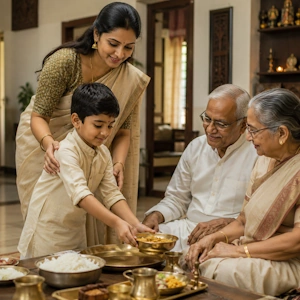
Children should not grow up feeling life must always feel comfortable.
That idea destroys inner strength.
In many homes today,
parents remove every discomfort.
No waiting.
No denial.
No boredom.
No struggle.
The child gets everything quickly.
Food instantly.
Entertainment instantly.
Attention instantly.
Slowly the mind loses tolerance.
Even small problems feel unbearable.
This is dangerous.
Sanatana Dharma never trained children like this.
Look at how princes were raised.
Sri Rama lived in forests.
The Pandavas faced hardship early.
Krishna grew among cows,
dust,
rain,
nature,
responsibility.
Comfort was present.
But toughness was also present.
That balance mattered.
A child who never hears 'no'
becomes mentally fragile.
The world will not obey their emotions forever.
One insult breaks them.
One failure crushes them.
One rejection shakes their confidence.
Why?
Because the mind was never trained to endure.
In Hindu thought,
strength is built through tapas.
Tapas does not mean torture.
It means learning to stay stable
even when things are uncomfortable.
Waiting calmly is tapas.
Controlling desires is tapas.
Waking up with discipline is tapas.
Finishing duties before pleasure is tapas.
Serving others without complaint is tapas.
This is how inner power develops.
Today many children have comforts
but no stamina.
Entertainment has increased.
Patience has reduced.
Information has increased.
Emotional stability has reduced.
Children must learn:
life will not always go their way.
This understanding protects them later.
Do not make children hate difficulty.
Teach them to face it.
Let them do small responsibilities.
Let them wait sometimes.
Let them hear 'not now'.
Let them help at home.
Let them sit without screens.
Let them learn discipline.
A mind that survives discomfort
becomes powerful.
This is why Hindu traditions included:
vrata,
daily routines,
service,
respect for elders,
controlled habits,
simple living.
These were not punishments.
They were mental training.
Real love is not giving endless comfort.
Real love is preparing a child for life.
Because one day,
parents will not be standing next to them.
But their inner strength will.
Question:
Why did Hindu traditions deliberately include fasting, discipline and controlled living for children?
Answer:
Because comfort alone cannot build a stable mind.
A child who gets everything easily
slowly loses emotional strength.
Sanatana Dharma understood something modern society is forgetting:
The mind becomes powerful
only when it learns control.
That is why children were trained through:
vrata,
service,
routine,
respect,
restraint.
Not to suppress life.
To master it.
Question:
Why do many modern children become anxious despite having more facilities than earlier generations?
Answer:
Because comfort and peace are not the same.
The body became comfortable.
But the mind became restless.
Too much stimulation weakens attention.
Too many choices weaken clarity.
Too much entertainment weakens stillness.
Ancient Hindu homes gave children rhythm.
Fixed timings.
Prayer.
Stories.
Duties.
Nature.
Silence.
These quietly stabilized the mind.
Question:
What is the hidden danger of giving children everything they want?
Answer:
Desire starts ruling the mind.
The child slowly stops developing endurance.
Then life becomes dangerous.
Because real life contains:
delay,
failure,
criticism,
uncertainty,
loss.
A mind trained only for pleasure
cannot handle reality.
That is why Hindu parenting focused more on inner strength than outer luxury.
Objection:
'Children should enjoy life. Why make them struggle unnecessarily?'
Reply:
Hindu parenting never glorified suffering.
It taught preparedness.
There is a difference.
A child who learns small discipline early
suffers less later.
The goal was never pain.
The goal was strength,
balance,
clarity,
and self-control.
Vedadhara brings back these forgotten Hindu insights in simple language for modern families.
Not as old nostalgia.
But as practical wisdom for raising emotionally stable human beings in a distracted age.
Share this with parents who want to raise strong children,
not dependent minds.






Children's Section
Parenting
Click on any topic to open
7
30
Astrology
Bhagavad Gita
Bhagavatam
Bharat Matha
Devi
Devi Mahatmyam
Ganapathy
Garuda Puranam
Glory of Venkatesha
Hanuman
Kathopanishad
Mahabharatam
Mantra Shastra
Mystique
Practical Wisdom
Purana Stories
Radhe Radhe
Ramayana
Rare Topics
Rigveda Explained
Rituals
Sages and Saints
Shiva
Spiritual books
Sri Suktam
Story of Sri Yantra
Temples
Vedas
Vishnu Sahasranama
Yoga Vasishta
26
17
10
0


